

On the night of September 26, 1983, if the Earth kept turning, it owed it to a single man, tucked away in a bunker south of Moscow. Stanislav Petrov, that is his name, is a lieutenant colonel in the Soviet air defense forces. That day, he is on duty at the Serpukhov-15 command center when Oko, the satellite system tasked with detecting American missile launches, starts flashing. The screen announces the launch of a nuclear missile from the United States. Then four more.
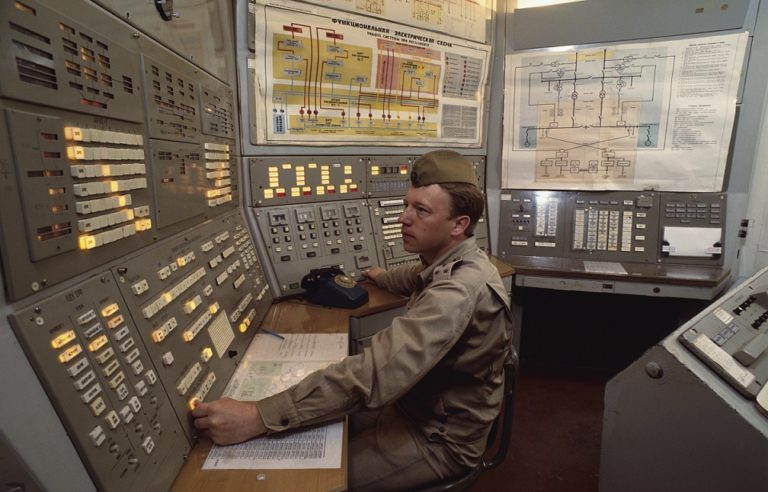
The procedure is clear: he must pass the alert up the chain of command, which then has only a few minutes to decide whether or not to retaliate. Curiously, Petrov decides not to pass it on.
Did he ask himself the recurring question that cinema so often puts in the mouths of its characters, Jack Ryan's in The Sum of All Fears, for instance: why would the other side launch, overnight and without the slightest provocation, a nuclear strike whose only outcome is the complete destruction of humanity?
In reality, his reasoning was far more down to earth. An American first strike would have consisted of hundreds of missiles. And the system, only recently put into service, could be wrong. So he reports a false alarm.
Whether you were born before or after 1983, we can all spare a thought for Stanislav Petrov.
This story remained confidential for a long time. In the very early 1990s, it was already circulating in underground hacker groups, without anyone really knowing the details. The facts were only confirmed in 1998, then told in 2014 in a Danish documentary by Peter Anthony, The Man Who Saved the World, in which Petrov revisits that night opposite Kevin Costner.
History is made of wars avoided, but also of wars fabricated out of whole cloth. On August 4, 1964, in the Gulf of Tonkin, American destroyers report an attack by North Vietnamese patrol boats. The attack never happened. Three days later, Congress passes the resolution giving the president full powers to wage war in Vietnam. Closer to us, the second Iraq war, in 2003, was built on the lie of weapons of mass destruction the enemy could deploy.
But the news has taken another turn in recent weeks. It is the United States that could have gone to war with China following an artificial intelligence hallucination. Like many of you, I was surprised at first by this news, and I started looking into it more deeply.
The subject of AI being deployed too fast in analysis and combat processes, but also the question of manipulation in war, have already been covered in many newsletters. But this week, we enter the heart of a new unthought.
The military world was supposed to be the last bastion of rationality and determinism, and it is giving in to the siren song of generative AI without really owning the consequences. That is true in the United States, but also in France, as we will see in the second part of this newsletter.
AI warfare is a major point of discontinuity in the evolution of war. It seems in every respect opposed to the doctrine that emerged from the Cold War, whose entire model rested on the balance of terror.
That expression, which dates from 1958, comes from Albert Wohlstetter, a researcher at the RAND Corporation. It defines modern conflict as a hybrid of algorithmics and game theory.
Facing nuclear fire, beyond the hotline that lets you talk to "the enemy," it is a structured system of escalation and de-escalation that keeps anyone from doing just anything: 44 rungs, finely calibrated between nations, where each side knows how far it can go and what the other will do next.
Behind the famous DEFCON levels, there is also a fine political orchestration, but one that requires regularly testing the enemy's limits. That is why you sometimes see Russian aircraft venturing into NATO airspace or into Alaska. In short, a system that leaves very little room for improvisation, which makes the gesture of 1983 all the more admirable.
The Cold War had built a world structurally designed so that human error would never be the cause of nuclear holocaust.
The arrival of non-deterministic technologies, meaning unreliable ones, at the heart of the military's most critical decision-making centers seems to be a fundamental break with what came before. The main reason is the politicization of the system, which allows some to sell products that are useful, certainly, but not finished, to the Department of War.
And a leadership team ready to do anything for short-term results. The question arises in France too, so skewed is the government's AI policy, which has, it seems, forced the military to use products whose real effectiveness and real intentions are unknown.
Generative war
The idea that the machine hallucinates is not new. In 1984, in the episode "Moffett's Ghost" of the series Airwolf (Supercopter, for the aficionados of La Cinq), it is the machine that dreams up its own enemies.
The creator of the ultra-sophisticated helicopter, Doctor Moffett, is dead, but he left a logic bomb in the onboard computer. Failing to receive a code that only he knew, the machine takes control of the aircraft, locks its weapons onto everything it encounters and makes phantom targets appear on NORAD's map. A scenario not so far from what we are talking about today.
In 2001: A Space Odyssey, HAL, the onboard computer, announces the imminent failure of a part of the ship's antenna. The astronauts remove it: it is intact. HAL maintains his diagnosis with total confidence. It is when the humans begin to doubt him that he turns against them, going so far as to refuse to open the airlock door to the astronaut left outside.
But the most masterful depiction of a computer hallucination comes from the film WarGames, where the WOPR can no longer tell the difference between simulation and reality. "What's the difference?", Professor Falken reminds us.
But a sensor error, a machine unable to distinguish simulation from the real world, are a far smaller risk than the use of generative AI.
We have already seen two major risks unfold before our eyes.
The first risk is the use of outdated data which, once folded into the training of models, no longer really allows its origin to be understood: that is what was responsible, on the very first day of the war, for the bombing of a school in Iran. We have already discussed it in several newsletters.
The second risk, which we will discuss in this newsletter, is operational hallucination. The machine fabricates a piece of information that does not exist and feeds it into the decision chain. It seems almost hard to believe, it is so outrageous, and yet.
AI and war in this newsletter (worth rereading)
- The Epistemic War Has Already Begun, February 9, 2025
- How Should the State's Services Be Reorganized to Prepare for Epistemic War, February 12, 2025
- The Artisans of the Unthought, May 4, 2025
- Anthropic vs. the Pentagon: What You Need to Understand, February 28, 2026
- Is War Just Another Data Point?, March 1, 2026
- The Painful Transition to the Digital War Economy, March 8, 2026
- The Battle for Local AI Is Only Beginning, March 15, 2026
- The West of the Tech Bros, April 26, 2026
- Sovereignty, Cybersecurity, Cognitive Autonomy, June 1, 2026
- Embargo on Intelligence, June 15, 2026
But let's come back for a moment to the first risk, because since then, we have learned a little more.
On February 28, two Tomahawk missiles struck a girls' school in Minab, in southern Iran. A strike that shocked the entire world. More than 150 dead, including at least 123 children.
How could such a tragedy happen?
Officials who took part in an unpublished internal Pentagon review told the story to Bloomberg. The site had been flagged as a Revolutionary Guards facility, on the basis of outdated data. It was fed into Maven, Palantir's targeting system, along with the other possible targets, and came out as a recommended target for day one.
Before, building target lists took hours, with heightened human oversight. It now takes a few minutes, with fewer people to analyze them on top of it.
What is fascinating is that the paradigm of non-deterministic generative AI is still confused with that of classic computing. Operators may have assumed that Maven would flag obsolete data, but we now know it did not. A model works on a model of the world and cannot be 100% reliable by construction.
Palantir replies that it is not responsible for the data it is given. Since the strike, word is that it has added to Maven functions that spot inconsistencies in the intelligence. A beta test taking place in the middle of the conflict.
As we can see, the tension between speed, precision and accuracy of information is a problem that is only just beginning.
The ghost ship
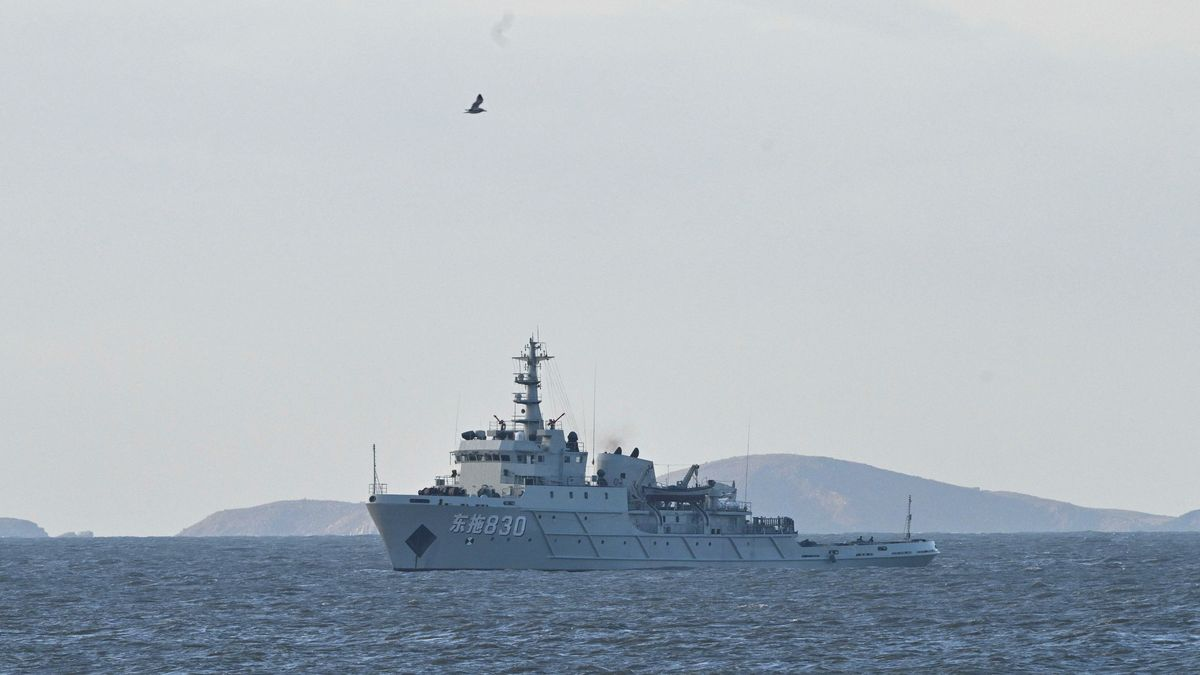
According to CNN, citing four sources familiar with the matter, a Chinese ship sailing in the Middle East was identified as carrying components for an Iranian nuclear weapons program. This happened in the spring, in the middle of the war with Iran, and was only revealed on September 18.
To believe it, you have to understand the full sequence.
The starting point is a piece of intelligence about the ship's manifest, the declared list of its cargo, which comes from the special operations command for the Pacific, in Hawaii.
A special operations analyst queries a chatbot about it. The chatbot cross-references what it finds in open sources with classified signals intelligence, that is, intercepted communications, and concludes that the cargo consists of nuclear components.
The analyst then asks it to put that conclusion into the format of an intelligence report, and he circulates it.
The same machine produced the error, then gave it the appearance of a serious document. Something every one of us has run into in daily life, but with far higher stakes.
The US military prepared the interception. Armed men were getting ready to board, aircraft were already in the air.
The error was discovered just before the operation, when someone wanted to know how the report had been produced and found that the text had been written by a chatbot.
The operation was called off. We still do not know which model was used, nor whether it was commercial or governmental, that is, whether this was shadow AI, nor what the ship was really carrying.
The Pentagon declined to answer.
The investigation goes further. One source says this type of hallucination "is not an isolated incident in the intelligence community since these tools started proliferating."
Several sources say that young analysts, "native" to these tools, trust them uncritically. There is "no set of standards" for verifying what these tools produce.
And a source close to military policy: "AI in targeting is ramping up and there is no real guidance on how a human in the loop will prevent civilian casualties or friendly fire."
What worried us in previous newsletters is now confirmed. The uberization, or rather the palantirization, of intelligence in the United States is a real problem.
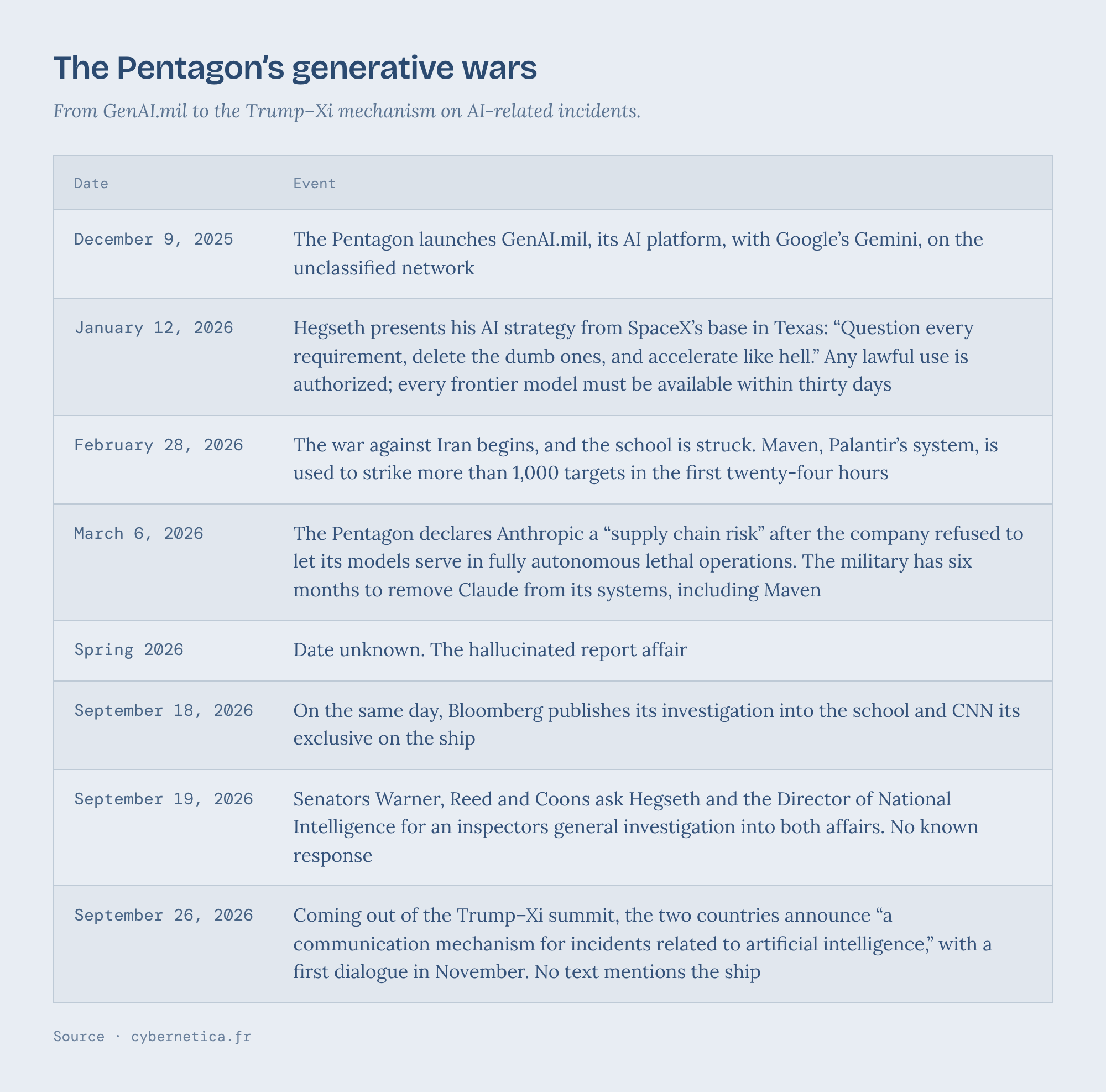
And when you look at the chronology, there is cause for concern.
The enshittification of classified data
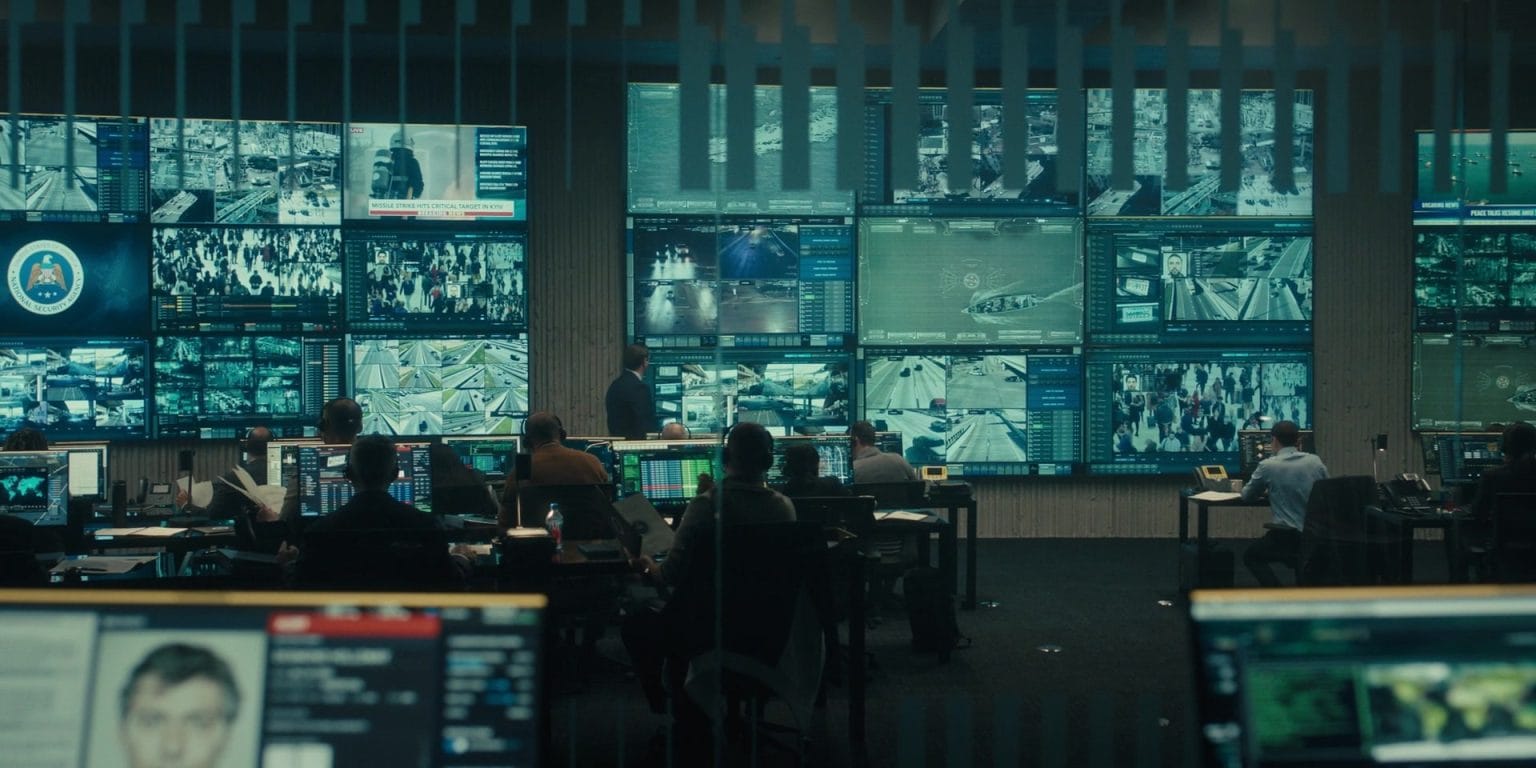
Obviously, there is a problem: the enshittification of classified data is now a real risk.
GenAI.mil is only supposed to run on the unclassified network, and frontier models were still not on classified networks at the end of September. Yet the analyst's chatbot had access to secret signals intelligence. In other words, it was running on a classified network. Nobody has been able to establish which one, and no vendor has denied anything.
A CIA researcher wrote it in 2024 in the agency's internal journal: "generative AI will find what we tell it to find." Nothing in the text produced distinguishes what comes from the sources from what the machine inferred. And when the same tool formats the conclusion, the report looks like all the others.
The intelligence community's ethics framework for AI, adopted in 2020, says that any AI output "must be marked to clearly show that it comes from an AI." This report was not, otherwise nobody would have needed to dig to find out.
The question of speed versus accuracy is now the main ethical question.
Military AI is sold on speed: analyze more information and decide faster than the adversary. But the time saved producing a report says nothing about the time it takes to verify it. If that speed is used to multiply decisions, it also multiplies the results to be checked, without increasing the means of checking them. Training an intelligence professional takes a very long time.
"Keeping a human in the loop" is the magic formula, provided it means something and the conditions in which that human works are spelled out. Does he have access to the sources? Can he tell what the machine observed from what it inferred? Does he have the time, and the authority, to stop everything?
Crisis simulations shed another light as well.
In 2024, Juan-Pablo Rivera and his team had five language models play war games. All chose escalation, arms races included, and in a few cases the nuclear weapon. These are specific models and scenarios, not a prediction of what an AI-equipped military would do. But one cannot infer a system's prudence from its ability to produce convincing reasoning.
Another 2024 study compared AI simulations with the decisions of 214 national security experts.
The result: simulated discussions between agents tend toward an artificial harmony. Having several agents talk to each other does not recreate the contradiction of a human group.
For a general staff tempted to multiply specialized assistants, this is essential: several concurring answers do not make several independent analyses.
In February 2026, Kenneth Payne pitted three recent models against each other in simulated nuclear crises. None chose accommodation or withdrawal, even under heavy pressure. Concessions were limited to reducing the violence.
Here again, it is a simulation, and the machine invents no facts in it, it chooses a course of action. But after the reliability of the information, there is a second question: the strategic logic the tool applies to that information.
As in science, the way you arrive at the reasoning matters as much as the final result. Otherwise, there is no going back.
Cognitive autonomy
For Europeans trying to exist in this new war, dizzying questions arise. If the enshittification of classified data (on top of its politicization, but that is a risk already known and managed) coming from American services becomes real, then Five Eyes-type collaborations will find themselves facing new problems.
One must be able to trace a conclusion back to the information on which it rests, know how old that information is, and keep a capacity for analysis independent of its answer. Using the same AIs as the American services, or models trained on data that is too similar, no longer allows primary data to be analyzed under proper conditions. As an aside, the same problem is arriving in cybersecurity.
What AI war strategy for France?
In the courses I have taught at the IHEDN (the Institute for Advanced National Defense Studies), but also at conferences, I have had the chance to meet several branches of the armed forces, from cyber to special forces, from military or civilian intelligence to the police and the gendarmerie.
By nature, I have always agreed to meet the people involved. Naturally, I never ask them to hand me anything confidential, I never repeat what they tell me, and I remind them that I do not consider myself an expert on military matters (TV panels and YouTube shows are crawling with them).
On the other hand, I perceive between the lines their questions in the face of a world that is changing in an ever more chaotic direction.
But that said, I am worried about the direction things are taking, because I cannot figure out where we are going and, above all, what our values are in this generative war that is brewing in spite of us.
At a dinner, I met someone whose job, in the military, is to work on the question of ethics. Thinking about the ethics of war is the most important thing for a soldier in combat. The worst thing, he tells me, is not knowing. I discover that combat is often more codified than it appears.
The conversation had fascinated me, all the more so because once you add a new player, namely a language model, the question of human ethics is no longer sufficient.
That is why I think AI ethics is at least as important as its sovereignty. A sovereign infrastructure does not settle the question of reliability, and it says nothing about what the model judges.
We have spent a lot of time finding out where the models are hosted, and less getting to know the people who deploy them and their values.
Is a model of thought a tool, or a weapon like any other?
I wrote it in "The Epistemic War Has Already Begun": AI is not a mere software tool. It is a model of thought and a worldview, learned somewhere, by someone, from something. A language model judges, ranks, retains one hypothesis rather than another.
That becomes a problem the moment you install it in a public service, whose promise is equal treatment. That equality is already very hard to demonstrate algorithmically, as Parcoursup, the university admissions platform, taught us. It will now have to be demonstrated epistemically, that is, by proving that the worldview built into the model does not treat two identical files in two different ways.
Nobody knows how to do that, and nobody is asking for it. Yet it is one of the main questions for 2027.
The questions put to the American military are the same for the French military:
- Should AI be used to speed up what requires human judgment and perspective? Target selection, for example. If we buy American tools like Maven (or their French version), will we be integrating the same features, and therefore the same risks?
- What do we do about the risk of hallucination? How do we decode the chain to get back to the underlying information? Do we know how to debunk a piece of tactical intelligence enshittified by AI and coming from another country?
- What ethics and what rules of engagement in the AI era? That is the fundamental question. Will the French, European, Chinese or American militaries agree to use an AI that does not respect the Geneva Convention?
But there is obviously an elephant in the room.
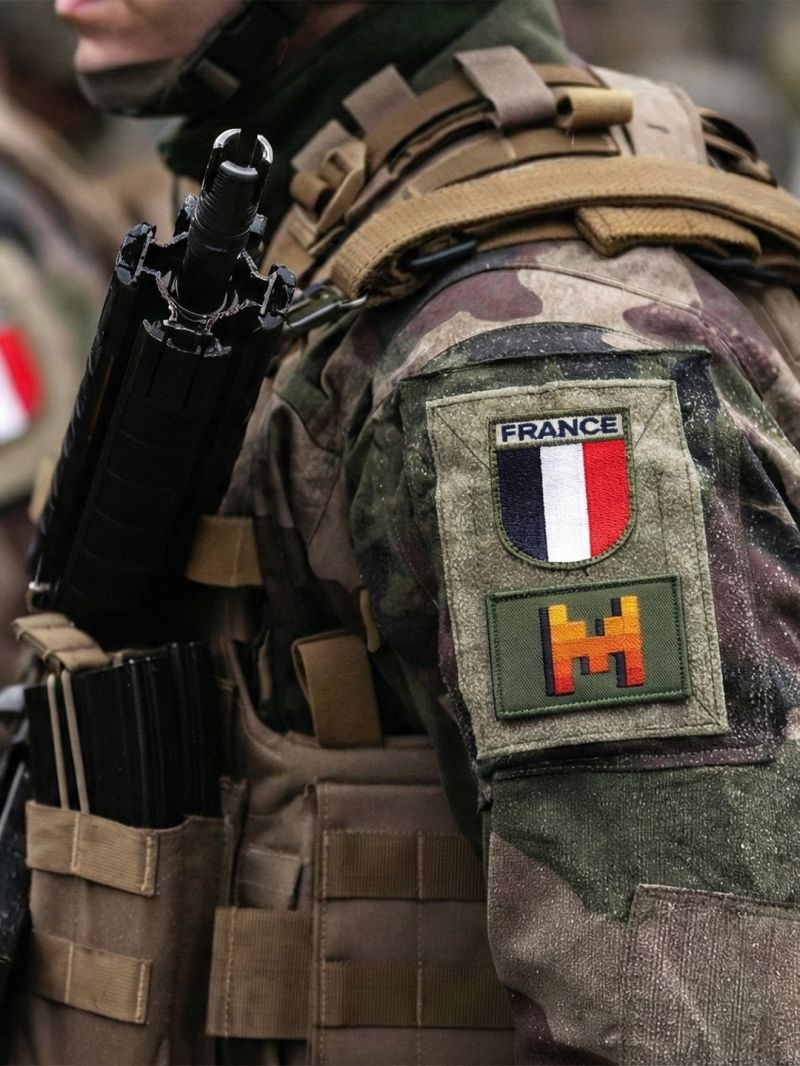
The French military seems to have accepted without flinching having a single supplier, Mistral AI, placed at the heart of its system (at least in appearance). But in reality, what do we know about it?
Mistral AI, a synthetic soldier that has truly pledged allegiance to France?
In the conversations I have been able to have, or reading between the lines, since the military world also speaks through its silences: Mistral was imposed on it for political reasons.
And since the military never voices its doubts publicly, it seems important to me to ask the question: are we sure this is the right choice, or are we, in France too, dealing with a form of favoritism disguised as patriotic procurement?
On December 16, 2025, the Ministry of the Armed Forces awarded Mistral a framework agreement, run by the AMIAD, the ministerial agency for defense AI, covering all the armed forces, directorates and services, plus the CEA (the atomic energy commission), ONERA (the aerospace research center) and the SHOM (the naval hydrographic office). No other supplier is named.
Two questions arise immediately.
The first. If the United States and China have frontier models, do we have tools good enough to enter a war that, let us remember, also claims human lives?
War is not just a matter of industrial preference. It is about whether we send people into combat with the most reliable tool, or with the one we decided to buy for PR reasons. It is also what makes me wince about Palantir's removal from domestic security. I had been shocked at the time by the choice of the American company to equip the DGSI (domestic intelligence), but finding a successor to handle terrorism cases cannot be just a communications exercise about sovereignty.
The second. To whom does Mistral pledge allegiance? Not economically, not in terms of ownership, but from an ethical point of view. Is the model configured to be compatible with French vision and doctrine, and with the nation? That is a fundamental question, and nobody can answer it.
Sovereignty is no longer enough. That a model is made by French people says nothing about what it judges.
Politico documented it in September, on the basis of a dozen accounts: the closeness between Arthur Mensch and the President of the Republic eased access to public decision-makers and to large corporations, and Macron personally intervened with French companies for the partnership with Nvidia. Mistral did not respond to the investigation.
In that article, the timing matters as much as the arrangement. The point is to install the product at the heart of the state as fast as possible, before the presidential election, and to build a captive clientele by making the state one of the company's main French customers, on top of its investors.
If France's security is at stake, more information would be needed about this company's intentions. Which raises a dizzying question.
We publicly discuss the ethics of Anthropic and OpenAI, their charters, the employees who storm out, their internal trade-offs. We do not know who, at Mistral, is in charge of ethics. Nor do we know the political positions of its founders.
Is the level of information we have, at the moment we entrust whole swaths of our state to this company, sufficient?
One would like to know what other models are being deployed.
What happens if Mistral is bought out? A parliamentary report from July proposes a state golden share to keep a say over a sale, which shows the question is real. What happens if their model is the wrong choice? What plan B?
The alternatives are not necessarily easy.
Use Chinese models? It is a real question. The problem is that, for frontier models, they will soon be available only via API and no longer for download at all: Reuters reported in July that Beijing is considering a three-tier export control, with the most advanced models reserved for the domestic market or left unpublished, Alibaba, ByteDance and Zhipu first among them.
Trade restrictions, usage optimized for Chinese chips that are not sold in Europe, and surely logic bombs as well. In a way, we are stuck.
There are also the American models. The Mythos blockade showed that the system is not reliable over the long term. Remember too the debate over the possible disabling of the F-35s, which the Pentagon officially denied in March 2025 while leaving the dependence on American software updates fully intact. Except that here we have the Rafale.
In both cases, we realize that at some point, we have no real capacity for independence, or that we have let ourselves be dragged into a debate with no way out.
Yet if France is not able to be in this next market, that of defense AI, if it is not able to have an AI doctrine that matches its ethics and all these questions, then it will no longer be a leader in the field of defense.
And above all, our humanist soft power and our defense of human rights will take yet another hit.
The three challenges facing the French military

France's AI strategy, which has consisted of copying and pasting the American strategy, without the means or the intellectual firepower, must be stopped, because by transitivity it paralyzes our capabilities in every domain, and especially the military domain.
We have at least three major challenges.
The first is to make sure that our analytical capabilities remain as good as ever in the era of generative AI.
In the age of superintelligence, the only thing we can do to fight on equal terms is to invest in well-designed harnesses (the software layer that surrounds the model, gives it its tools, its limits and its controls). We now know that a well-designed, clever harness is worth more than a superior model with an inferior harness.
The problem today is that companies like Anthropic have managed to dominate both the harness and the model.
But the fact that there is no investment in France and in Europe on harnesses, especially in the military world, is worrying. And yet Europe is squandering its skills on the subject.
The second is small models. It is a matter of defining them and seeing to what extent they can be placed in key positions. The question is not whether a small model is smarter than a big one, it is not, and it hallucinates more as soon as you ask it to write. The question is who controls whom. To verify an action, block a report with no sources or flag outdated data, a small model that we master, that we can test end to end and run offline is an alternative worth studying. That is already what American labs do to monitor their own models.
The third is independence of decision, but also of action. I would remind you that France has always had a "bonsai" army: effectiveness without size. That was the case in the analysis of intercepts with the CELAR and the Frenchelon listening network, automated analysis with TAIGA, or the pioneering use of undersea cables as a bargaining chip with other services.
I hope 2027 will be an opportunity to raise these questions more deeply than the public debate has so far.
Short of a definitive conclusion, I already know that the news will surely give us occasion to talk about all this again.
Thank you for reading.
To learn more
The complete sources are for subscribers.
Read the full article
Sign up now to read the full article and get access to all articles for paying subscribers only.


