

From the unthinkable to the unthought
At a press briefing at the US Department of Defense on February 12, 2002, Donald Rumsfeld declared: "Reports that say that something hasn't happened are always interesting to me, because as we know, there are known knowns; there are things we know we know. We also know there are known unknowns; that is to say we know there are some things we do not know. But there are also unknown unknowns, the ones we don't know we don't know."
Donald Rumsfeld unknown unknowns speech
That statement has become emblematic of discussions about uncertainty and risk management. The choice of its author is no accident, as you will understand a little further on.
But let me return for a moment to the duality that drives me: on one side the unthinkable, on the other the unthought.
- The unthinkable remains within the known cognitive field: it is what exceeds our current frameworks of thought but can still be formulated, even if it seems impossible or absurd.
- By contrast, the unthought refers to what has not yet been explored, often because it has not yet imposed itself as a necessity, or because our intellectual structures have not yet absorbed it.
- What happens if the United States, Europe's historic ally, sides with Russia?
- What would happen if, tomorrow, a country like France elected a president capable of completely reversing France's position within Europe?
In a way, in the digital world, one of the unthoughts that has stirred the most debate is the abrupt reversal in the position of social networks: they started out supporting the Arab and Iranian revolutions, to the point of becoming the darlings of progressive movements, and they are now the leading champions of "fake theories" and of a more or less openly avowed desire to overthrow Europe's liberal democracies.
Last year, at the first edition of the Strategic and Defense Forum, on the disinformation panel I was moderating, NATO's Christian-Marc Lifländer described the period we are living through as the unwar, a state between war and peace.
Today, one might speak of Slider Geopolitics, after the series Sliders (1995), in which the heroes hopped from one parallel universe to the next, through worlds whose politics were turned upside down.
In a cult episode (The Weaker Sex, May 3, 1995), the series Sliders imagined a parallel world where Hillary Clinton was president.
Oddly, the second edition of the Strategic Defense Forum dropped these subjects to return to less "disruptive" themes. A pity!
One cannot talk about Donald Rumsfeld without mentioning the American neoconservatives of the 1970s and one of the textbook cases of disinformation that inspire what we are living through today: Team B.
Many 1970s spy films hinted at its existence, but it is Adam Curtis's series The Power of Nightmares, produced by the BBC, that explores it most clearly.
The documentary draws a striking parallel between the neoconservatives and the radical Islamists, both born in the United States in the 1950s.
We need to understand how this became the ideological matrix of the new American administration.
From Team B to Trump: the legacy of a doctrine of geopolitical manipulation
What is Team B
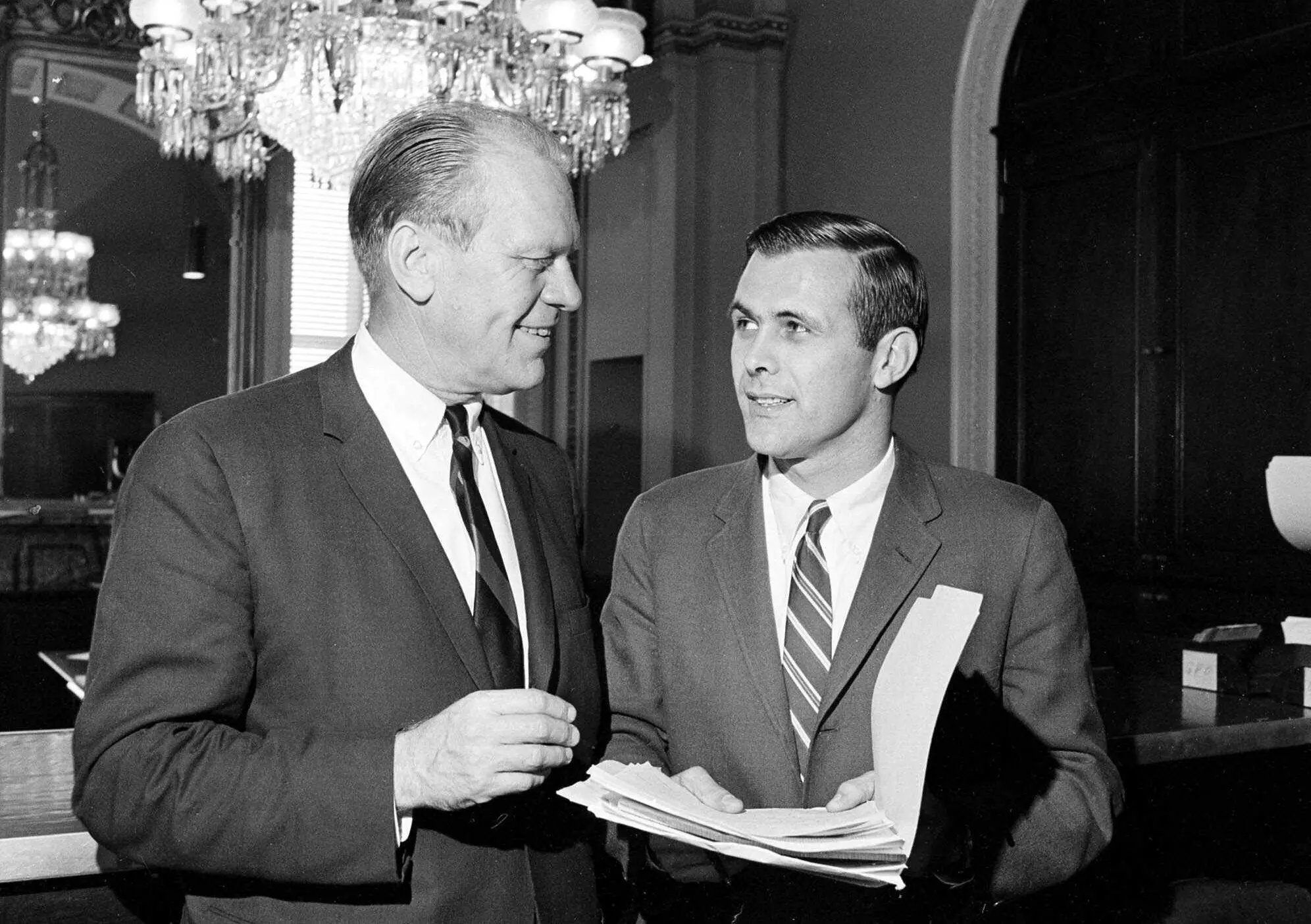
Created at the instigation of Donald Rumsfeld, then Gerald Ford's chief of staff, Team B was made up of neoconservatives such as Richard Pipes and Paul Wolfowitz. Its mission was to challenge the CIA's assessments of the USSR, which were deemed too moderate.
Its reports, based on assumptions rather than evidence, claimed that:
- the USSR had secret weapons and was preparing a nuclear first strike
- the CIA was systematically underestimating the Soviet threat
- massive American rearmament was essential to avert catastrophe.
These conclusions, though largely contradicted by the facts, deeply influenced Ronald Reagan, who in 1983 launched the Strategic Defense Initiative (SDI), a space program meant to protect the United States from a nuclear attack.
When science fiction pushes the USSR to collapse
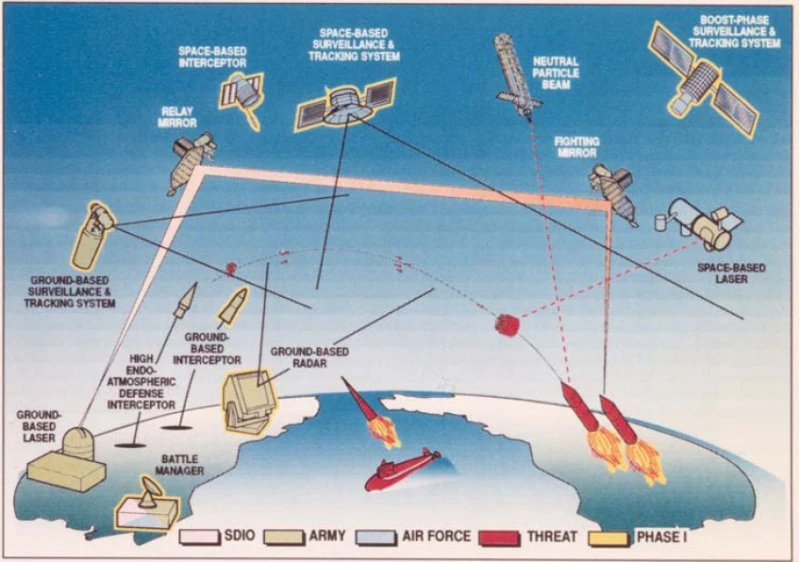
SDI, announced by Ronald Reagan in 1983, embodies the direct influence of science fiction on American military strategy. This space-based missile shield, nicknamed "Star Wars" after the film, actually drew its inspiration from authors such as Robert A. Heinlein, Jerry Pournelle and Larry Niven.
Heinlein, author of Starship Troopers and a fervent advocate of the militarization of space, popularized the idea of orbital technological supremacy. Elon Musk's favorite author, he influenced thinkers like Pournelle and Niven who, through the Citizens' Advisory Council on National Space Policy, turned these science-fiction visions into "concrete recommendations" for the Reagan administration.
SDI promised a space shield capable of neutralizing Soviet missiles with satellites that could reflect lasers fired from the ground. Technically unfeasible, the project nonetheless had a major psychological impact:
- It pushed the USSR to step up its military spending, hastening its economic collapse.
- It served as a propaganda lever to cement American technological superiority.
- It justified a lasting explosion in the American military budget, from which Silicon Valley benefited enormously, at least as much as it did from the personal computer boom.
A strategy whose echo we will hear resonating through both of Donald Trump's terms.
How does Trump reactivate the Team B playbook, this time against China and the deep state?
the rest is reserved for paying subscribers
Read the full article
Sign up now to read the full article and get access to all articles for paying subscribers only.


