

There are plenty of arguments for defending France's digital sovereignty.
The first, obviously, is to limit the impact of our economic dependencies. We used to buy computers and software; now, on top of that, we buy tens of billions of euros' worth of digital services every year. A considerable share of our digital budget goes to Big Tech. Just go back to what Nicolas Dufourcq said about what it costs.
The second is technological: depending on others limits our ability to invent new things. In someone else's cloud, we are held back.

None of the big tech platforms use off-the-shelf products; they build their own custom tools.
But today, the war in Iran gives us a third reason. The data centers hosting the big platforms' services are now targets. We covered this at length last week. Dual use now creates risks for services, but unfortunately for people as well.
The Tasnim news agency, affiliated with Iran's Revolutionary Guards, published a list identifying the offices of several major American technology companies as potential targets: Google, Microsoft, Palantir, IBM, Nvidia and Oracle.
 O’Ryan Johnson
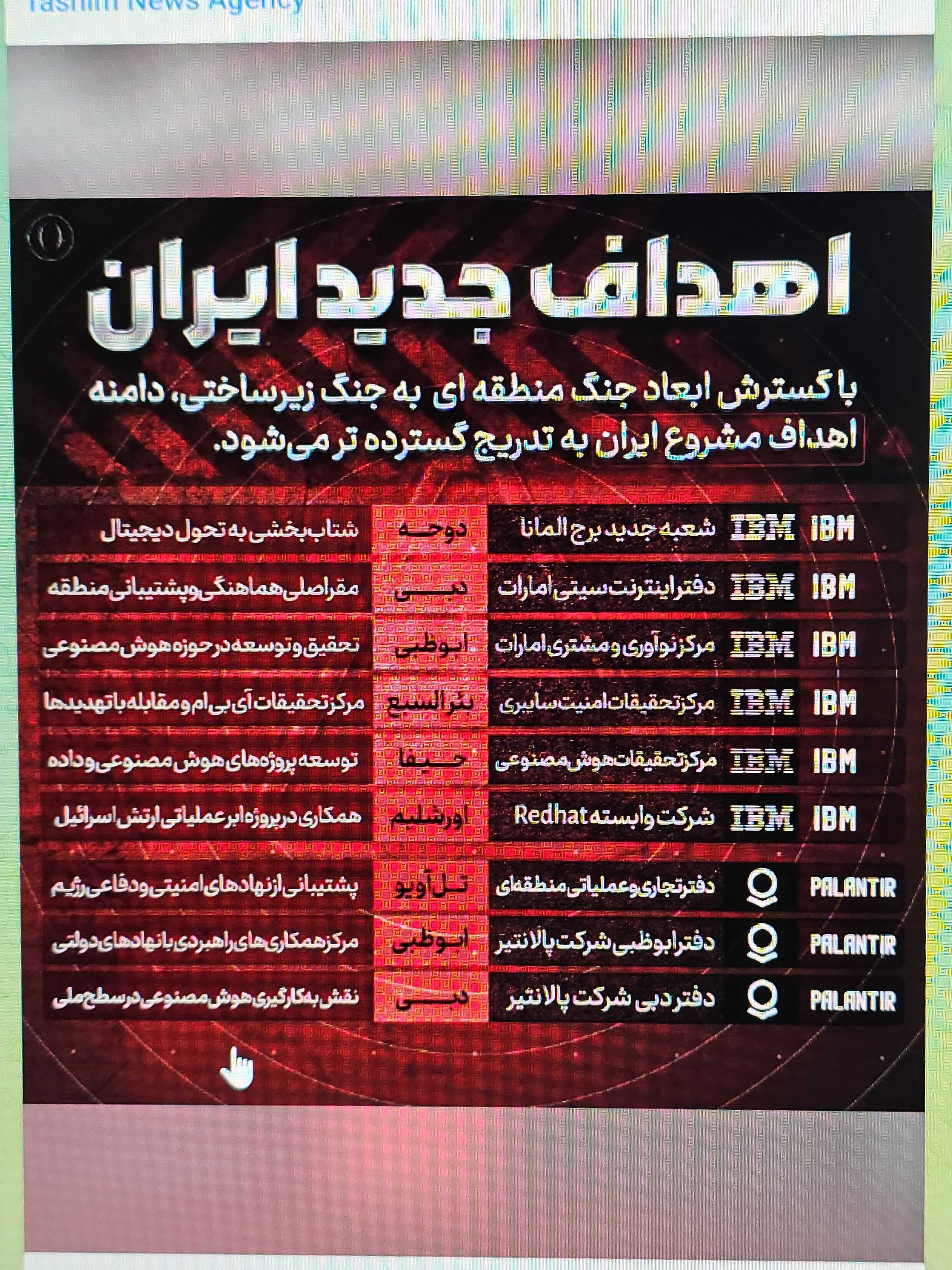
One of our readers asked me a simple question: should we host our everyday services (our email, our social networks, and so on) in data centers that also host data, analysis or software used by the military?
My first answer was that military services run on specific systems and data centers. Then I caught myself.
Today, even if the core of military systems is kept separate, it feeds on civilian data that is often necessary for its understanding of the terrain. It is a bit like the bridge that civilians also use but that gets destroyed to stop a military advance.
Cyberattacks will obviously be the preferred route, and they obviously raise the question of backing up your data, including on services that claim to be secure. Let's not forget that, on top of the conflict, the big platforms are rushing the use of AI-generated code, which sometimes causes trouble. The obvious case is Amazon's big "bug" in the United States, linked to AI-generated code that was pushed too fast. Since then, a senior manager has to sign off before anything is deployed.
 Rachit Agarwal

This week, we are taking a break from geopolitics to look at a subject the press rarely covers: the quiet battle between Apple and Nvidia over the future of computing power.
Apple has released a monster, its new MacBook Pro M5 Max, whose extreme power is still held back by the operating system.
But that computing power finally makes it possible, as we will see, to run large models entirely locally.
📘 The handbooks for the world after
I am preparing two short handbooks for paying subscribers:
It is a long road ahead of us, but we might as well walk it together!
More and more of you are reading us!
And I learned it at the great Neon Noir evening: a lot of VCs and AI entrepreneurs read us closely! Thank you for your trust.
Since the launch, I have chosen to keep the price very low. Some of the notes alone are worth several times the price of a subscription. A consultant told me recently that a single one of our newsletters had landed him a year-long contract.
Choosing an affordable price also reflects a desire to reach audiences beyond my initial target, in particular students, but also small SMEs, and anyone who wants to think these subjects through with us.
💸 Worth noting: I am finishing a new version of the site, better organized and with a few surprises. That is also when I will raise the price, so think about subscribing.
Club des Résilients
Paying subscribers will also have access to the club. An intellectual safe space to think together and prepare effectively for the world that is coming.
✔ Strategic intelligence on a private channel
✔ Access to the Handbooks for the World After
✔ Film Club
✔ Member meetups and conference invitations
So enjoy the new newsletter, reserved for paying subscribers.
The Apple-Nvidia war is on
Read the full article
Sign up now to read the full article and get access to all articles for paying subscribers only.


