

After 15 years headed in the wrong direction, driven by announcements and theatrics, many of us are exhausted. None of the important issues seems to find a satisfactory resolution in an increasingly complicated digital world.
⠀
And one year to the day before the next presidential election, the ocean liner that is the State faces a wall of problems and complexities it is no longer able to solve on its own.
It is surely too early to draw up the balance sheet of 15 years of digital policy that have, on the whole, weakened us. But not too late to offer the beginnings of an analysis and try to identify a few solutions.
⠀
On 2027, I have a strong intuition: like macOS releases, which alternate between versions with new features and versions that bring nothing new but fix the bugs, the next five-year term will have to devote 80% of its time and energy to making the State functional.
In our digital world, liberty, equality and fraternity translate into sovereignty, cybersecurity and cognitive autonomy. Solving this triptych means keeping a place for France in the near future.
More and more of you are subscribing! Remember to forward this newsletter to friends and anyone who might be interested.
With this newsletter, I see myself a bit like a chef offering you starters (opinions on a topic), main courses (a more in-depth reflection) or desserts, like the film clubs, which are very popular.
Since launch, I have chosen to keep the price very low. Some notes are worth several times the subscription price on their own. Many of you have written to tell me that a single one of our newsletters made the difference for you.
The choice of an affordable price also reflects a desire to reach audiences beyond my initial target, notably students, but also small SMEs, and anyone who wants to think through these subjects with us.
💸 Please note: the subscription price will go up next week.
ℹ️ As a paying subscriber, you get access:
- to the site's entire archive,
- to all my monitoring via a private channel,
- to priority replies to your emails,
- to the events we organize,
- to the meetups of the Digital Resilience Council (Conseil de la Résilience Numérique), held on the sidelines of the conferences where I speak.
It is here
Understanding why the triptych matters
Digital sovereignty matters as much as ever in 2026
Quite simply, for three reasons:
⠀
The first is existential: the State, in 2026, must, on top of everything else, guarantee its citizens that we have a minimal communications infrastructure that cannot be affected by a possible kill switch decided by the president of the United States, or by China, should our economic, political and geopolitical interests become misaligned.
⠀
The examples of Afghanistan, where Google blocked the Afghan government's services within minutes of the Taliban taking Kabul, of Ukraine, where Russia massively jams and spoofs GPS/GNSS signals, or of Iran, where GitHub restricted its services for developers in 2019, show that both the means and the will exist.
The kill switch applied to ICC judges, notably the case of the French judge Nicolas Guillou, sanctioned by the US Treasury on August 20, 2025, shows that it is already possible at the individual level. The question now arises at the level of a country.
⠀
The second is economic: how to use a software and hardware infrastructure that does not cost us a fortune.
⠀
The new study by Astérès, a consultancy close to the big American platforms, for Cigref (the association of large French companies' CIOs) in May 2026 puts the cost of cloud and software price increases at an average of €140 billion a year for Europe over the 2026-2030 period, of which €93 billion would leave the European economy for good. The study estimates that these increases could cost the European economy €107 billion in value added per year, or 0.6 points of GDP, and 1.4 million jobs by 2030.
⠀
I had reservations about the first study, but this one improves on its predecessor, even if I think it underestimates hardware costs, notably RAM, and token costs for the next few years.
Jean-Baptiste Kempf, when I was a guest on the YouTube show À la French, explained to us that the prices of VMware, tools that are necessary for the cloud, were going to rise again because the majority of customers decided to pay despite staggering price increases. (Link at the end)
⠀
The third is inspirational: I was already writing it in my 2013 government mission: creating a local digital industry of excellence is something that exports abroad. We need to bring forth a new generation of builders. We are starting to see it in the cloud, where French players are in demand, or in AI. Building rather than buying has always been the better solution in tech.⠀
Cybersecurity, or the stifled digital state of emergency
This subject has become an intractable political problem. Here is a sampling of what I have heard on the matter.
⠀
- The State has failed its citizens by exposing their data to cybercriminals and traffickers, but also to economic espionage.
- Some citizens are being put in danger, since the Palantir-style cross-referencing used by cybercriminals makes it possible to locate people who own a gun, such as members of the French shooting federation, police officers, or people with high incomes, such as members of the French golf federation, or crypto wallets.
- This deficiency, exploited by young hackers but also by cybercriminals, can become something far more serious in the event of war, or, as is the case today, in a pre-war situation according to NATO terminology.
⠀
The cyber world is in turmoil. And if our banks, carriers, administrations and critical services did not have access to tools of the same level to detect, fix, patch and understand vulnerabilities at very high speed, then we would be entering a security asymmetry such as we have never known.
⠀
Remember that the head of Britain's GCHQ explained that from now on 100 countries will be able to breach the UK. How many individuals, acting on their own, will be able, with Mythos, to become a state-level threat?
⠀
Will Europe hold Anthropic responsible for hacks that could be attributed to the use of its product? Many questions without answers for now.
⠀
The challenge of cognitive autonomy
In this third panel of the triptych, I prefer the idea of cognitive autonomy to talking about AI. AI is the technology; cognitive autonomy is the superpower it gives us.
The possibilities are immense.
⠀
- Using agentic AI to make the State and companies more productive. Recruiting more administrative "labor" for repetitive tasks.
- Allowing citizens and users to be less dependent by reducing the knowledge asymmetry: it becomes possible to understand an administrative question from the State without having to call someone, or to figure out how to program your oven without calling Darty, the appliance retailer.
- Agentic AI could finally make it possible to recode the services that work badly. I have studied this subject in detail: a team with the right tools could audit, fix and re-document the IT systems that have not yet been addressed, rather than waiting and pondering how to transform the State's IT quickly. But for that, you need to use the right frontier models and the right context windows.
The real subject, in my view, will be agentic sovereignty: the ability to control your agents, master your tools, understand your systems and not depend on a single AI service that could limit the cognitive capacity of civil servants, companies and citizens for reasons beyond our control.
⠀
Because the real battle of 2026 is no longer cloud sovereignty but agentic sovereignty. Used well, it defines how we will restructure the cognition of the State, of every administration, of every civil servant and, ultimately, of every citizen. Used badly, it is one more chaos to manage.
⠀
So why is it stuck at the State level?
Three reasons.
⠀
The centralization of power
To build a digitally strong State, I had proposed a how-to guide as early as 2013, with the mission I carried out for the Prime Minister.
But I made a political rookie mistake: by explaining that France needed to develop technological know-how by promoting engineers and developers rather than the politicians and senior civil servants who imagine themselves as the true heroes of the State's digital transformation, I was quickly pushed out of the conversation and targeted for my positions on sovereignty.
⠀
What I had not understood was that digital policy in France was going to be, for a few thousand people, the opportunity to rule unchallenged over the State's resources, budgets and actions. But 15 years later, that power grab has run out of steam and has not delivered the promised solutions.
France failed to seize the opportunities that came its way.
⠀
- Fifteen years ago, at the time of Web 2.0 and the early days of the cloud, we had the opportunity to regain control by working on alternatives to the tech monopolies and building a French technological capability. Instead, the State rolled out the red carpet for Big Tech and sidelined everyone with a different message. If the sovereignty discourse is now everywhere, the question I ask myself is one of sincerity. Trump 2 serves as a bogeyman, but it should be remembered that Trump had already been elected once before, and that Biden, on digital matters, went even further than Trump 1. So I remain skeptical.
- Instead of building a strong technology offering, we built standards. To become "sovereign" in France, you have to go through a Franco-French standardization system, inaccessible to small companies and costly for large ones. Yet on standards, Europe is structurally stronger than France, and France learned this the hard way. France tried to export SecNumCloud (the cloud security certification issued by ANSSI, France's national cybersecurity agency) into the European debate around the EUCS. In 2024, the "sovereignty" requirements were removed from the draft under pressure from the American hyperscalers and from European economic players.
⠀
Brussels is now taking back control of digital sovereignty with new measures such as the Tech Sovereignty Package and the CAIDA. - In France, sovereignty is above all a communications tool: nobody is really trying to create sovereignty, they are trying to stage it. Just look at the range of people putting out press releases to explain that they are switching to Linux or OVH.
On that note, a former government adviser explained to me that the "cloud at the center" directive, sold to us by the State as an answer to sovereignty, mostly served to impose digital hypercentralization.
The State becoming a gigantic OneDrive. Except that this vision does not create agility. On the other hand, when problems arise, it becomes a centralized sieve and gives people access to things they would never have had in a decentralized world.
The expanding remit of the agencies in charge of digital policy
⠀
A former very senior civil servant gave me one explanation for the impasse we are in: over the past twenty years or so, the State agencies in charge of digital matters have considerably expanded their remits, without really having the means for these tasks or the competence to carry them out.
⠀
Doing the research, I realized he was right.
Some have seen their remit explode. Out of hubris, every agency wanted to do everything, control everything, standardize everything, while their core missions were at the same time growing in complexity and difficulty.
⠀
A few examples:
⠀
ARCEP (the telecoms regulator), which now also handles cloud interoperability on top of regulating telecoms. A complex subject, with very little adjacency to its core function.
⠀
Regulating telecoms means putting a limited number of players around the table and forcing them to follow French regulation, or fining them for non-compliance. Hence the famous phrase: the telecoms cop.
⠀
Cloud and interoperability are far more complex. Which framework to follow? Google's or Microsoft's? The State's? But then it has to be defined. Whom to bring to the table? How many hundreds of players? How to impose regulation when the tech world itself does not agree? And meanwhile, the classic crucial issues remain open: the arrival of Starlink and Amazon in satellite internet, with services operating outside regulation; the intelligence services terrified at the idea of having to ask Musk's teams for intercepts in the current geopolitical climate; and the dead zones that the traditional carriers still cannot fill, even though open-source telecom solutions exist in Europe.
⠀
There is also ARCOM (the broadcasting and digital regulator), supposed to regulate both YouTube and CNews. The classic domain of what used to be called the CSA was regulating television programs, what is said on air, respect for the diversity of political opinions, in short something tangible and easily verifiable. YouTube and social networks are hundreds of thousands of channels, algorithms often defined by users' likes and subscriptions. I am not even talking about the social networks that pour out terabits of unverifiable content every day. How to do both jobs properly? It is a real challenge.
⠀
There is also the case of ANSSI. Before ANSSI, there was the DCSSI, itself heir to the SCSSI and the old cipher and secure telecommunications structures. ANSSI was thus born as a sovereign agency with a clear mission: protecting the State's information systems, sensitive communications and critical infrastructure.
⠀
The drift came gradually: it no longer just secures the State. It oversees the whole of French cybersecurity, with guides, labels, training, awareness campaigns and support. It becomes the producer of standards and labels that are essential for cyber players wanting to work with the State. Then its remit expands further with a regional logic: territorial relays, support for local authorities, coordination of local ecosystems, coordination with the regions and regional cyber players.
⠀
A cybersecurity player with deep knowledge of the sector told me it is therefore not surprising that, in the face of the disastrous hack of ANTS (the agency that issues ID documents), but also of other sovereign services, its director is now under threat, according to Le Canard enchaîné (a satirical weekly). Because behind all the training missions and the alerts remains the core of the mission: protecting the State. And if ANTS gets hacked, that means the protection of the State is not working, regardless of the qualities of this agency.
⠀
Even though, personally, I find that ANSSI is too easily blamed for problems that are far more systemic, there is still a reality: the expansion of the role of State agencies in digital matters has not translated into more simplicity or more ease, but into more standards, more complexity and therefore, in the end, more fragility.
⠀
We could also talk about CNIL (the French data protection authority), which has also seen its scope of action explode, but which, for now, has managed to stay under the radar with fines that lead the general public to believe it is still carrying out its mission as the cop of personal data.
⠀
It is impossible to close this chapter without talking about DINUM (the government's interministerial digital directorate), whose director also appears to be on her way out.
⠀
It was born from ATICA, created in 2001, which became ADAE in 2003, then was absorbed into DGME in 2005, while Etalab was created in 2011 to design data.gouv.fr and coordinate the opening of public data, before being folded into SGMAP in 2012, while DISIC was created in 2011 to steer the State's information systems, then transformed into DINSIC in 2015, also taking over Etalab, the data.gouv.fr mission, the open data logic, the chief data officer, beta.gouv.fr, the State startups and the public product logic, before itself being replaced by DINUM in 2019, which now aggregates IT steering, digital transformation, data, cloud, design, accessibility, AI, public products, incubators, support, recruitment and ecosystem coordination, not to mention that, since this year, it also wants to replace private players by producing its own software suite and its own cloud services with La Suite.
⠀
Twenty years, seven names, one constant: the accumulation of power without a strategy.
⠀
The State's wanderings in digital policy are the direct consequence of the way it has, for twenty years, piled up structures, acronyms, platforms and digital satellites according to fashions and buzzwords, without settling on a coherent strategy.
⠀⠀
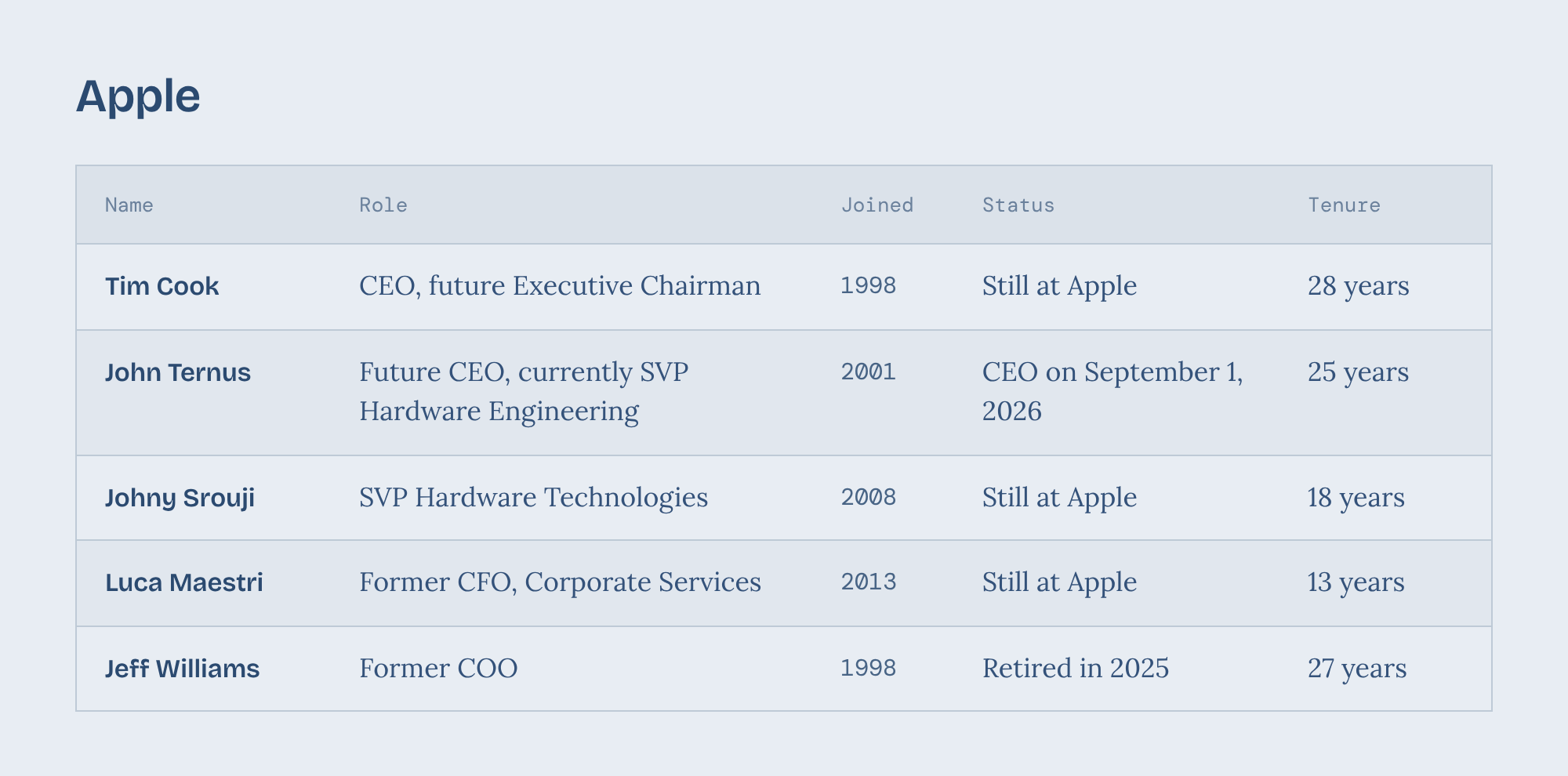
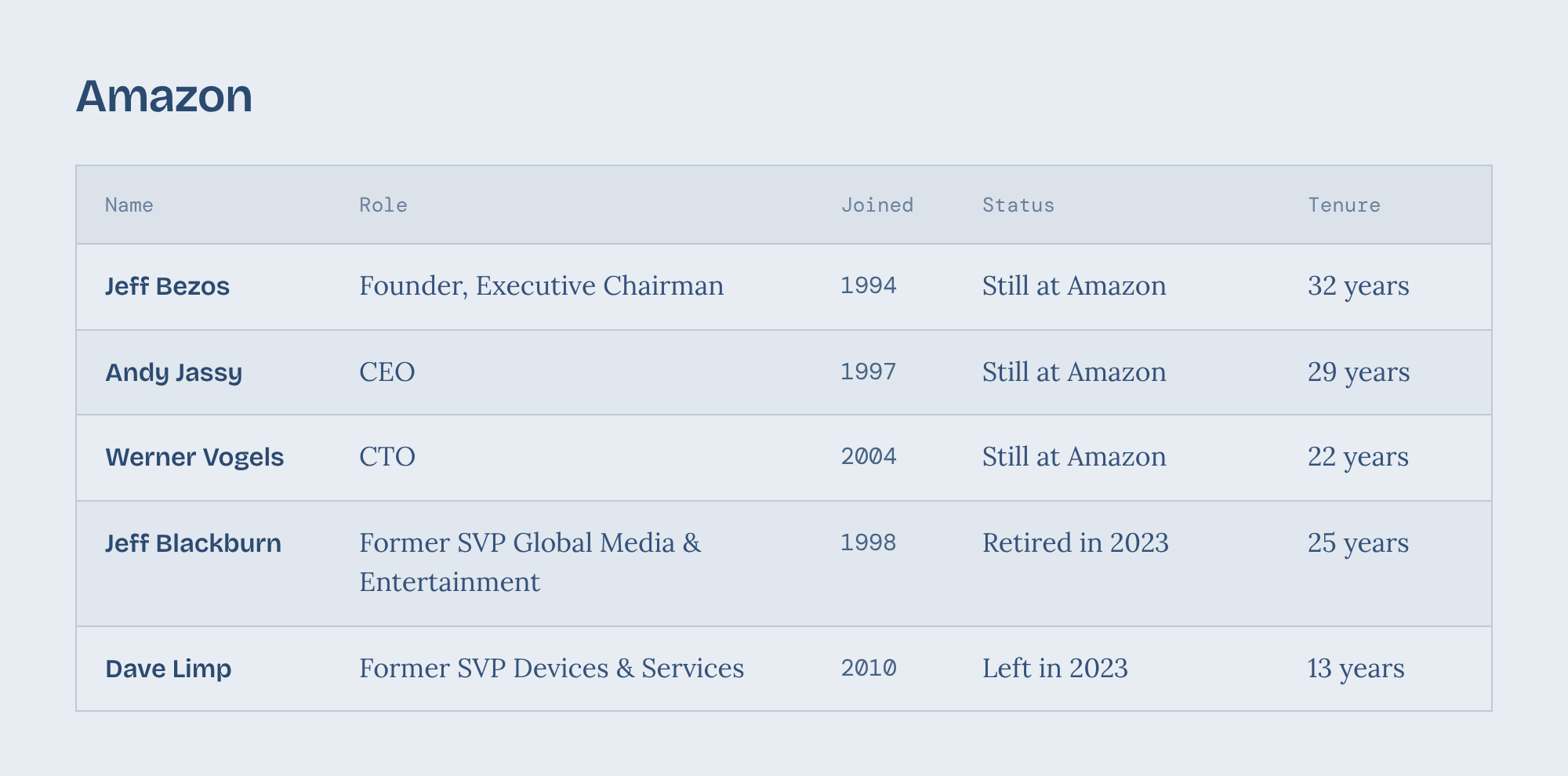
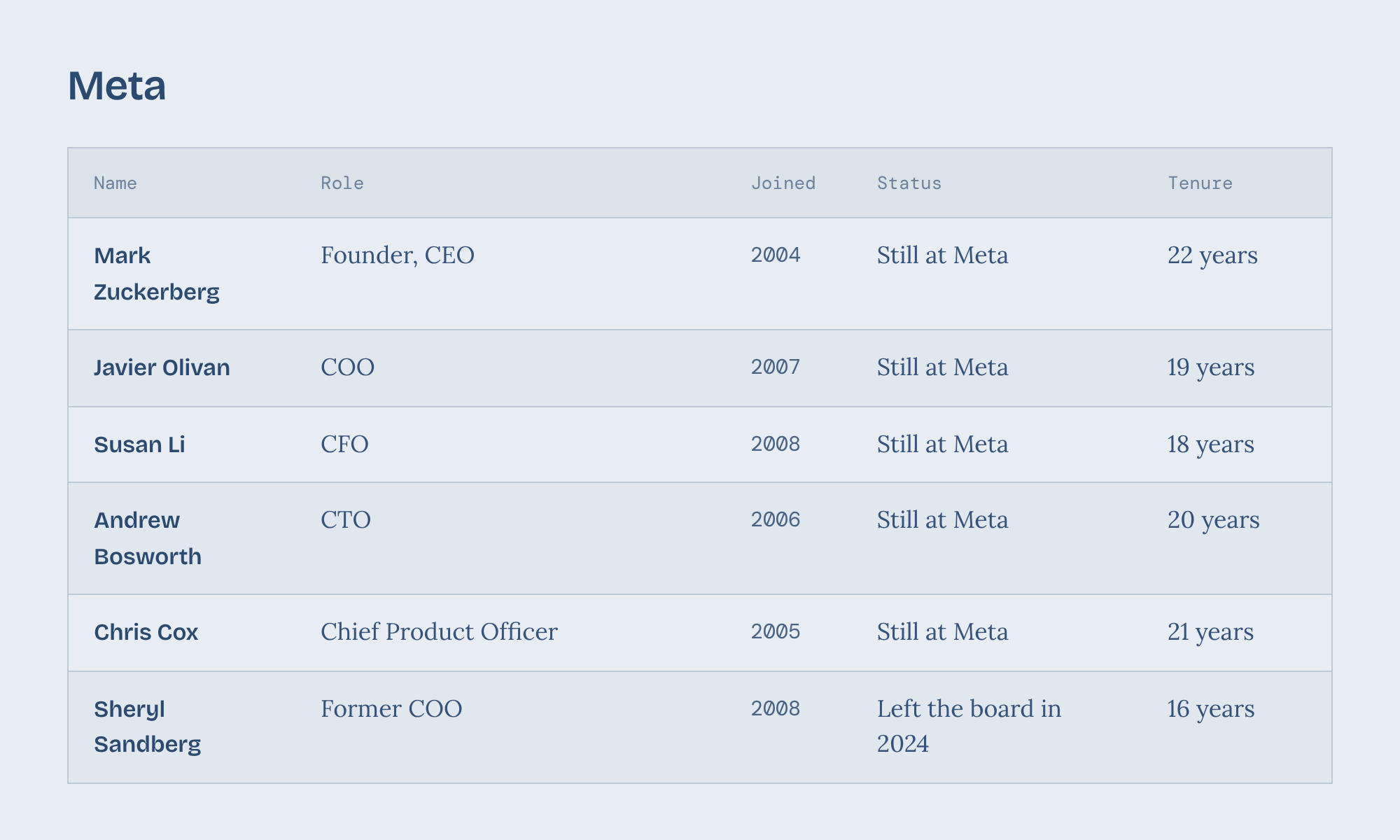
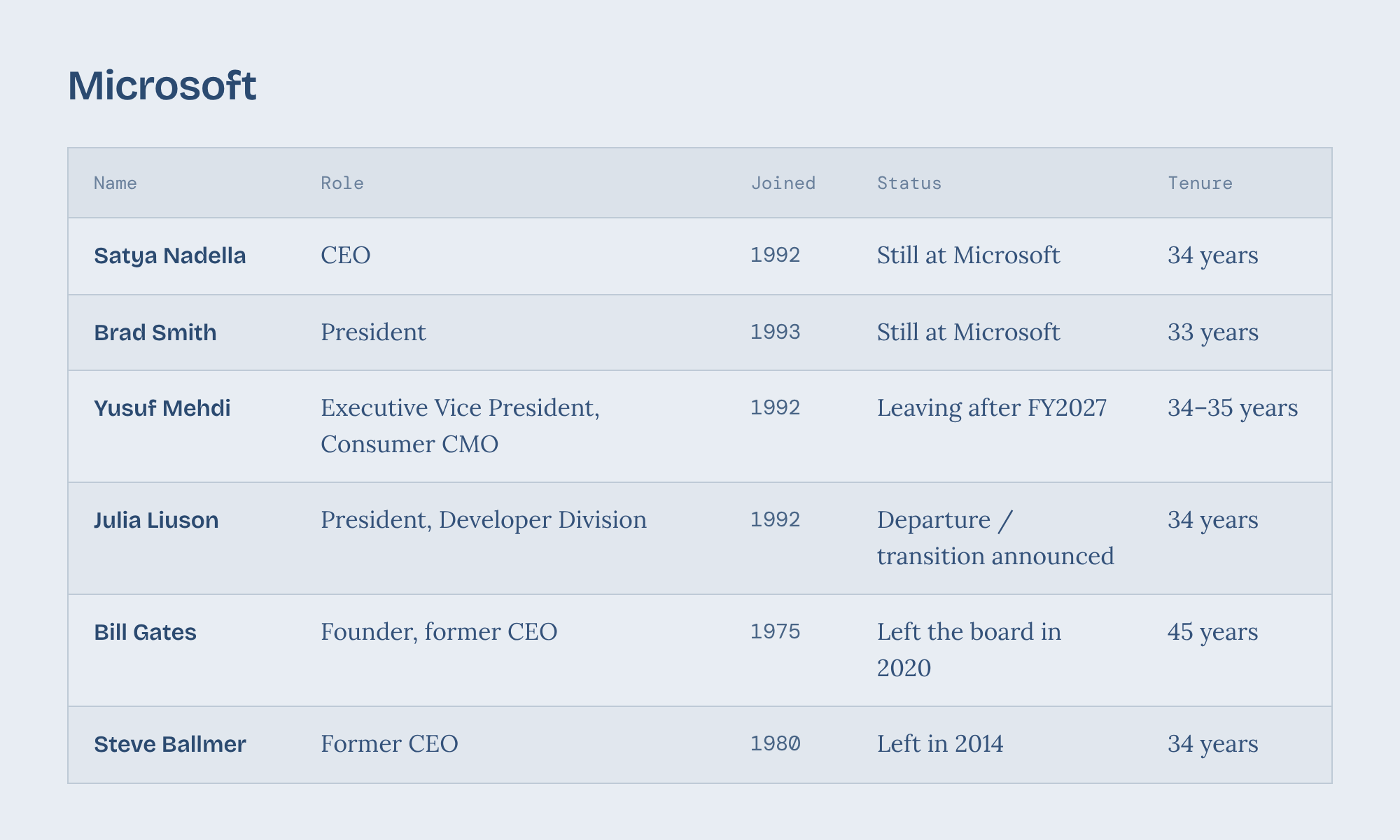
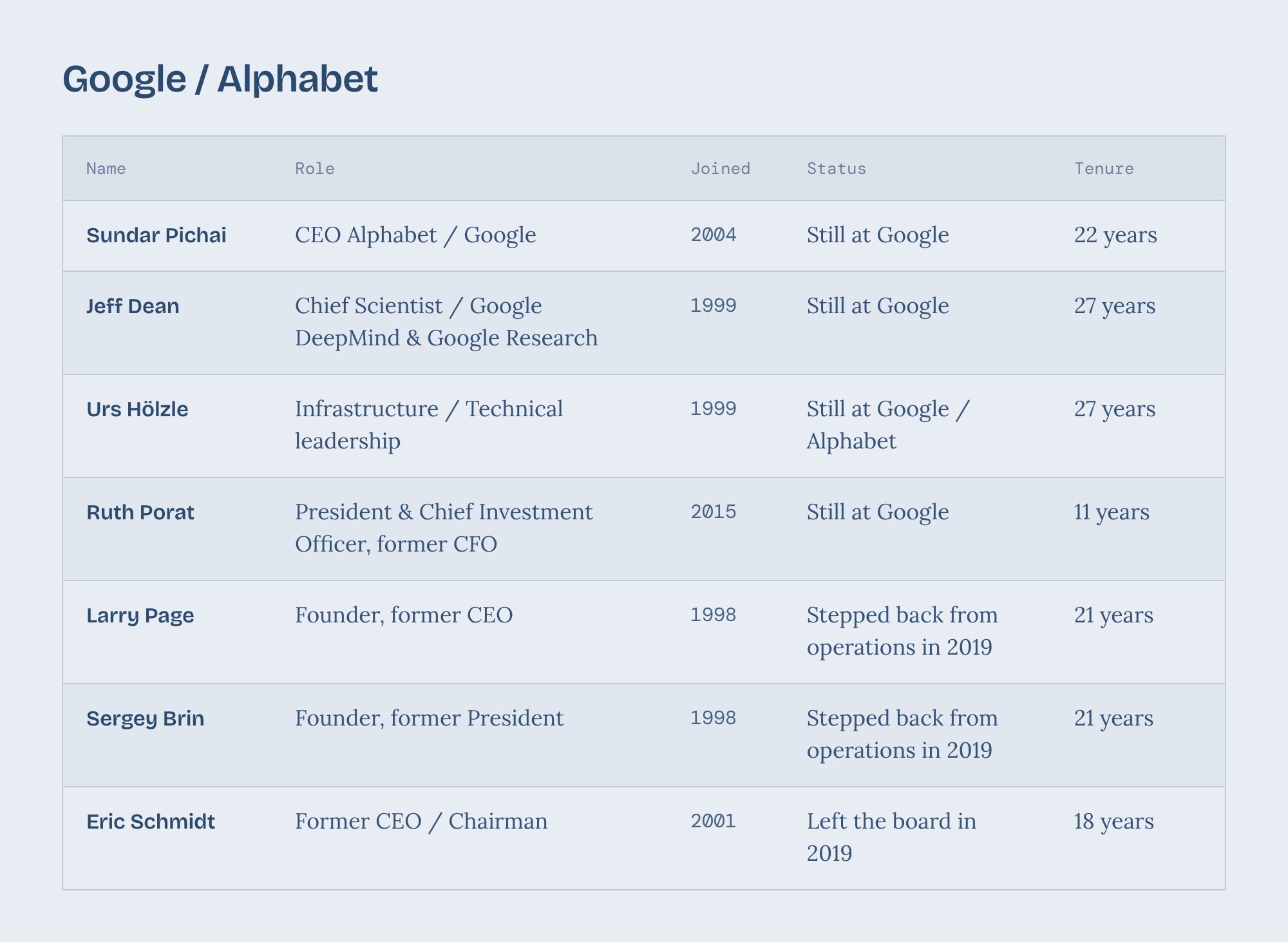
Because in a world where innovation is often fantasized, it must be understood that the real success of American Big Tech is to have been islands of stability: the same leaders, the same architects, the same technical cultures stayed twenty, thirty, sometimes forty years in the same organizations. See for yourself.
The question of technical talent has become a political problem
As a researcher friend put it: people leave for the United States or Canada not only because the pay is better, but because they will not find themselves in the administrative hell of the big institutions, having to manage complicated bosses and do reporting instead of science or code.
⠀
The absence of a real talent policy, in computing everyone knows their level, is in my view the main problem explaining the lack of mastery of the three critical subjects. Talent exists everywhere, but is it in the right places?
⠀
That leaves the third reason, the most disturbing one. And this is where the numbers become hard to look at squarely.⠀
The myth of the lone hero in AI
Betting everything on Mistral, a company that has not yet proven it can, in the long run, stay in the top five, the top ten, or even the top twenty of the world's AIs, is not without risk. Especially since its very clever integrated-services business model positions it more as an AI services company on the Palantir model, which pushes it toward B2B rather than serving as the government's AI seal of approval.
⠀
I saw that Mistral made numerous announcements, interesting things, surely a bit of vaporware. I took the opportunity to look at its ranking.
⠀
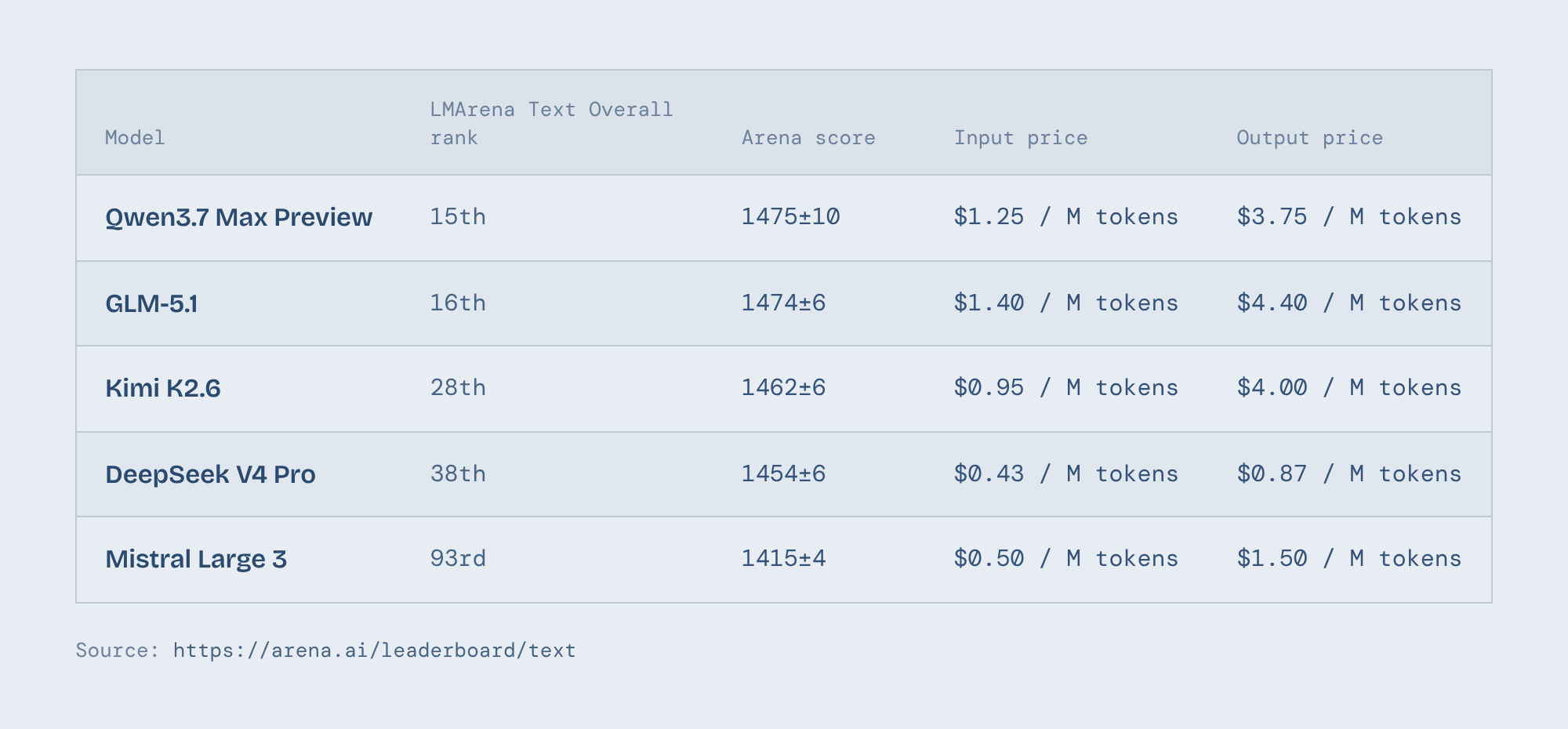
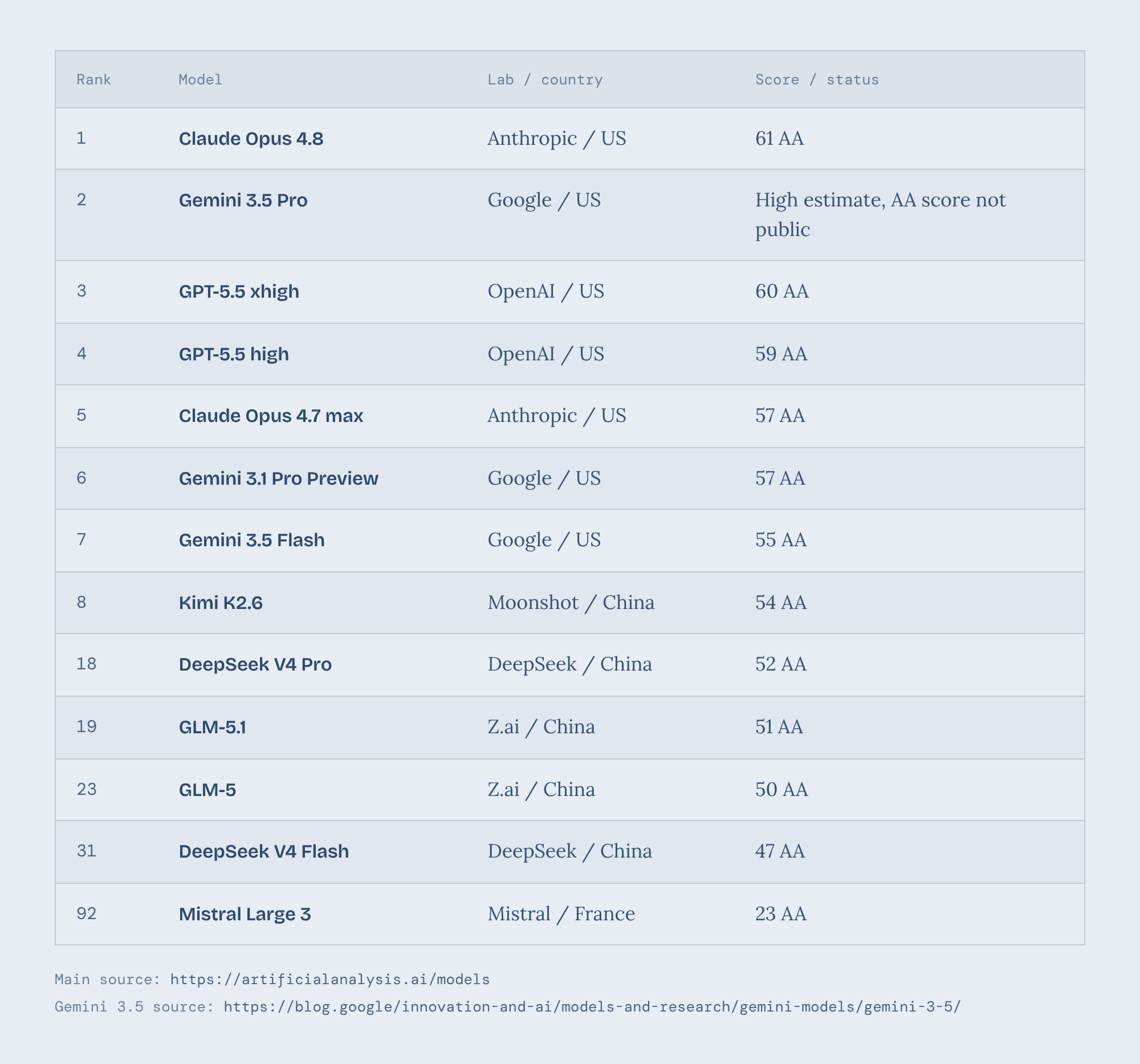
The current leaderboard is brutal: on LMArena Text Overall, Mistral Large 3 is ranked 93rd (https://arena.ai/leaderboard/text). On Artificial Analysis, Mistral Large 3 scores 23 on the Intelligence Index (https://artificialanalysis.ai/models/mistral-large-3).
⠀
It should nevertheless be noted that Mistral Large 3 ranks well in open source: #2 among non-reasoning open-source models and #6 among open-source models overall on LMArena, according to Mistral (https://mistral.ai/news/mistral-3). But in the global rankings, it remains far from the pack of frontier models.
Source: https://arena.ai/leaderboard/text
⠀
On cost, Mistral Large 3 is cheaper than the American frontier models, but does not have the price-performance advantage against the best Chinese models.
⠀
If you asked me about the global ranking:
Breaking free of the dependence on Mistral?
The real question nobody dares to ask is whether their centrality in France's AI strategy is preventing any thinking about the future of our cognition strategy.
⠀
It is important to separate the future of Mistral and the future of France, whose interests do not always converge.
⠀
The idea of making Mistral the single point of failure of French AI is problematic. It is not a strategy, it is a dependence. Even if Mistral is a clever player, strong on certain subjects, it offers no access to frontier-level models at the very moment we need them most.
⠀
In other words, a country's cognitive autonomy cannot rest on the assumption that a single national player will stay in the global race.
⠀
The single French champion strategy is therefore dangerous, but it is political and, it seems, nobody can do anything about it before 2027.
Yet a normal strategy, in a normal country, would consist of creating and opening several competing workstreams.
What should be done
Here are a few somewhat disruptive ideas I have never yet discussed publicly, to change the game.
Read the full article
Sign up now to read the full article and get access to all articles for paying subscribers only.


