

Over the past few weeks, I have been traveling across Europe and around France to give talks, meet the people we work with around this newsletter, and discuss the topic of the moment: the geopolitics of AI, and how to choose a strategy in a world where there is no perfect choice, only options and intelligent trade-offs.
Over those same weeks, we have also welcomed many new subscribers who are discovering this newsletter.
I wanted to take the opportunity to briefly remind them of the context in which it was created, and also to share a few ideas for 2026.
This newsletter runs on a weekly format, with issues that mix in-depth analysis for our paying subscribers, opinions and intuitions, as well as our now eagerly awaited film club for those who want to revisit or discover the films that anticipated the world we now live in.
Sometimes, when it illustrates the point, I share the notes we produce for the people we work with.
Since 2020, it has become obvious to everyone that we have changed worlds.
Whether it is geopolitics settling permanently into our industry, Covid showing the need for stable and resilient infrastructure, or the shift in tone and strategy of the companies that control every tool we use each day, Big Tech and the big Chinese platforms alike. And now AI promises to rethink the entire digital value chain.
Faced with these transformations and this turbulent world, which for a few years now I have been calling the digital age of uncertainty, there are two possible approaches.
- The first is to believe that everything currently changing is an exception, including the political shifts, in the United States in particular, and that the pendulum will swing back to a more comprehensible world, where habits, powers and balances return to what they were before.
- The second, which I subscribe to, holds that the world we knew, the Internet we cherished, will no longer exist. And that we are stepping straight into an unknown world, in which we will have to think about what we want, what we can get, and above all understand the technological, cultural, economic and geopolitical shifts at work.
First of all, I want to thank you for your trust. I am myself surprised by the success of this newsletter, which was far from a given at the start. The idea of offering a space for reflection that breaks with the ready-made thinking of French tech seems further and further removed from the pragmatic realities of that world.
2026 will be the year this newsletter gets a stronger structure.
I made a choice: to keep the price very low. Some of our notes are worth, on their own, several times the price of a subscription. A consultant told me recently that a single one of our issues had helped him land a year-long contract.
The affordable price also reflects a desire to reach audiences beyond my initial target: students in particular, but also small SMEs and anyone interested in these subjects.
Many of you have also told me that you subscribe to Ben Evans' newsletter and to Le Grand Continent (the European geopolitics journal) alongside this one, and I thank you for it. It is always gratifying to see our work recognized.
- If you are subscribed at the €60 rate, as a founding member, that rate will not change.
- If you are subscribed at the €99 rate, as a co-founding member, and you subscribe now, that rate will not change.
By the way, you are invited to come hear me at the API Days Summit, where you can get a free pass for API Days: click the button and use the VIP invitation code.
I will be closing the Digital Sovereignty track there with a brand-new talk titled "After Sovereignty," followed by a small meetup to get to know one another.
2026 will also be the year we build an arc of thinking ahead of the 2027 digital debate.
I hope, as I wrote in the previous newsletter, that we will avoid a debate reduced to a clash between naive enthusiasm about AI and its litany of layoffs and destruction, fear-mongering postures often pushed by those who are short on ideas.
The debate in France deserves better. With this newsletter, we hope to help make it calmer.
On behalf of the newsletter team and The Sovereign Way, thank you once again for your trust!
Do we have to keep living with a rotten web?
Digital sovereignty and resistance to Big Tech have never had so much wind in their sails as in recent weeks. Between the Franco-German digital sovereignty summit and the invitation of former Commission vice-president Margrethe Vestager to Denmark, to announce the rebuild movement next week.
The organizations that want to change things in Europe, such as Euclidia, Eurostack and tech-entrepreneur movements like EU-INC, are more and more active.
Word even has it that, during the side meeting between Merz and Macron in front of a small audience of European entrepreneurs, our President said:
“When I talked about digital sovereignty 10 years ago, everyone thought I was crazy. Now it's the hot new thing.”
Fascinating! I will of course let you parse that sentence in light of the past few years 😉
Except there is a real problem.
The government's message, Europe's message and the tech industry's message is that B2B must be saved. That is laudable, but by saying nothing about the consumer stack (LinkedIn post), the implication is that it is acceptable to abandon consumers in today's unlivable digital world, one that governments find harder and harder to regulate.
That is a major mistake, because if we want to survive the Internet (which was this newsletter's original title), then we are going to have to fight two forces that now shape the digital products and services of everyday life.
Enshittification: planned degradation
First, enshittification. It is the planned degradation that turns products essential to our daily lives, products that are supposed to work simply and perfectly, into increasingly unusable services.
That is how Instagram, a pleasant tool at the outset, slowly morphed, in the name of competition, into Instatrash.
The term was coined by Cory Doctorow in January 2023, and it describes a relentless economic mechanism in three stages:
- Stage one: the platform operates at a loss to win over users.
- Stage two: once users are captive, it locks in suppliers and creators, for example by forcing them to pay to be seen on Facebook or Instagram.
- Stage three: the platform betrays advertisers and business partners too, to extract maximum value. This is not an accident. It is a mathematical necessity for these monopolies to survive.
One way to see it is to watch the slow decay of the interfaces.
- For example, on the iPhone, in many cases it is no longer possible to easily "Select All" to copy text!
- On social networks, you can no longer fine-tune how you access content, for instance by starting somewhere other than the "For You" tab, which is, in some cases, a compilation of the most controversial content! A tab you cannot remove!
These techniques work because users have no choice. More and more commercial services, and even public services, are taking inspiration from them.
In the race to build the "sleaziest" service, it is not clear the consumer comes out ahead. Alas, design and the way a product is built fall outside the regulator's remit; it declares itself competent only on questions of competition or price.
When the product is free, it is open season for the worst use cases. The DSA is mostly concerned with content, not with the mechanics of interfaces. The real regulatory subject is thus avoided, to the great delight of the big platforms. In 15 years, we have really missed the point.
Sloppification: the invasion of rotten content (brainrot)
Then comes sloppification: the invasion of sloppy content, generated without soul or intention (AI).
It started with images, then videos, but soon it will be badly vibe-coded, utterly pointless casual software and games generated to waste your time that are on their way.
But not without risk: the study on Model Collapse ("The Curse of Recursion: Training on Generated Data Makes Models Forget"), published in Nature, describes what is known as model collapse. If future AIs train on the slop generated by today's AIs, the models collapse and go mad. It is digital inbreeding.
Curiously, the Dead Internet Theory, a theory that is no longer really a conspiracy theory, takes the reasoning further: the majority of traffic and content is supposedly already generated by bots talking to other bots.
The comments under the "Shrimp Jesus" images? Often bots.
How did we get here?
This situation is the result of two, maybe three, combined factors.
First factor: when you dominate a market, you stop innovating. You can afford to let things rot, and you keep them rotten as long as they make money. What is the difference between social networks and the mountains of clothes dumped by fast fashion in Ghana?

Second factor: when you exploit users, when you rip off advertisers and the regulators look the other way or hand out an inadequate fine, there is no incentive to improve anything at all. The only thing being tested is people's patience.
- How long before they leave X, now a toxic dumping ground
- How long before they give up on Facebook, Instagram, TikTok?
The risk is real now that platforms like ChatGPT and their personal conversations are tipping people into endless introspection. A Vibe Shift that now worries Mark Zuckerberg.
At least TikTok, from the very beginning, showed its true colors, unlike Instagram.
In 2021, Adam Mosseri, the head of Instagram, stated without ambiguity: "Instagram is no longer a photo-sharing app." Abandoning the social graph (your friends) for the interest graph (the TikTok-style algorithm) was a deliberate strategic choice. An unapologetic betrayal of the original contract which, so far, is not working nearly as well.
How long before we can no longer leave?
Interoperability, meaning the ability to leave with all your data, is still not made easy in Europe. Blame European regulation, which regulates nothing.
And yet Article 20 of the GDPR guarantees the right to retrieve your data in a structured, interoperable format. Article 7 of the DMA (Digital Markets Act) mandates messaging interoperability. In theory. In practice? The gatekeepers, Apple, Meta & co., skirt the spirit of the law with no immediate sanction. Apple kills Web Apps, Meta makes technical interoperability impossible.
Third factor: political complicity. But why does the political world do nothing? The immediate answer: incompetence?
I have a different view. Politicians and regulators benefit indirectly from the fact that the platforms alienate our ability to think clearly. We live in a world of organized chaos. If people's personal lives are turned upside down, if their conversations are fragmented, then their political engagement will be too.
For some, that is excellent news. No more need to talk about the real problems. The impossibility of finding a starting point to change the system becomes a good reason to do nothing.
The alternative: the Slow Web and a new consumer stack?
The question for us, citizens, entrepreneurs, tech people or politicians, the only real question, is this: how do we rebuild a new consumer stack that is no longer enshittified, that goes back to the fundamentals of the web while categorically refusing slop? Is it still possible?
On that note, I draw a distinction between AI-derived art and slop.
Because slop goes further than mimetics and the René Girard theories so dear to Peter Thiel. Slop is a new generation of destructive memes designed to fill and empty our brains at the same time.
Someone must have decided one day that humans were no longer competent enough to produce low-value content and thought: why not use AI to generate attention deficit disorder at an exponential rate?
Except that AI video consumes enormous amounts of energy and, for now, is not "sold" at its real price. If generation is not profitable compared to UGC (User Generated Content), why insist on growing it? Haven't the social networks trapped themselves with AI?
Then again, the advantage of AI over a creator is that you don't have to pay it, and there is no copyright on content that can drift endlessly.
In this context, I find that the thinking and the fight around the Slow Web make sense all over again.
The Slow Web is the idea that technology is like food: we consume it every day and, if we are what we eat, then we are also what we consume digitally.
I coined the term in 2010 in an article titled "The Age of Emotions," drawing on my experience with Netvibes and Jolicloud. There I had discovered the power of influence a developer can have over the end user, and how easily one can plug into people's intimacy, at scale, without any real permission. A power I found very troubling at the time.
The 4 rules of the Slow Web are simple:
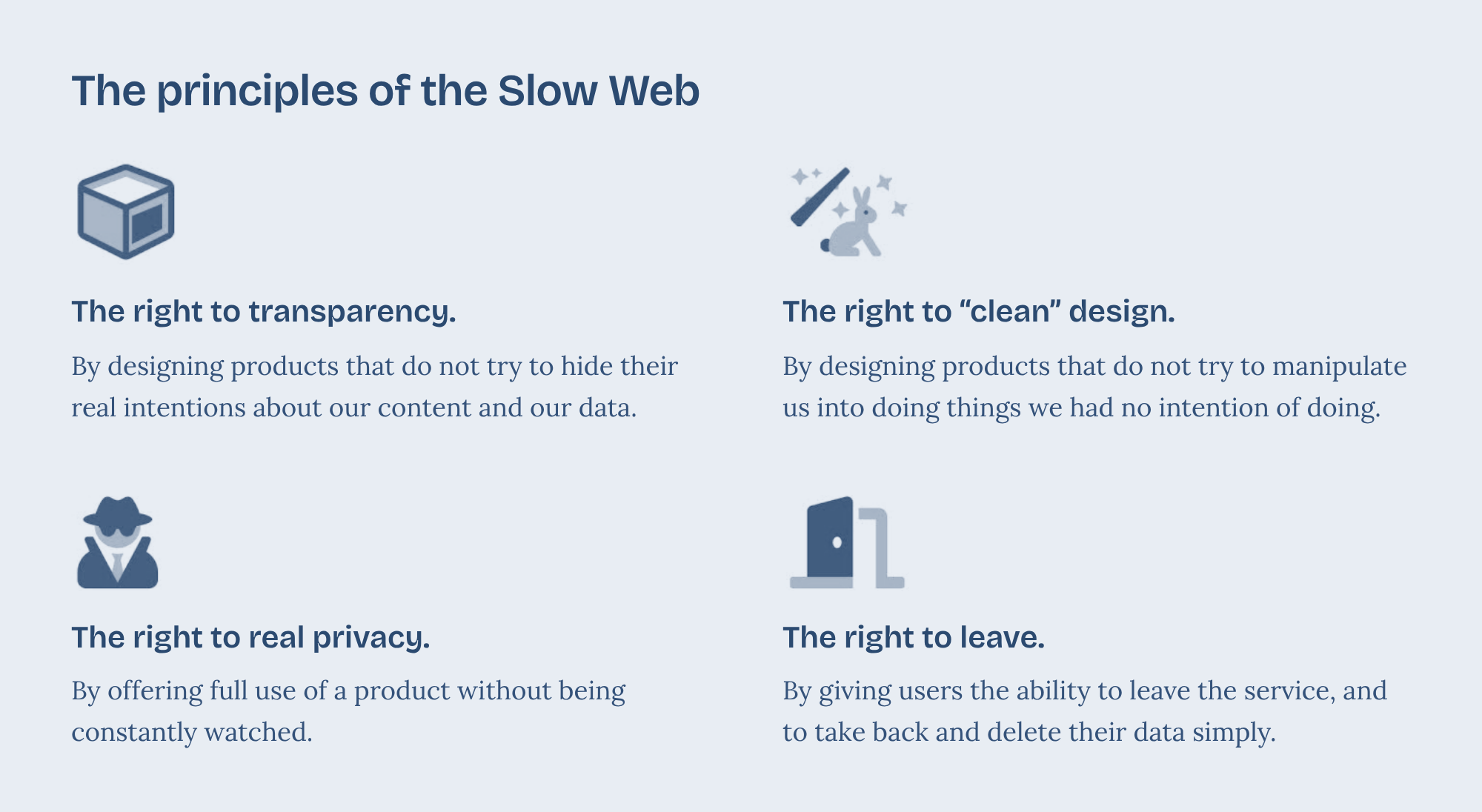
If organic and Slow Food are the answer for food, then the Slow Web is the answer to the fast food of the mind. My friends Tristan Harris and Aza Raskin, through the Center for Humane Technology, have long documented how these interfaces exploit our neurobiological weaknesses, like the "slot machine" effect of infinite scroll.
Defending our personal space and our intimacy is one of the last political fights we have left.
If we do not replace the tools that manage our intimacy with things that respect us, then we will not be able to fix anything else.
How are you supposed to give people a coherent political vision and an understanding of the world if they no longer even have the capacity to pay attention to anything?
And what if political messages are sandwiched between four iterations of "Shrimp Jesus" and a cute blue dog in a spaceship?
1 minute of slop
Because enshittification now hits businesses too. Most of the software we use tries to paper over the enshittification of its own experience with announcements of an "AI version."
A way of saying: "We know our product is no longer any good. But you know what? We are going to use AI to make you believe we could build a better version of it."
It is up to you whether to believe them.
And to join the fight for a de-enshittified Internet where slop is not a foregone conclusion.
thank you for your attention
A few references to go further:
My writings on the Slow Web
- The Age of Emotions: the founding 2010 article where I coined the term Slow Web
(https://tariqkrim.tumblr.com/post/15040172288/the-age-of-emotions
- Drifting, a Slow Web manifesto (2016):
https://medium.com/@tariqkrim/drifting-c45102df9e3
- The Slow Web: my full article on the origin and principles of the movement:
 Tariq KRIM

References to learn more (reserved for paying subscribers)
Read the full article
Sign up now to read the full article and get access to all articles for paying subscribers only.


