

Introduction
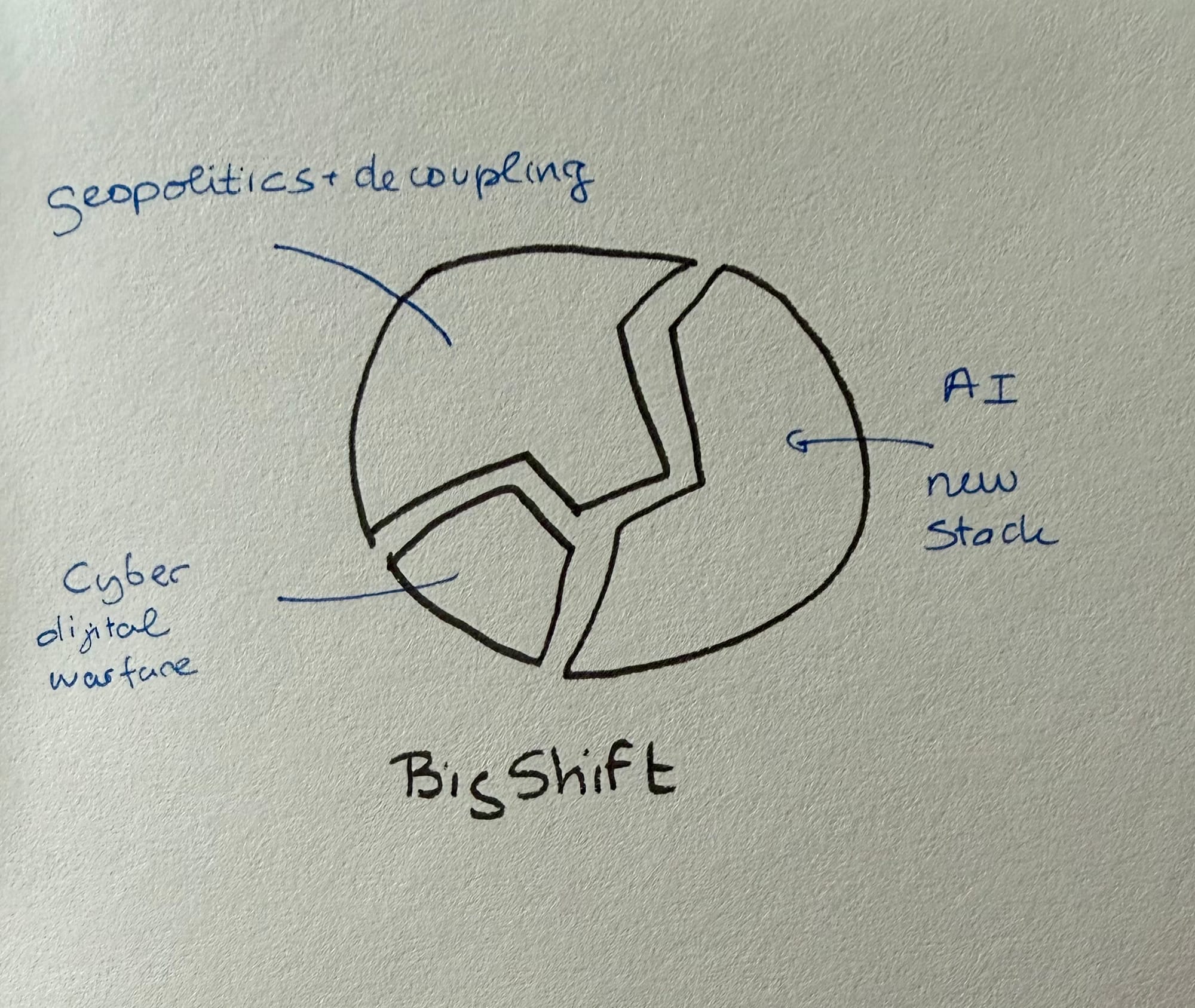
This week was largely devoted, on my side, to preparing my keynote at the World Government Summit, where, in front of an audience of heads of state and entrepreneurs from around the world, I will be talking about the strategy to adopt in the face of the Big Shift.
It has been several years since I left the conference circuit, Davos and the like, to focus on more specialized events. But I am returning to that world with pleasure and a little anxiety. The good news: 25 degrees Celsius and perfect sunshine. This conference, which hopes one day to dethrone Davos, will be a prime pilgrimage site for tech bosses in search of funding.
This week also saw the birth of a new religion: Crustafarianism. It was created by swarms of artificial agents around the Clawdbot project, since renamed OpenClaw.
Is this the ChatGPT moment for agentic AI, that is, AI that works for us autonomously?
- Any of us can join, provided we are willing to shell out for a €200 Claude Max subscription and a Mac mini (out of stock) to build our own autonomous system, which sometimes runs off the rails when it takes initiatives.
- The Internet is full of accounts from people who gave OpenClaw access to their accounts and let the agents organize their lives.
- Created by the Austrian engineer Peter Steinberger, this open-source project confirms that AI, for better and for worse, is tipping into a new dynamic. 2026 will be the era not of agentic AI but of agent swarms.
- I have been testing local alternatives on my Mac mini for some time now, to have a cognitive backup, but this is a whole new level.
Preparing for the Internet that comes next
Many people have joined us in recent weeks, and I wanted to take the opportunity to announce the newsletter's new mission: preparing for the Internet that comes next.
Because more than ever, we need to prepare for the Big Shift that is landing on us.
One piece of news may have escaped you (it happened on Swedish television): Bill Gates explained in prime time that a European shutdown of American cloud services by the current administration cannot be ruled out! This is new, and very worrying.
I was on France 24 last week, on The Debate, to talk about this Big Shift and the impact of our dependence on the American cloud. I do not believe in a general shutdown, but rather in a targeted cutoff of citizens or organizations to speed up negotiations. But after all, nobody knows, so anything is possible!
France 24 The Debate
France is therefore now facing a triple attack: foreign interference, cyber, and now the risk of decoupling. On top of that come the first waves of AI-related layoffs, as at Microsoft.
We had asked the question: what is France's cyber strategy? As if the president of the Republic or his advisers were reading us, the document has finally been presented, at least its public part.
This newsletter complements two other posts I have written:
A LinkedIn post explaining why the general public and SMEs are a blind spot of state policy
 Tariq Krim

A strategic summary of the two and a half hours of the Rencontres de la Souveraineté Numérique conference at Bercy. (For our paying subscribers)
 Tariq KRIM

If the strategy carries a preface by the president, which gives it weight, it falls to the digital minister to handle the after-sales service.
I admit that while I gave her the benefit of the doubt when she arrived, I am increasingly puzzled by her strategy. She seems to be running through an agenda that was written for her.
So there is a lot to say
A reminder of the context:
- France is facing an explosion of cyberattacks: 348,000 digital offenses recorded by the Interior Ministry, up 74% over five years.
- More than 43 million people have had their data exposed on the darknet in the past two years (Free, SFR, Orange, Bouygues, France Travail).
- The cost to businesses reaches €2.2 billion, and remember that six out of ten SMEs hit by a major cyberattack file for bankruptcy within six months.
These figures are frightening.
It was La Tribune that published an interview with the minister as the Cyber 2026 doctrine was released.
Here is my analysis.
The five pillars of France's cyber strategy
- Training and talent (the fundamental pillar, according to the minister): train more engineers, keep them in France, bring more women into cyber careers. The target of 75,000 jobs set in 2021 has not been met (45,000 today). France has only 500 cyber employees per 100,000 workers, three times fewer than Estonia. It bears repeating that the first line of cyber defense inside companies is mostly made up of engineers from the Maghreb. In France, but above all offshore, in their home countries. This dependence obviously raises questions: where are the centers of excellence in cyber training that we were promised?
- Cyber resilience of the Nation: large-scale awareness campaigns, a program of national crisis exercises, extension of cybersecurity obligations to a far larger number of entities (in line with NIS 2).
- Disrupting the cyber threat: earlier detection of attacks, improved blocking and containment capacity, faster response.
- Mastery of digital foundations: R&D investment in AI and breakthrough technologies, civil-military synergies, retention of critical cryptography technologies, a broader range of defensive products.
- International stability of cyberspace: reliance on European texts (Cybersecurity Act, the future Cloud & AI Act), cooperation in international bodies such as the UN.
Concrete measures:
- The anti-scam filter (a warning system that would alert users before they reach a fraudulent site), promised since 2022, will finally be entrusted to OFAC (the anti-cybercrime office, the new specialized police unit). The minister has committed to delivering it before the end of Macron's term. After a launch with great fanfare, the system's limits are showing.
- Creation of a national prevention brand with a portal centralizing the procedures for citizens and businesses, linked to Cybermalveillance.gouv.fr (the public website that assists victims of cyberattacks) and 17 Cyber (the emergency number for reporting a computer attack).
- On the funding side, it is utter destitution. Unlike the one billion euros of 2021, no overall budget has been announced. €7 million is earmarked for the regions through a call for expressions of interest (AMI, a grant mechanism) issued last September. Funding will depend on the vote on the 2026 budget.
Regulatory delay
- The NIS 2 directive (the European text imposing tougher cybersecurity rules on 15,000 French companies and administrations, up from 400 before), which should have been transposed into French law before October 2024, remains stuck in the parliamentary shuttle.
- The Resilience bill was approved by a special committee in September 2025 but is not on the agenda.
- The minister cites the political instability that followed the dissolution of the National Assembly and promises it will be scheduled quickly after the municipal elections. Translation: she has no leverage on the matter.
Position on Chinese equipment makers
- On the European cyber package, which provides for the gradual removal of Huawei and ZTE (the two Chinese telecom giants) from 5G infrastructure, the minister welcomes the ambition but calls for consultation with member states and industry players to assess the technical, operational and economic consequences.
A call for sovereignty
- Anne Le Hénanff explicitly encourages local governments and businesses to favor French and European solutions, welcoming the fact that more and more local authorities are abandoning the legacy American software.
What to make of all this?
A number of gaps and unwritten things need pointing out, and they raise a lot of questions.
Read the full article
Sign up now to read the full article and get access to all articles for paying subscribers only.


