

I have always been fascinated by the idea of the computer simulation. Like many of you, I discovered it in Tron in 1982, but what really did it was the holodeck in Star Trek: that room on the Enterprise where the crew conjures up an entire world, walks around in it, alters it with a sentence, then says “computer, end program” and goes home for dinner. A world you can try out: it may be one of the most beautiful ideas science fiction ever had.
As I pointed out during a talk on AI in cinema at the HEAD design school in Geneva, the computer simulation is one of science fiction's most popular subgenres.
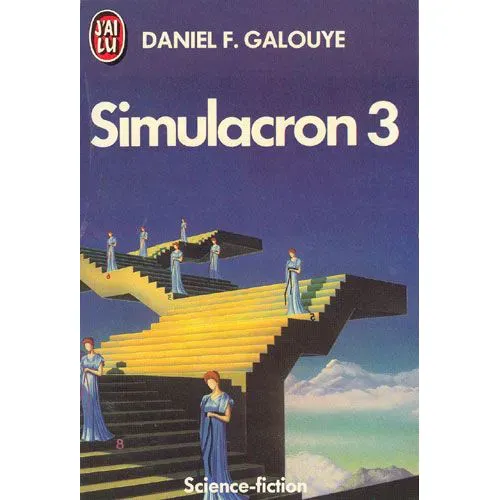
But if we had to give it a true origin, it would surely be Daniel Galouye's novel Simulacron-3, which has, incidentally, been adapted for the screen twice.
That is why, when I learned that a team of researchers had published a paper on a model of all of humanity, it was the first thing that came to mind.
The novel that imagined the simulation playbook
On the question of simulation there is an abundant literature, many books and talks, one absolutely brilliant documentary and dozens of YouTube videos.
But before going any further, I wanted to go back to the book that did the most to define the political vision of simulation.
In 1964, Daniel Galouye, a journalist in New Orleans, published a novel set in the middle of the twenty-first century, in a society that opinion polling has devoured. A quarter of the workforce spends its days questioning people, stopping them in the street, cutting into their conversations to find out what they think of a product. Answering is compulsory.
A private company, Reactions Incorporated, finds the workaround. A total environment simulator, a city of ten thousand inhabitants endowed with consciousness and convinced they are real, who can be observed, questioned and manipulated at will. The machine is called Simulacron-3, because it is the third attempt.
In the novel, the simulation is not science-fiction set dressing but a commercial product, and Galouye spells out in black and white why it was built. The playbook fits in one line: study human behavior in all its forms without ever polling anyone.
Galouye even foresaw the social conflict. In the novel, the pollsters' organization understands that the machine spells its doom, and its anger ends up in the street, right up to the company's gates. The whole story of the automation of an intellectual profession is already there, along with the reaction of those it replaces.
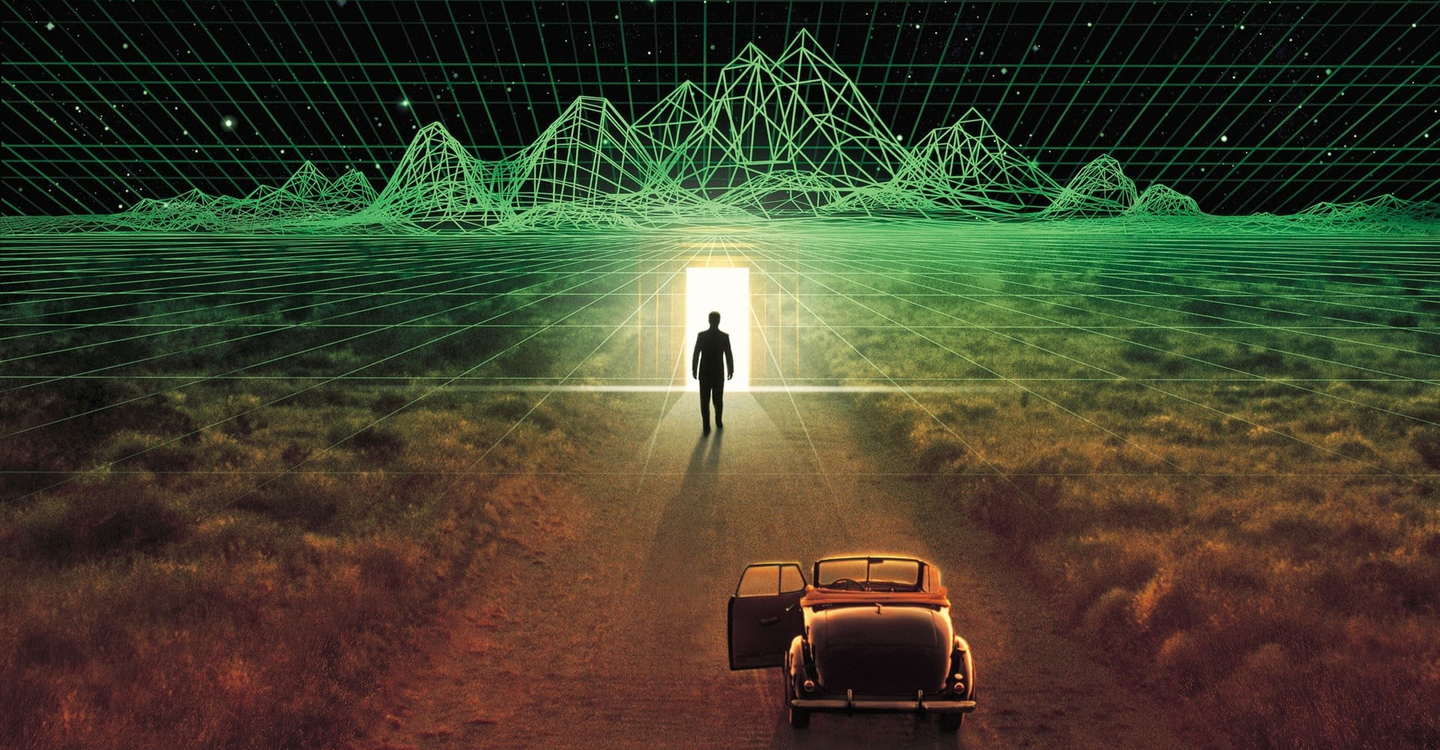
Then the novel tips over. The simulator's technical director, Douglas Hall, sees his mentor die in strange circumstances and a colleague vanish without anyone else remembering him. He eventually understands that his own world is also a simulation, run from one floor up, and that he himself is merely a conscious inhabitant of someone else's fishbowl.
What people always remember from this story is the twist, the hero who discovers he is simulated, and that is a pity, because the lesson lies elsewhere.
In 1964, before data went digital, before networks, Galouye had already identified the only reason anyone would ever fund a complete simulated world: because real people are expensive, slow to answer, and say unpredictable things. Build a digital double of the world to get rid of the original.
The reason for the simulation has changed with the times, and with the authors. In Tron: Legacy, it is the hope of creating a fairer world. In The Matrix, the simulation is a prison. For Philip K. Dick, a manipulation. For Greg Egan, a metaphysical experiment.
For Galouye, the goal is the creation of a vast market study, which is, very precisely, the purpose of the MatrAIx project that has just been announced and that prompted this article.
He predicted nothing about the technology, neither language models nor data, but he predicted the motivation, and that is what came true, word for word: the 2026 MatrAIx paper opens on the cost and slowness of human evaluation, exactly like the Reactions Incorporated prospectus.
Only one thing about our modern world escaped him: the inversion. He imagined a society crushed by the obligation to answer, whereas ours has simply stopped answering: response rates for American telephone surveys fell from 36% in 1997 to 6% twenty years later. So the simulation does not arrive to challenge a system that works; it fills a void.
Simulating the world in order to dominate or influence it is not a new undertaking. It has been attempted and repeated many times, at Facebook for instance.
In January 2012, for one week, Facebook removed positive content from the feeds of 689,003 people, and negative content from the feeds of the others, to see whether mood spreads.
The results appeared in 2014 in the journal of the American National Academy of Sciences. It published an expression of concern a month later. The debate over consent went on for years, and Facebook's defense, namely that the terms of service amounted to informed consent, ended up in ethics textbooks on the side of the counterexamples. The lesson learned internally was not that one should stop experimenting on people, but that one should stop doing it on real people.
The second attempt is fascinating because few people know about it.
Read the full article
Sign up now to read the full article and get access to all articles for paying subscribers only.


