

This week, one number gave me pause. Not the figures from the Choose France announcements, though I will come back to those at the end, because those deals may be less favorable than they look. The number that struck me is this one: $3.6 trillion. That is the sum of the latest valuations of OpenAI, Anthropic and SpaceX's announced IPO.
That order of magnitude is roughly the GDP of France. Of course, a market valuation and a GDP do not measure the same thing. But the signal is there: the American market is starting to price these three companies as the equivalent of an entire country, a country where a growing share of the work would be done by autonomous agents, language models and space infrastructure.
And that is only the beginning of the problem.
Many of you have told me that this newsletter has helped you win contracts, rethink your strategy, and in some cases take a new job.
Keep supporting us to get access to information you will literally find nowhere else.
We are caught in a multi-cushion bank shot.
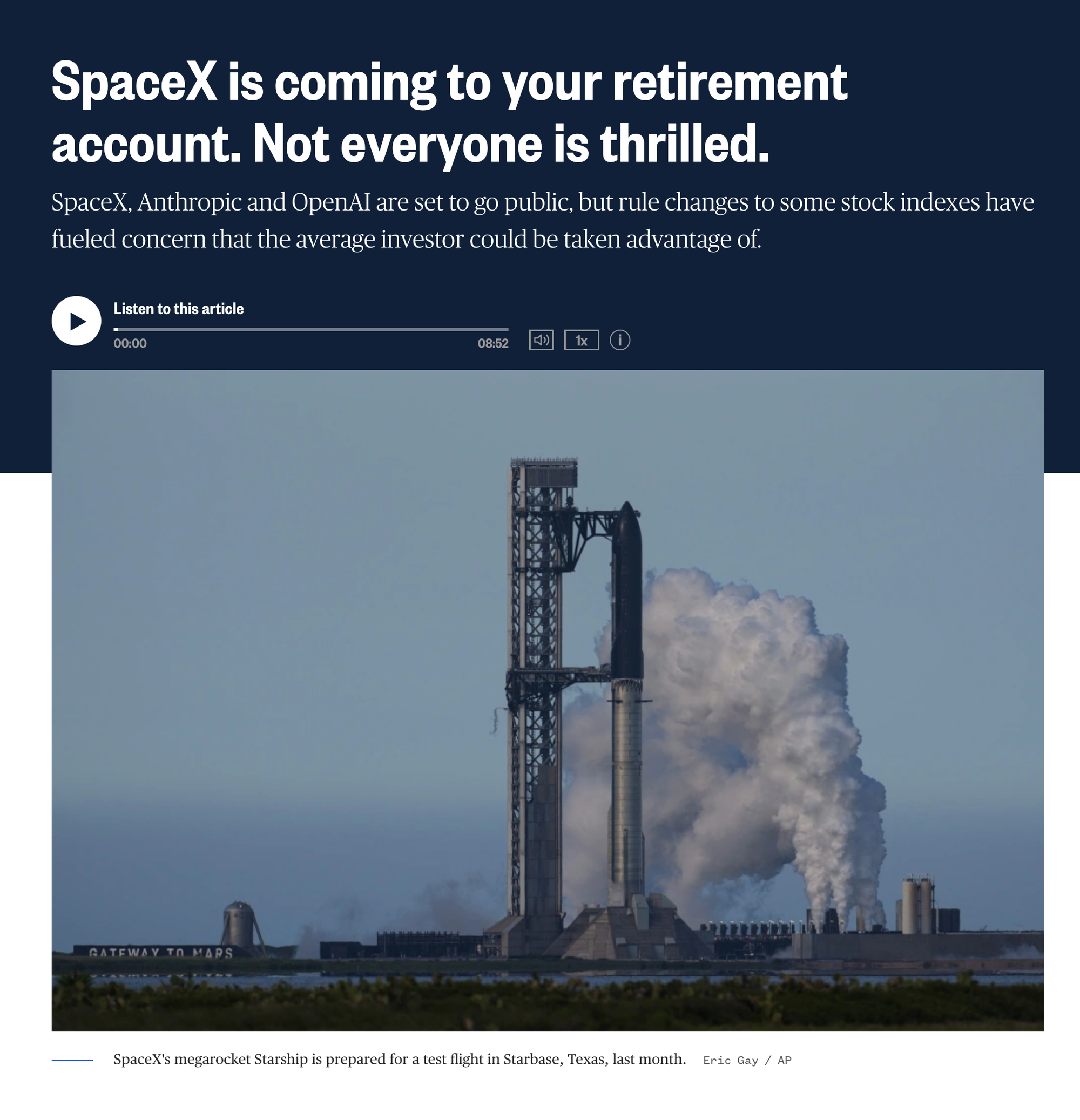
First point: the SpaceX IPO is now Elon Musk's great financial bet.
SpaceX is aiming to raise around $75 billion, at an IPO valuation of about $1.75 trillion and a reported price of $135 per share. Market rumors in the spring even floated a valuation above $2 trillion.
Musk is trying here to alter the very logic of an IPO. In principle, a company goes public to amplify a revenue model that is already clear. In SpaceX's case, retail investors and automatic buyers of shares will be placed in a position much closer to that of venture capital: financing a radical, neo-cyberpunk space-tech bet, somewhere between Outland and Alien.
Two references Musk knows well, since we discussed them over dinner more than fifteen years ago.

Nestled at the heart of his new SpaceX is Starlink, the most profitable business, which generates about $2 billion.
When SpaceX was flying the Falcon 9, an extraordinary use of reusability, SpaceX had a profitable product. But with the push to launch Starship, that profitability has evaporated, and on top of it comes the loss-making business of xAI, which reportedly lost about $6.4 billion on operations in 2025 against roughly $3.2 billion in revenue.
Elon Musk sells AI, but it is neither his business nor his core activity. And the funniest part is that SpaceX has already secured the right to acquire Cursor for $60 billion by the end of the year, or to pay $10 billion for "our work together." The acquisition is expected to close 30 days after the IPO, so in July 2026.
And we are all, quite literally, going to pay for it. Let me explain.
- On May 1, 2026, Nasdaq officially changed its rules for inclusion in the Nasdaq-100: any newly listed company ranked in the top 40 by market capitalization can now join the index after only 15 trading days, down from 3 months previously. The minimum free-float requirement was dropped.
- According to Reuters, SpaceX had signaled from the outset that fast inclusion in the indexes was a central condition in its choice of exchange. Nasdaq and the NYSE were fighting to host it. Nasdaq changed its rules. So SpaceX chose Nasdaq.
- The Nasdaq-100 is tracked by more than 200 investment products representing over $600 billion in assets. More than $30 trillion is benchmarked against the major US indexes. Passive fund managers will be mechanically forced to buy. In short, retirement savings and pension funds are going to buy SpaceX automatically.
The new intermediate class
Many people think AI will democratize prosperity and boost the middle classes.
I think the opposite: those who today pay one or two hundred euros a month for access to the best tools are becoming an intermediate cognitive class. Above them will be those with access to the models that really matter. Below them, those who will have to make do with the free, degraded or limited versions.
This is where the subject tips over. We are starting to see two AIs emerge: one AI that is useful to citizens, freelancers and small businesses; and another, far more powerful AI, designed for the military world, the big platforms and the very large corporations.
This new cognitive hierarchy is what I wanted to explore this week.
We had already discussed the first cognitive divide: the one separating those who stay on the free versions, those who can afford a $20-a-month subscription, and those who are already moving up to $100- or $200-a-month plans to regain control of their digital lives.
 Tariq KRIM
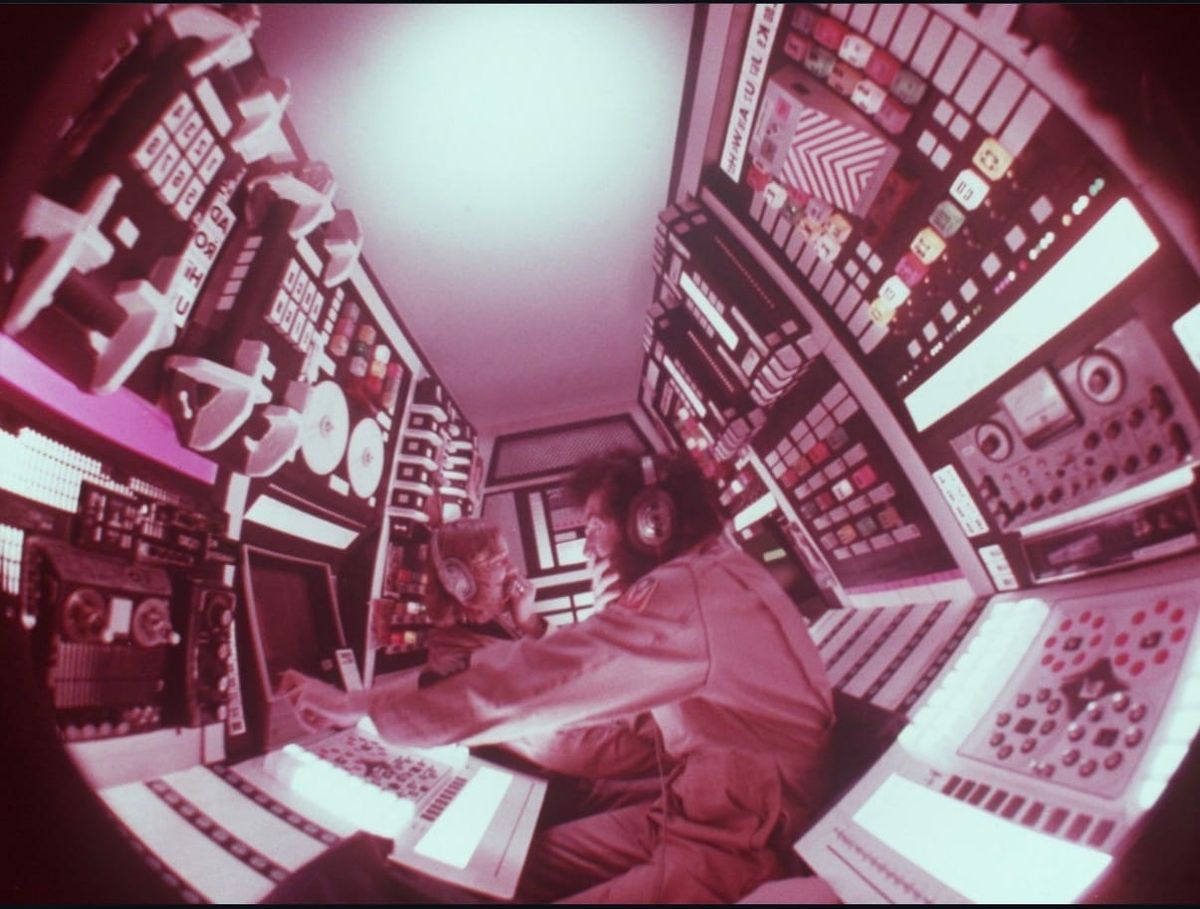
From the information I have been able to gather from a few friends already testing Claude Mythos Preview, I am starting to see a second cognitive divide taking shape: no longer between free versions and paid subscriptions, but between those using the $100- or $200-a-month plans and those who will have access to super-frontier models of the Mythos type.
The free versions will get more and more enshittified
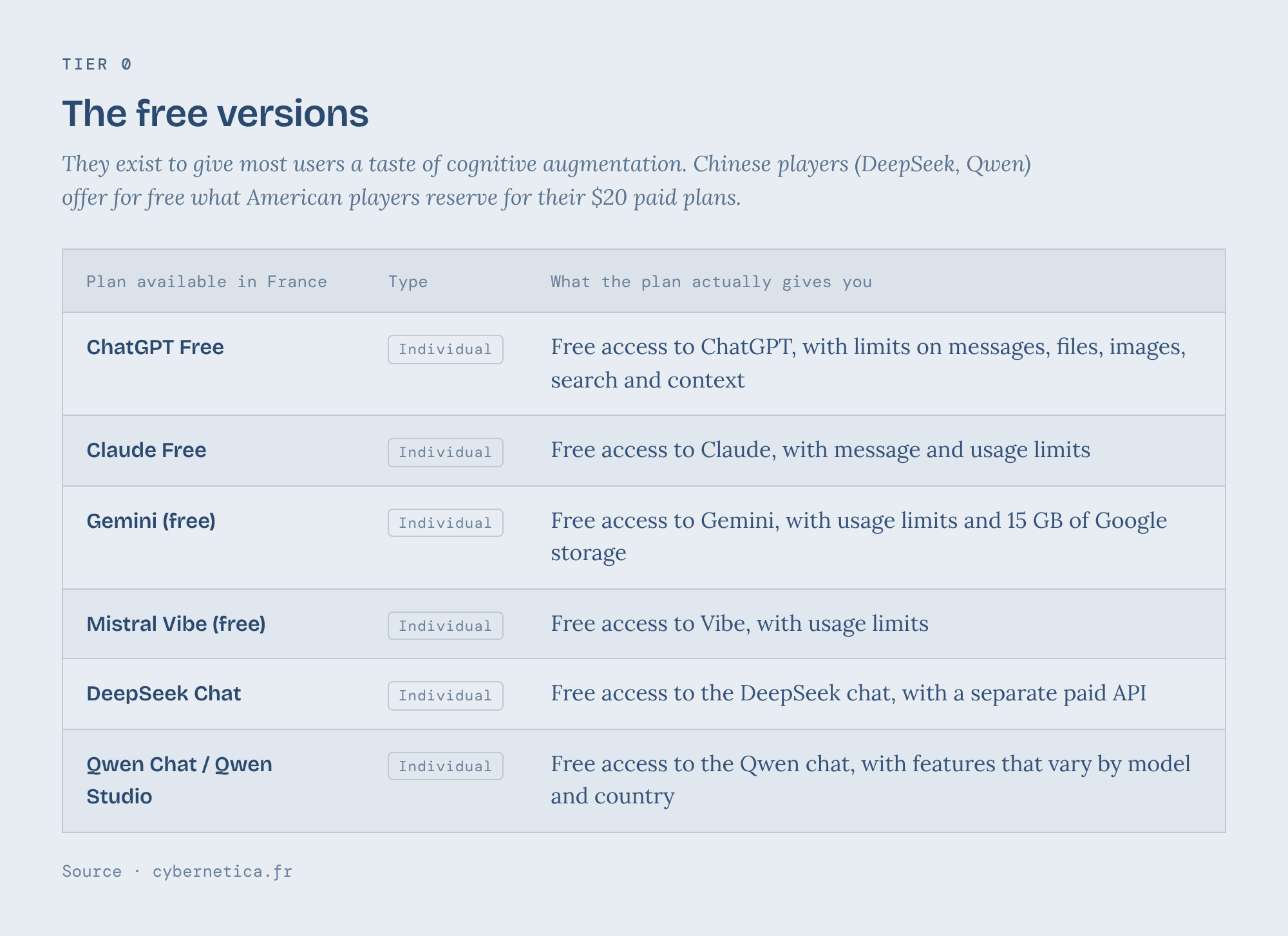
Free versions do not exist by social contract. They serve first of all to give the majority of users a glimpse of cognitive augmentation.
As often happens, free users end up finding their own niche uses. But free AI is not designed to make them genuinely more efficient with their time. Their data can be used for training, the services on offer remain basic or limited, and advertising is on its way to monetize these uses. For some players, the goal remains simple: push users up toward the paid plans.
As we have said before, there are two visions. ChatGPT tries to keep users inside its service as long as possible, even with a degraded offer. Anthropic shows you the potential, then quickly caps usage to push you toward the paid version, or lets you leave.
But this American free-tier strategy is already being challenged by the Chinese players, with a logic closer to TikTok or Temu. Products like DeepSeek or Qwen are trying to offer for free what the American players reserve for their paid plans at around $20 a month.
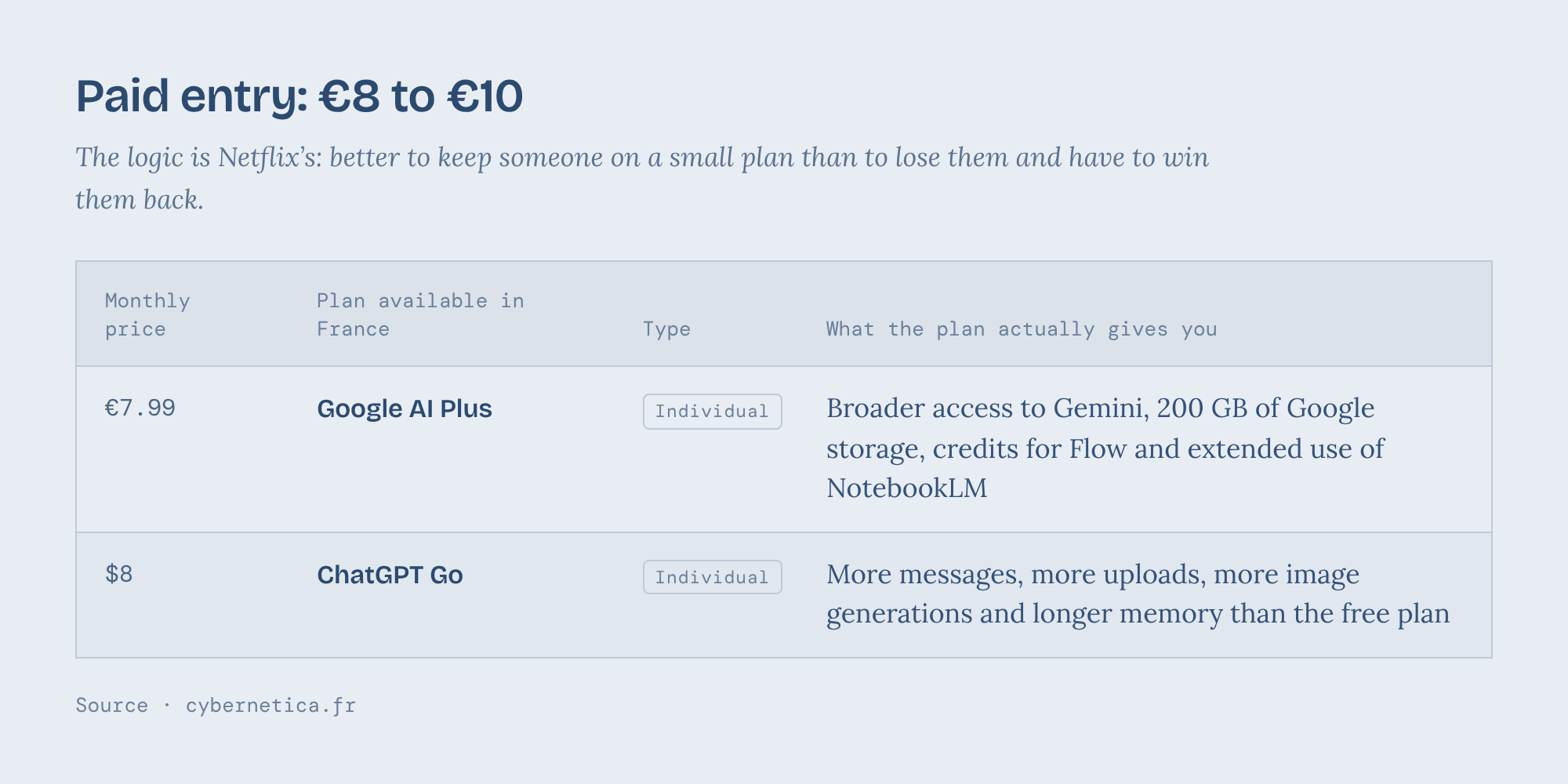
There are also the entry-level paid versions, such as ChatGPT Go at $8 a month or Google AI Plus at €7.99 a month.
The logic is Netflix's: better to keep someone on a small plan than to lose them and have to win them back.
What has changed for OpenAI and Google is that they have managed to deploy smaller models that do the job and cost far less than before.
In the $15-to-$25-a-month basket, there is Mistral Vibe at $14.99 a month, ChatGPT Plus at $20 a month, Claude Pro at $20 a month, and Google AI Pro at €21.99 a month in France. Twenty dollars is now the standard level for paid AI, the one many advanced users today consider the minimum for working properly.
But this price range does not work for agentic use.
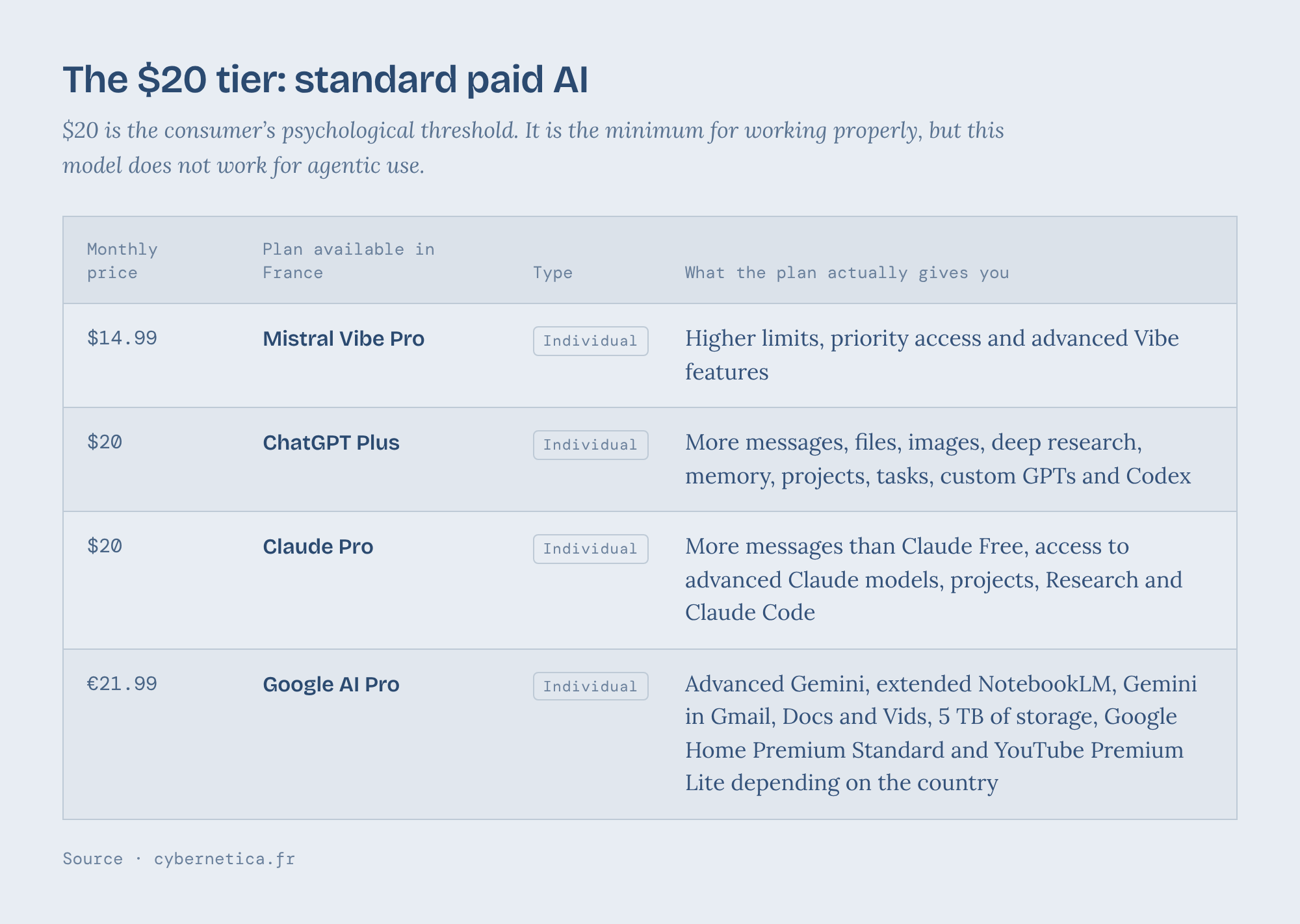
- What is interesting is that since Claude took off, ChatGPT has been trying, notably with Codex, to bring users back to a $20 plan. On code review, Codex is not that far from what Claude offers in its $100 plan.
- It is possible that OpenAI has worked enormously on optimization and speed. It shows in the products. But there is also a simpler factor: $20 remains the psychologically acceptable threshold for many users.
- And there is a third thing. For someone who already uses Claude intensively, taking Codex at $20 as a second subscription for code review becomes more rational than paying for a second, pricier Claude subscription. For many developers, the trade-off becomes obvious.
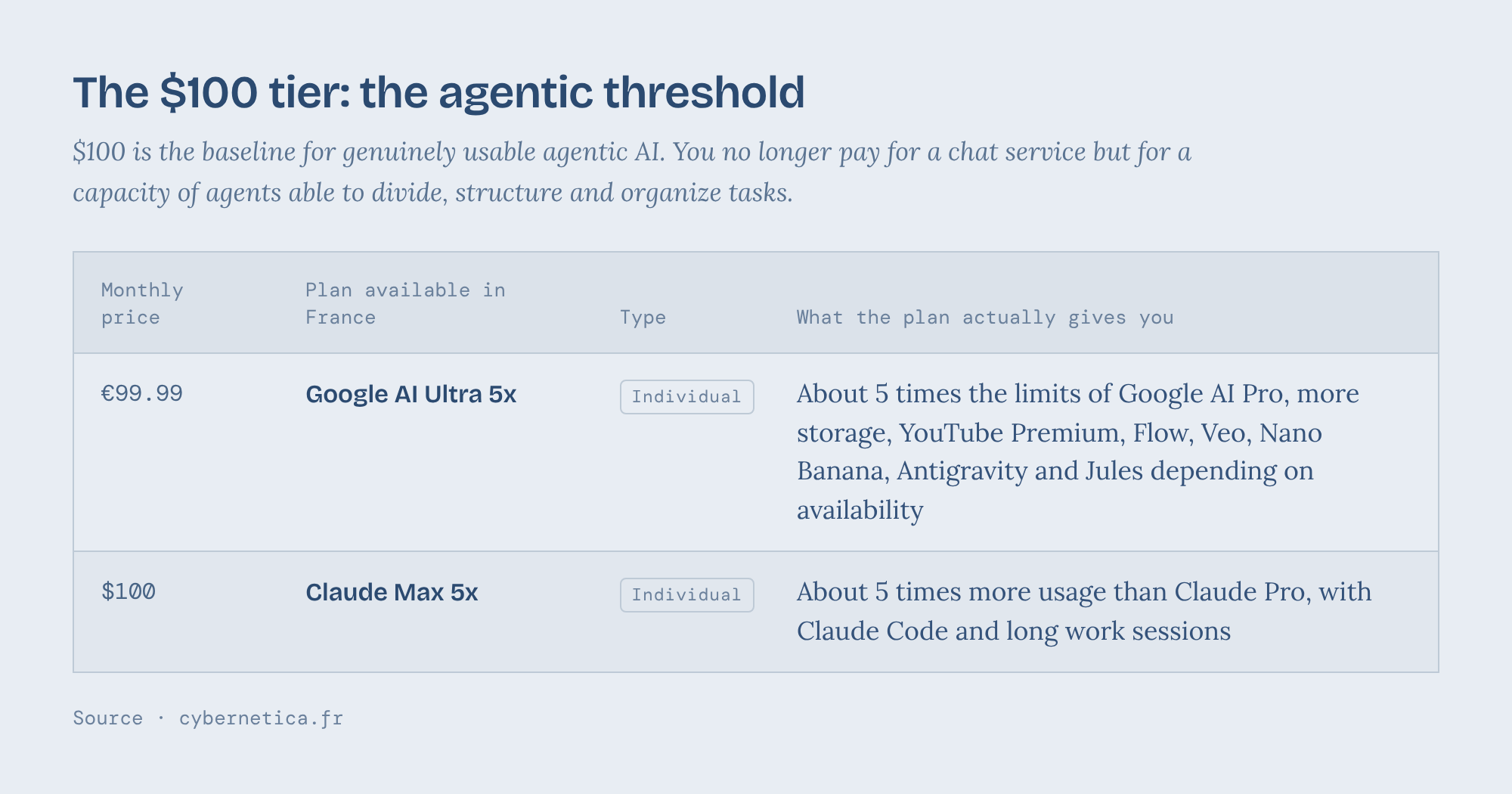
The new threshold, the $100 one, is now the baseline for genuinely usable agentic AI.
- It is a psychological threshold for intensive use. Claude Max 5x is $100 a month.
- Google AI Ultra 5x is €99.99 a month in France. You pay more not for a chat service but for a capacity of agents able to distribute, structure and organize tasks.
Access to agentic AI is, for me, the first tier of the cognitive divide.
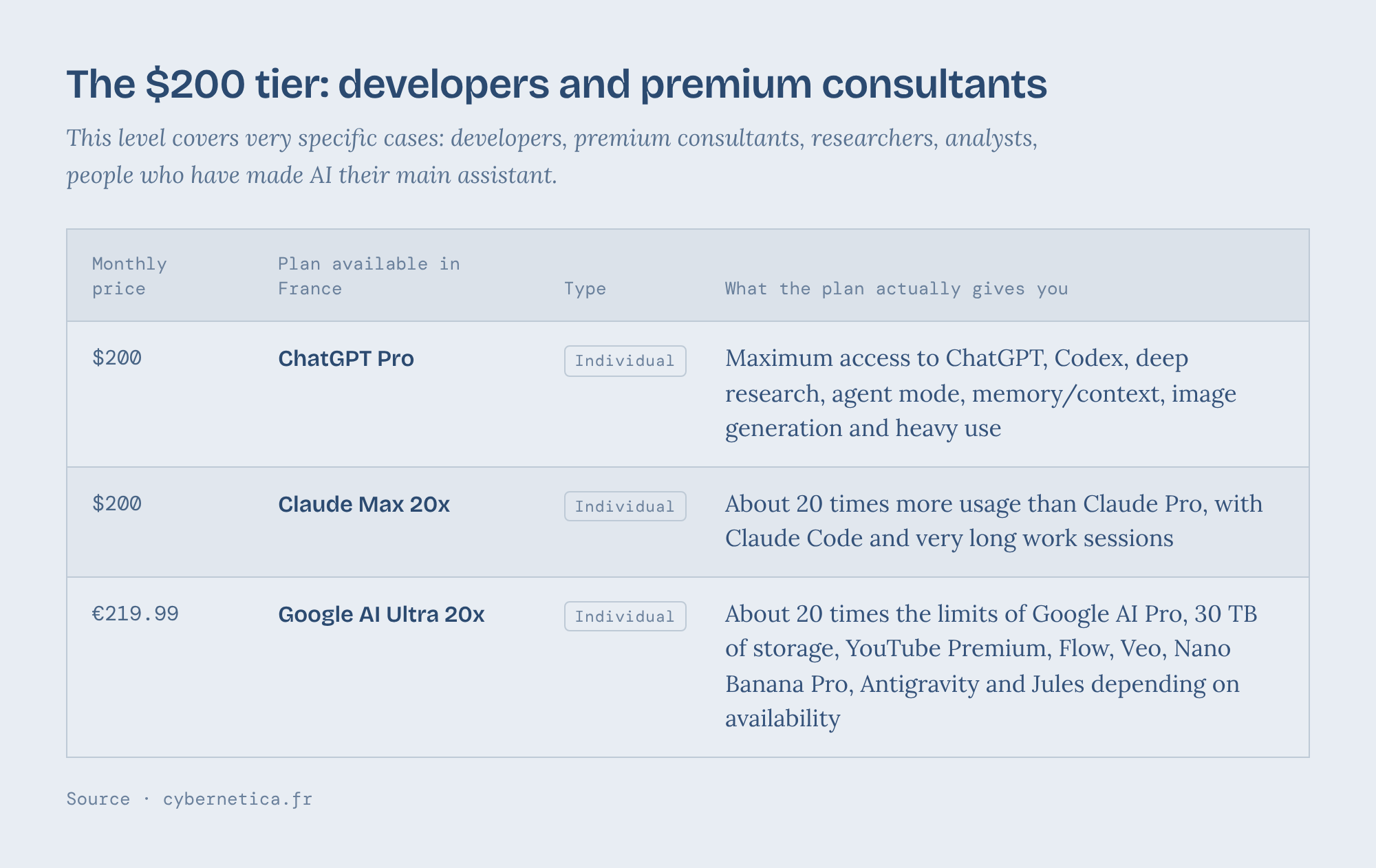
For code and for ultra-intensive use, there is the $200 tier, or about €220 a month.
- ChatGPT Pro is $200 a month. Claude Max 20x is $200 a month. Google AI Ultra 20x is €219.99 a month in France.
- This level really corresponds to very specific cases: developers, premium consultants, researchers, analysts, people who have made AI their main assistant and their PA.
- Google, which is the least confident and the least used for development, is trying a bundling logic.
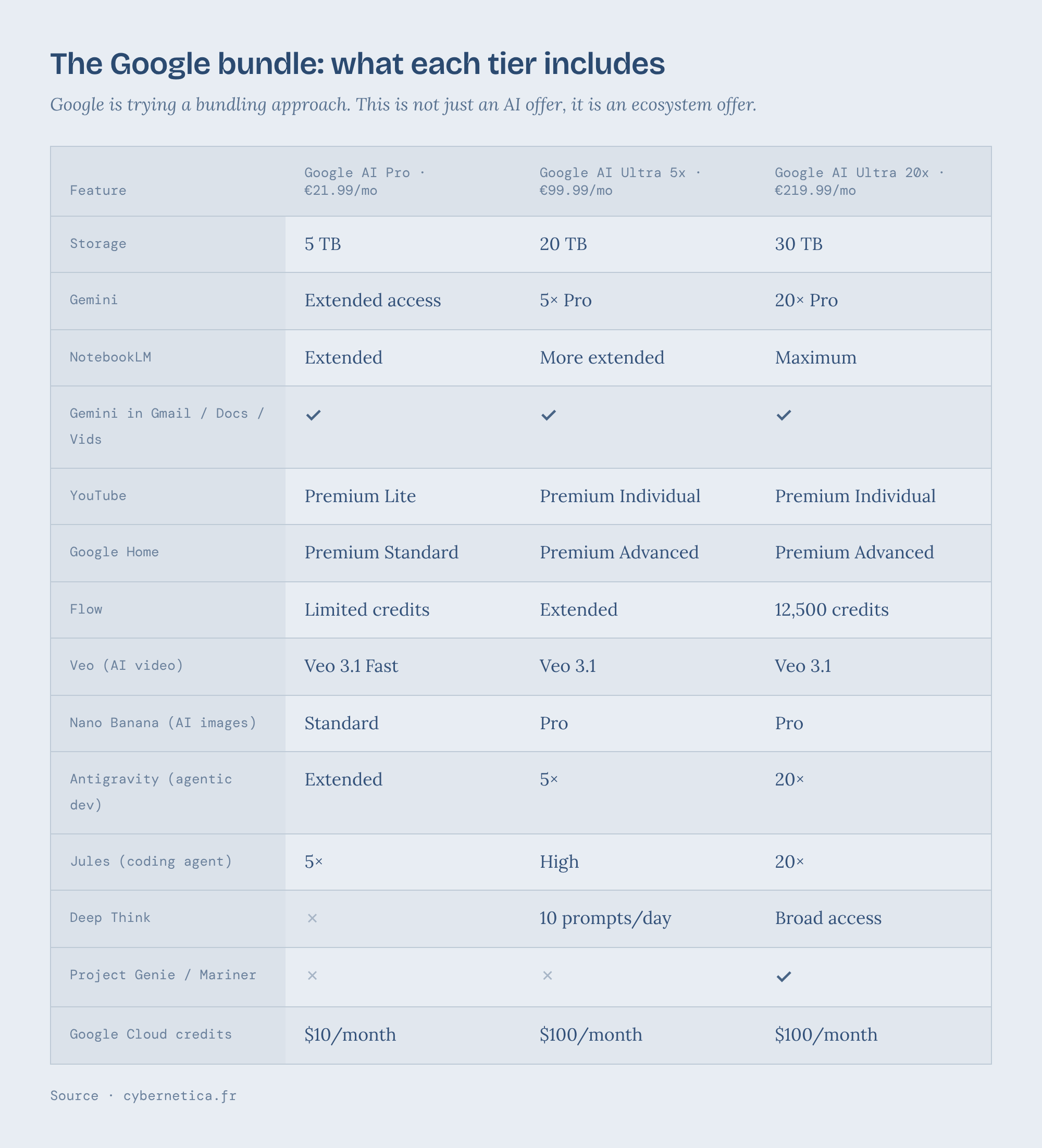
- Google's product lab ships a lot of things and sometimes manages to create mini-hypes: Veo, Nano Banana, NotebookLM, and several very interesting products. The strategy is original, but it runs into Google's historical problem: too many brands, too many products, too much internal logic.
- That is probably one of the reasons Google did not impose Gemini from the start as a single, obvious brand. That hesitation cost it time. Where ChatGPT and Claude have become reflexes, Google keeps scattering its uses across several names, several interfaces and several promises.
- The problem is even more visible with the Pro and Ultra plans. You cannot justify a high-end subscription solely with products that are too specific, especially when Chinese services are becoming very competitive on video, and when tools like Nano Banana stay locked inside Gemini instead of becoming products people think of spontaneously.
- By creating products within products, Google makes the experience less legible. Users end up preferring aggregators like Perplexity, which give access to several models without asking them to understand the internal architecture of a large group.
- Google's hubris, which wanted to sell a super-AI plan pricier than everyone else's, ran into market reality. Google had launched Google AI Ultra on May 20, 2025, at $249.99 a month in the United States. On May 19, 2026, the offer was restructured: a new Ultra tier at $100 a month, and a top tier brought down from $250 to $200 a month.
In other words: Google came back to everyone else's price.
- In France, that now means €99.99 a month for Google AI Ultra 5x and €219.99 a month for Google AI Ultra 20x. This harmonization makes the tiers more legible: free, €20, €100, €200. Everyone then chooses the level of cognitive capacity they can or want to pay for.
- But this logic also says something else. The world is now dividing between those who take the AI's first answer, and those who have €100 or €200 worth of tokens a month to iterate, correct, compare, test and push their ideas to a satisfactory level.
But how far will we be allowed to think?
That is the next cognitive divide.
It is still hard to know whether Claude Max subscribers will automatically get access to Mythos. On OpenAI's side, the next non-public super-frontier model is GPT-5.6, expected in June 2026. OpenAI also has its own restricted-access program, Trusted Access for Cyber, with GPT-5.5-Cyber, a model dedicated to cybersecurity, the functional equivalent of Project Glasswing.
On super-frontier models, Google seems to have fallen behind. Its state-of-the-art model is still not available: Gemini 3.5 Pro promises a lot, but still has not shipped.
I have always tended to think that hype is proportional to the price you want to charge. Beyond the exact reality of Claude Mythos Preview, the real subject may be this: preparing users to accept a new price range.
What those who have tested Mythos report is interesting: some capabilities, notably in cybersecurity, appear to be blocked unless Anthropic grants specific authorization.
If this logic is confirmed, the next divide will no longer be only about access to the most powerful models, but about access to specialized agents. We will no longer be talking about subscriptions at $20, $100 or $200 a month, but potentially about products at $2,000, $10,000 or $20,000 a month.
If the reports about OpenAI's future agents are confirmed, we will no longer be dealing with mere general-purpose assistants. We will be entering a market of verticalized tools for software development, research, finance, cybersecurity or biology.
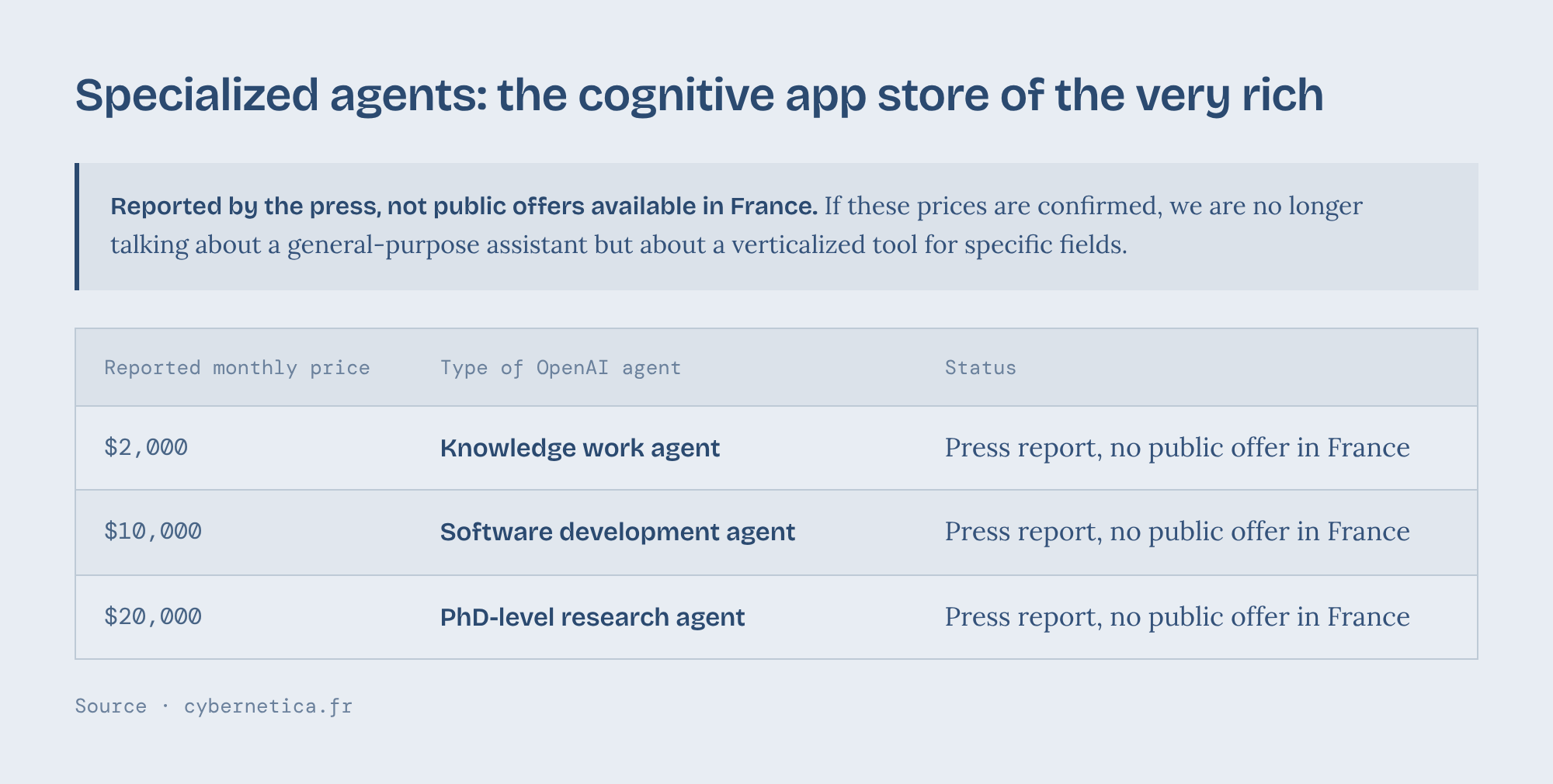
To access cyber functions or bio capabilities, paying will not necessarily be enough. You may also need specific authorizations.
This week, I was with one of the world's leading specialists in biological viruses. He told me that many of his conversations with Claude were understood upstream, then blocked as soon as they entered certain sensitive topics.
This means that even users able to pay for the most advanced models might not have access to all their capabilities. The next frontier will therefore not only be a price frontier. It will also be an authorization frontier.
And to think that in 2026, many of us believed a €100 subscription was enough to work properly with AI. We are now talking about models or agents that could cost €20,000 a month.
This completely changes the political reading of AI. Especially for American citizens, who are being asked to accept the massive rollout of data centers, rising electricity prices, pressure on water and on local infrastructure, while access to super-frontier models and to superintelligence remains reserved for a handful of players able to pay.
Is Choose France financing America's super-frontier AI?

But you will see, the story is even crazier than that.
To read the rest, you can subscribe to the paid newsletter.
Subscribers get access to three things:
- The whole newsletter, with the in-depth analyses and the advice reserved for members.
- All the bonuses, with articles published exclusively for subscribers.
- All my monitoring, through access to the /club.
If this newsletter helps you understand what is coming, make better decisions or steer your work better, the best way to support it is to subscribe.
Read the full article
Sign up now to read the full article and get access to all articles for paying subscribers only.


