

The first question you are surely asking yourself is: who on earth is Leopold Aschenbrenner? This former researcher, fired from OpenAI for sharing internal documents, who has just quietly married Avital Balwit, chief of staff to Anthropic CEO Dario Amodei, in Carmel, California, is at the center of a financial storm.
In June 2024 he published Situational Awareness: The Decade Ahead, a 165-page, extremely bullish document on AI. He put his vision to work through a hedge fund that gathered the cream of Wall Street and Silicon Valley: Patrick and John Collison, the founders of Stripe, Nat Friedman, the former head of GitHub, the investor Daniel Gross, Ilya Sutskever's partner, and even Jane Street, the most discreet of New York trading firms (where Sam Bankman-Fried took his first steps).
The fund's objective: to defend an openly pro-AI thesis and define strategic choices that are now colliding with the reality of the world.
In the abstract, it holds up, provided the road to superintelligence is smooth sailing. Unfortunately, between the wars, inflation, the war in Iran and government interference in AI models, nothing is anywhere near as peaceful or as simple as we imagined.
And the crash, the loss of 67% of his fund in a single month, reminds us of that. Did he see the bubble before everyone else? Did he see something else? That is what we are going to talk about this week.
The making of a prophet

Leopold Aschenbrenner grew up in Germany, graduated top of his class from Columbia at 19 (class of 2021), passed through the FTX Future Fund, Sam Bankman-Fried's foundation, a few months before the collapse of the crypto empire, then joined OpenAI's “superalignment” team, the one meant to guarantee that a future superintelligence stays under human control.
In April 2024 he was fired: officially for leaking an internal document, by his own account for having raised the alarm about the company's security flaws.
His answer came two months later: 165 pages dedicated to Ilya Sutskever, in which he argues that AGI (an AI able to match humans on most tasks) is plausible as early as 2027, and superintelligence before the end of the decade. Silicon Valley made it required reading. The press nicknamed him the Nostradamus of AI.
At the end of 2024 he turned that prophecy into money: a fund bearing the name of his manifesto, a few hundred million dollars, an investment team of four. Like any hedge fund, it runs on borrowed money: Bank of America, Goldman Sachs and JPMorgan lend it roughly four times its capital. Performance does the rest: up 47% net in the first half of 2025, then up 439% net in the first half of 2026 according to an investor letter revealed by the Financial Times, and, at the peak in early July, $45 billion in assets.
Those figures, which made his legend, measure less of a stock-picking talent than people think: they add up real performance, a constant inflow of new capital and a massive use of derivatives. Nobody takes the time to analyze them in detail.
The portfolio
The portfolio tells the thesis better than any speech.
His conviction: in a gold rush, you make a living selling shovels. AI will not run up against ideas but against matter: electricity, chips, memory, buildings. So he buys the suppliers of that matter. SanDisk, for storage. Bloom Energy, for the fuel cells that power data centers. CoreWeave and Nebius, the neoclouds that rent computing power to AI companies. And the former bitcoin data centers converted into GPU farms: IREN, Core Scientific, Applied Digital.
On the other side, he shorts the software of the old world, Adobe first and foremost: if AI generates the images, why keep paying for a Photoshop subscription. He also bets against the chipmakers, Nvidia first. And, off the exchanges, he holds the two assets no market prices day to day: a stake in Anthropic and 20% of SharonAI, a data center operator.
On paper, it is perfectly coherent. In reality, it is the same bet repeated six times. Memory, compute, storage, data centers, energy: everything rises together as long as money flows toward AI, and everything falls together the day it hesitates.
Here is what his latest official filings reveal.
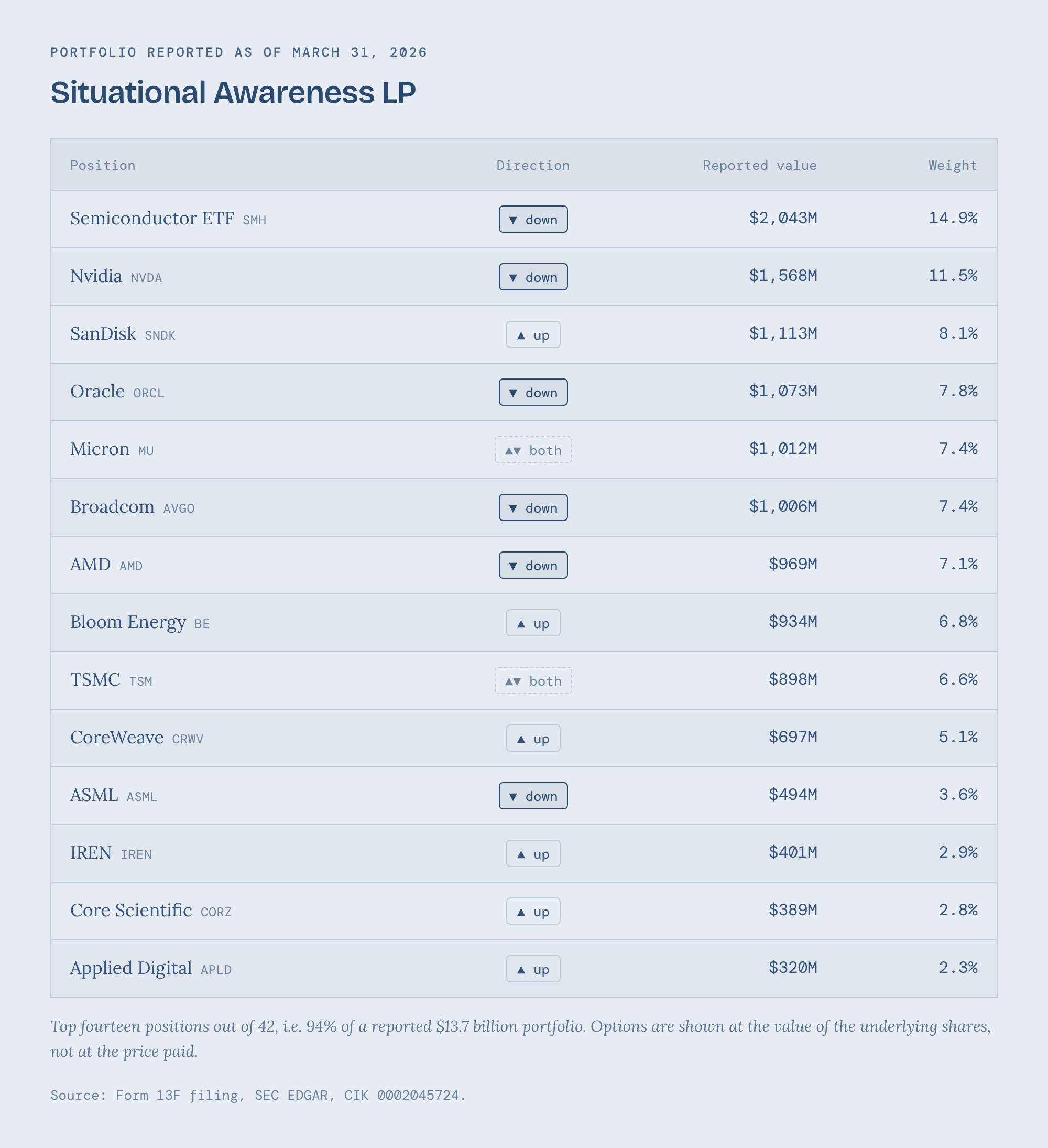
Three caveats for reading them.
- These filings, the famous 13Fs, date from March 31 and show only long positions and listed options: no short sales, no debt, no private holdings.
- For options, they also show the value of the underlying shares rather than the price actually paid, which mechanically inflates the amounts. That is how his $8.46 billion in bearish bets, including 1.57 on Nvidia, sent social media into a panic in May while saying little about the real portfolio.
- Finally, they cover $13.7 billion when the fund weighed 45: that is a third of the ship, not the full map. The top ten positions nonetheless represented nearly 73% of the declared portfolio.
One last thing, and not the least: this snapshot dates from March 31. In July, the financial press described him as long memory and short software. In between, he flipped his position on chips: from seller, he had become a buyer. Just before they collapsed.
His other mistake was choosing small vehicles. Nebius, SanDisk, CoreWeave are not Apple; they are mid-cap stocks, where a few hundred million dollars are enough to move the price. With the size of his fund concentrated on that handful of names, he was no longer a player in that market, he had become the market.
Add a San Francisco mansion a few streets from Sam Altman's, a marriage to Dario Amodei's chief of staff, early backers who have since moved to Meta to lead its superintelligence effort. AI looks more and more like a tiny world where money, models and alliances circulate in a closed loop.
The week of maximum danger
In July, doubt sets in about those hundreds of billions sunk into infrastructure with no visible returns. The most troubling part: the S&P 500, the index of large American stocks, stays close to its records throughout the turmoil.
The crash is not general, it is surgical. Memory stocks lose 30%, semiconductors post their worst month since 2002, the fund's top five positions fall by 27 to 54%.
The mechanics then turn cruel. His positions are public, since American law requires large funds to disclose their holdings every quarter. Rival traders therefore reconstruct his portfolio and short it, betting that he will be forced to liquidate. Morgan Stanley's “momentum” index, which tracks the strategy of buying what is already rising, collapses 17.4% in four sessions, worse than the aftermath of the dot-com bubble.
The lending banks trigger the margin calls: additional collateral, in cash, immediately. To find that cash, you have to sell.
Selling pushes prices down. Falling prices trigger new calls.
Six days earlier, his July 24 letter had presented the correction as a buying opportunity, cited a future Anthropic IPO as a catalyst, and ended with a postscript inviting investors to put more into the pot.
This agony reached its provisional end on July 30: Citadel, Ken Griffin's fund, bought up most of the listed portfolio in a single block, at a knockdown price. Assets went from 45 to roughly 10 billion.
Down 67% in the month of July alone. In the letter to investors, Leopold opens with a single sentence: “We let you down this month.”
The financial press was quick to deliver its verdict: he may have been right about the growth of AI, its energy needs and its physical bottlenecks, but he underestimated an old and banal mechanism: leverage, liquidity, forced selling. The veterans, for their part, invoke the genealogy of funds that died of being right too hard: LTCM in 1998, Amaranth in 2006, Archegos in 2021. You can be right over five years and go bankrupt in five days.
Is his fund finished?
Honestly, it is impossible to say. The fund still shows roughly 80% gains for the year, it has kept Anthropic and SharonAI, and several of its former positions bounced back the day after the sale, which feeds the minority reading: a liquidity crisis, not an invalidation of the assets.
The man who bought while the cannons were firing, Ken Griffin, already held the same thesis. But confidence has been dented, and it is not rebuilt in a quarter. The coming months will need watching; from now on, Silicon Valley and Wall Street are no longer necessarily financially aligned.
Now, for our paying subscribers, we are going to look at what can be understood from what happened, and to what extent it gives us indications about the market in the coming months. This analysis is essential, in my view, to separate the fantasy of the bubble from the reality of its possible trigger.
Subscribe to this newsletter.
A subscriber convinced me last week to spend more time writing for my paying subscribers. She had just made the decision to buy computers and a disk server ahead of a major price increase, because she had read one of my articles on techflation.
The head of a large SME, convinced by one of our newsletters, is experimenting with local AI solutions on his Mac Mini. He got so far ahead of his sector that he has become the go-to person on the subject.
A consultant who decided to pitch an offering on transatlantic decoupling won her contract.
All of them told me they have more than recouped the cost of this newsletter.
As for the professionals who read me, I understood that they were not paying for information, but for one piece of information, one anecdote, one intuition that allowed them to make the difference. And that is what makes me happy to share my thinking with you.
As a paying subscriber you also get access to all my monitoring and all the bonuses I publish when I have the time.
The rest, for paying subscribers:
What to take from it
The bottleneck strategy
Read the full article
Sign up now to read the full article and get access to all articles for paying subscribers only.


