

It's been a little while since we last talked about digital sovereignty. This week, several news items deserve a closer look.
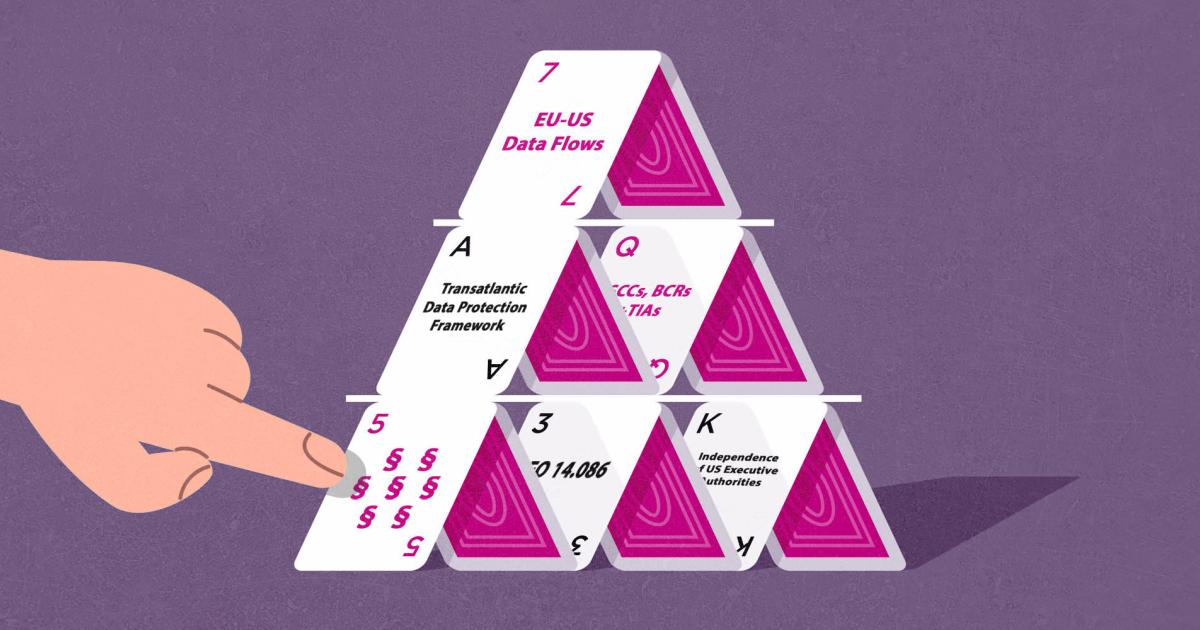
The first: the adequacy decision between the United States and Europe, the one that guarantees the legality of hosting European data with Big Tech, has been destabilized by Trump's actions. On June 29, the Supreme Court ruled in Trump v. Slaughter that the FTC, the American regulator, was no longer independent of the executive branch.
Yet the adequacy decision relies on that independence 259 times. Max Schrems and noyb are already asking the European Commission to withdraw it, and are preparing a challenge that some are already calling Schrems III.
In concrete terms, hosting your data on American platforms could once again become, at best, a legal vacuum, as it already was after Safe Harbor and then Privacy Shield were struck down, and at worst a legal risk.

The second: Europe's decision to take a different direction from France's, notably on SecNumCloud (the cloud security certification issued by ANSSI, France's national cybersecurity agency), undermines the entire French strategy.
The revision of the Cybersecurity Act presented in January drops the sovereignty criteria from European cloud certification, the ones that protected against American extraterritoriality, and June's sovereignty package threw out the European preference that France had been defending.
A Franco-French strategy that suffers from two things:
- the absence of a clear French geopolitical doctrine on transatlantic decoupling
- the feeling that implementing it costs too much and brings nothing in business terms.
And while we lecture the rest of Europe on sovereignty, NIS 2 still hasn't been transposed. Twenty months late, a bill bogged down in Parliament, a weakened minister, and on July 8 the Commission referred France to the Court of Justice of the European Union, alongside Ireland, Spain and the Netherlands, asking for a lump sum and daily penalty payments.
The third, which we'll come back to in more detail in a future newsletter, is that there isn't a single presidential candidate who doesn't talk about sovereignty, who doesn't talk about a CTO for the State (one of my recurring proposals since 2011), and who doesn't roll out a grand plan of their own for artificial intelligence.
The question we might ask ourselves at some point is how sincere these political players are. But for now, it has to be said that sovereignty has become a mandatory keyword and a rite of passage for the presidential race.
A piece of information we had given you has been confirmed: Stéphanie Schaer, the head of DINUM (the government's interministerial digital directorate), has officially been replaced by a new director from the military world. Is this the end of the state startups (startups d'État) and a return to a more classic management of the State's digital affairs? We'll see. What is certain is that the government, a year out from the presidential election, wants no more security scandals and no more standoffs with the software industry.
But the really big news this week was, of course, the debate between the new Under Secretary of State Jacob Helberg and former Austrian chancellor Sebastian Kurz, now partnered with the former head of NSO to build Dream, a company that presents itself as a sovereign AI solution.
On June 23, Jacob Helberg published “The Digital Sovereignty Trap” on his X account, a text that made a lot of noise.
His thesis: countries that rebuild their own technology stack won't get sovereignty but “synchronized mediocrity,” a planet of undersized clones busy rebuilding last year's breakthrough while work on the frontier, especially in AI, carries on without them.

I was there and, while we wait for the session to be broadcast, I'm offering our paying members a transcript with my commentary. This session was an opportunity to better understand what the Trump administration expects from France and Europe.
I'll admit I was rather pleasantly surprised by the Under Secretary, who has real technical expertise and knows his subject. I don't necessarily always agree with him, but some of his arguments are no different from the ones I was making twenty or so years ago, especially on innovation.
Which makes sense, since he, like the former chancellor for that matter, is close to Peter Thiel. You can criticize Thiel on plenty of things, but one thing he has always been excellent at is creating startups. His book Zero to One remains a real goldmine for anyone who wants to start a company. His strategy, though, which I call “one to monopoly,” is more debatable.
A word before we continue. Take advantage of the summer to become a paying member.
Our paying members have one thing in common: in their organization, they're the ones people turn to when sovereignty, cyber or AI needs to be understood.
Some already held that role and have kept consolidating it. Others have risen to it, newsletter after newsletter. Many discovered it in the middle of a conversation, the day they realized they were a step ahead of everyone else.
That expertise isn't acquired by reading a document. It's built over time, by following the issues week after week and understanding what the news changes, concretely, for your line of work.
One member recently told me that none of the consulting firms around her had brought her anything satisfying on sovereignty. A top French tech executive, for his part, subscribed to escape his own company's talking points and keep a nuanced view of where things stand.
This newsletter lets us think together. That demand forces me to be clear and to master what I write. It also brings together a community that thinks about tech for itself, against the grain of an era where influencers stand in for thinkers and marketing passes itself off as reality.
Our members are, in effect, the new Chief Resiliency Officers, the ones who will be able to navigate the digital age of uncertainty.
In your organization too, someone will have to hold that role. It's probably already you.
Receive the full newsletter every week, get access to all the monitoring on our private channel, and to all the content and bonuses reserved for members. We are also preparing, by the end of the year, a get-together with all our members.
⠀
⠀
“Thousands of engineers diverted to rebuilding yesterday's technology”: Kurz and Helberg on European sovereignty
⠀
Three weeks after Washington's decision to restrict non-Americans' access to the most powerful AI models, U.S. Under Secretary of State for Economic Affairs Jacob Helberg and former Austrian chancellor Sebastian Kurz met on stage to debate what sovereignty still means for democracies. We reproduce and annotate their entire exchange.
Read the full article
Sign up now to read the full article and get access to all articles for paying subscribers only.


