

Last week, I invited Meredith Whittaker, the president of Signal, to come to Nuits Sonores (in Lyon), where one of the legends of Detroit techno, Robert Hood, co-founder of the Underground Resistance collective and considered by many to be the inventor of minimal techno (the style that made the Berlin clubs' glory days), was performing. A big thank you to the Nuits Sonores team, Vincent, Juliette and Anne-Caroline, for their welcome and their VIP tour of this incredible event.

We took advantage of this year's European Lab (the conference side of Nuits Sonores) to set up a small conversation, which turned into something a bit bigger since, while I was still on the train to Lyon, the team from Quotidien (a French TV show) told me they were coming to film it. Scheduled to air on Tuesday, June 3.
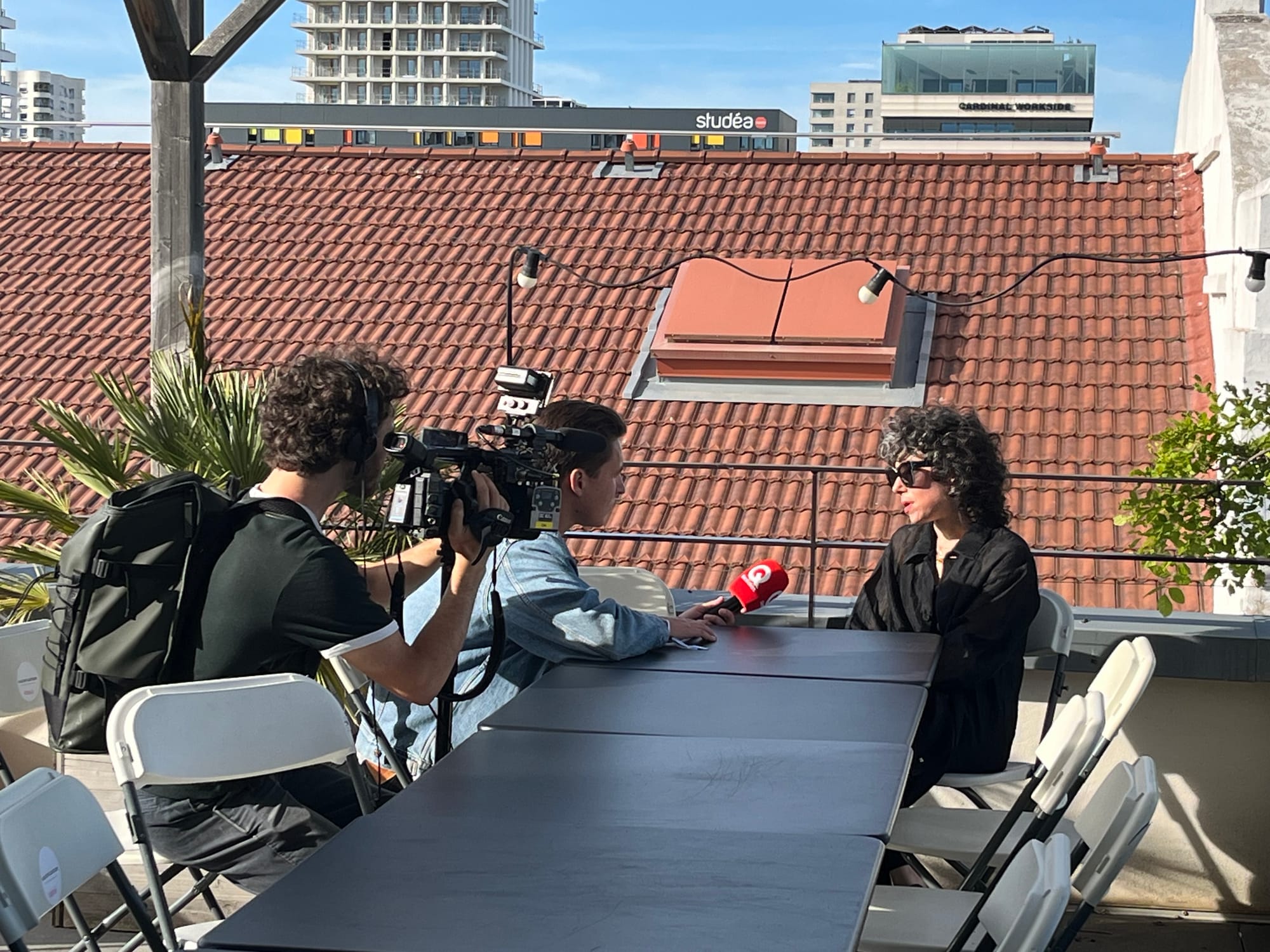
This little Lyon getaway was a time of intense conversations about the future of digital technology and, of course, geopolitics. I had promised a few days away from Signalgate and the other turbulence of the geopolitical news cycle.
The idea was to go back to the roots of Meredith's three major experiences: at Google, at AI Now, and now at Signal.
Meredith retraced her path and her analysis of Big Tech, AI and the question of privacy: from joining Google after studying the humanities, to taking the helm of one of the rare apps that still defend privacy.
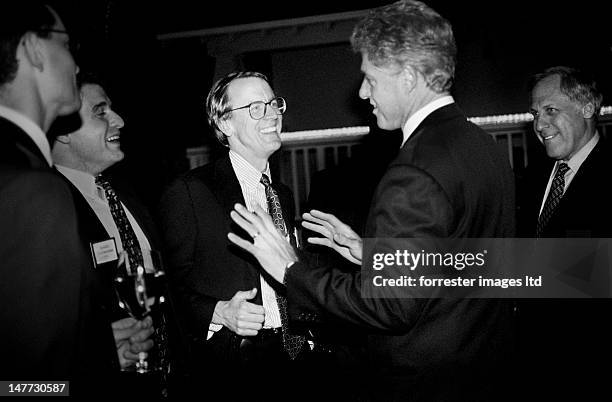
She explains how Cold War military investment shaped computer networks designed to ensure American supremacy, and then how, in the 1990s, the Clinton administration legitimized a commercial Internet built on advertising, with no rules governing private surveillance.
When she arrived at Google in 2006, she discovered a hierarchy in which the ability to "think in the abstract," to reduce the human to "bits," determined status and pay. Engineers who could optimize distributed systems were considered essential, while any administrative or support work was held in low regard.
She quickly saw that Google's growth rested on an advertising model, encouraged by the fact that, since the 1990s, no federal legal framework has prevented private companies from collecting more information than the state itself. The Clinton administration, facing a recession, made a "New Deal without socialism" its economic priority: promote the commercial Internet, accept advertising as the sole funding model, and set no limits on surveillance. As a result, companies threw themselves into the race for data:
"Surveillance is incentivized, because what you're selling is access to superior knowledge of a market, which you offer to advertisers."
Meredith is emphatic: AI did not appear by accident. The colossal resources (data, computing power) generated by the advertising model made it possible to revive deep learning approaches from the 1980s.
"The old models, if there is enough data and computing power, can do useful things for that advertising model."
So AI, in her view, is a byproduct of the "surveillance business model" and of the massive accumulation of data from targeted advertising.
She also retraces the military genesis: in 1948, Rosenblatt invented perceptrons, the first artificial neural networks, well before the term artificial intelligence was coined in 1958.
In the 1970s and '80s, the Pentagon funded computing research for nuclear deterrence and image recognition. In the 1990s, the "advertising model" took over that infrastructure, allowing data to spread into civilian uses. Meredith rejects the idea that today's technological evolution is an inevitable trajectory:
"Narratives of inevitability are a luxury for the elite. Nothing is inevitable."
She adds that the Clinton-era tech notion of a "New Deal without socialism" was seen as the answer to deindustrialization and to the recession in the American economy. In a way, you could almost say that databases became the new industry, and that the Internet was the industrial renewal (something Europe never quite managed to imitate).
Meredith points out that at Google, you could strike very lofty moral poses (Don't be evil) as long as the company was hugely profitable every quarter. But at some point the choices got thornier, and the Don't Be Evil injunction was turned against those asking the hard questions:
"Why weren't we stopping the military contracts?"
She describes how, around 2017, she learned of a contract with the Pentagon (Project Maven) to develop computer vision systems for drones. The engineers writing the code, she believes,
"didn't know their work was going to serve an unethical military use."
Faced with management's silence, she and a few colleagues launched an internal organizing movement, aware that, historically, only some form of labor movement has ever managed to contain the unlimited power of capital. They wrote a manifesto, used anonymous channels, handed out paper flyers (to get around internal digital censorship) and held clandestine meetings.
This mobilization culminated, in November 2018, in a global walkout: 20,000 employees symbolically left their desks to demand an end to military AI projects, the publication of all government contracts, and the elimination of the NDAs that forbade talking about ethics.

The walkout forced Google to take a few steps: a partial moratorium on Maven (transferred to an outside subsidiary), the creation of an ethics committee for any sensitive AI project, the annual publication of a report on government contracts, and a review of bonuses so as to stop penalizing those who raise their hand on ethical questions.
Meredith acknowledges that these changes remain partial: technical leadership keeps its decision-making power. But employees stopped idolizing the company:
at that moment, they understood that no web giant was morally untouchable anymore.
On the economic and social front, she argues that AI doesn't decide to "take our jobs": it's a question of politics and power relations. Ever since Babbage and the debate on the division of labor, it has never been about the technology itself, but about
"who decides how technological resources, and the value they produce, are shared."
I gave the example of how the "Uberized" economy evolved: first presented as a revolution, Uber quickly showed that the technology serves above all to maximize margins, not to improve drivers' incomes.
The algorithm, she says,
"observes, motivates, extrapolates, bites into every worker to extract maximum profit."
Drivers aren't even considered employees but, once again, abstract entities. That's more or less how AI sees us, too.
Meredith denounces the "theology" of AI: everything is excused in the name of the supposed superiority of algorithms, forgetting that most of them rest on data produced by poorly paid workers who label images or text. Those labels become the models' ground truth, then sold as intelligence to feed the advertising or military machine.
Yet she rejects the idea that there is no other way: she joined Signal to build a service that asserts a different purpose:
"At Signal, every time a library doesn't offer the privacy guarantees we need, we rewrite it and open source it."
Signal develops end-to-end encryption, minimizes stored metadata, and funds its operations through donations rather than advertising. The goal is to show that a mass-market technology can exist without exploiting every bit of its users' exchanges.
I forgot to ask her, but I think Signal has done what Mozilla failed to do: free itself from Big Tech dependencies to offer an alternative. But Mozilla does more politics than code. And on top of that, they just shut down Pocket!
She notes, however, that Signal cannot do entirely without the public cloud (AWS, Google Cloud): whenever those infrastructures don't meet its requirements, the team redeploys its own modules. This highlights the limits of an antagonistic project: up against Big Tech companies with tens of thousands of engineers and servers, a small collective has to keep rewriting software components to guarantee confidentiality.
On privacy, Meredith wants to go beyond the technical debates (pseudonymization, data location, retention periods): she calls for a fight against
the "epistemic authority" of platforms that claim to know more about us than we do ourselves, that write our stories, that draw the maps on which our lives are built.
She sums it up:
"I don't want to own my Facebook data; I want to challenge Facebook's right to generate data about me."
Privacy isn't just about limiting the circulation of data flows, but about contesting the idea that
"large corporations get to decide what is true for us, what is accessible, what should be shown or whether nothing should be shown."
In her view, the fight for privacy has to be grounded in the question:
"What are the precious things that need protecting? Why do we need privacy? What disappears when we hand everything over to Facebook, Apple, Google?"
She welcomes a latent movement: people instinctively feel that Twitter, YouTube or their online bank are often buggy and badly designed. Against hype disconnected from reality, there is a latent desire for different technologies. The problem, she says, is that people have been taught to feel ashamed if they don't understand the technology, when we should be trusting that feeling of discomfort.
Speaking to users, she recommends asking the "dumb questions":
- How was the training data produced?
(Is it an old IoT device sending a stream structured by an ill-suited schema? Were the labels applied by precarious workers paid a few cents per image?) - Why does the algorithm classify you this way?
(Why is the same ride-hailing trip more expensive for you than for someone else?)
She insists: we have to break the intellectual shame around technology; the fact that interfaces are badly designed, that menus are buggy, should be proof that the talk of "AI that works almost like a human brain" is empty. That "almost," repeated since Rosenblatt in 1948, guarantees the broken present we live in.
Conclusion
In conclusion, Meredith calls for action on several fronts:
- Challenge the "theology of AI" and reject the idea that technology is neutral;
- Reject the advertising model that feeds the building of AI systems;
- Support initiatives like Signal that demonstrate that privacy-respecting infrastructure can be built;
- Collectively take back the question of authority over our data and our digital representations, so that truth does not remain in the hands of a few private platforms.
In her eyes, none of this is utopian:
"We don't live in a world where every bit of our lives has to be sucked up by an AI; it is possible to design alternatives, to rebuild antagonistic infrastructure, and to restore a balance of power in favor of users."
Funny, it reminds me of what I was writing about the Slow Web as far back as 2010.
Like the rest of the room, I was won over by the strength of her vision and her ability to do what she believes is good for society. A rare person in the world of tech.
Section for paying subscribers
Read the full article
Sign up now to read the full article and get access to all articles for paying subscribers only.


