

Digital decoupling between the United States and Europe, techflation and steep price increases for digital services and products, American disengagement from the bodies that used to protect Europe. What do we do?
2026 has started at breakneck speed, and our leaders are finding it harder and harder to hide their panic. The tempo, it must be said, is relentless: just as Delta Force had carried out the lightning capture of Maduro in Venezuela, the American administration let it be known, through its most influential White House adviser, that it wanted to "take back" Greenland.
We are in the thick of it now: the United States is going after a NATO member, one of its most loyal allies and a member of the European Union.
The race against the clock has already begun, with two options on the table
- The question of transatlantic decoupling
Chosen (digital sovereignty) or imposed (a kill switch, meaning a cutoff of the network or of Internet services)
2.The question of renegotiating, to our disadvantage, the cost of American digital services
Which obviously means everything cloud, consumer services and, of course, cybersecurity. A scenario that would inevitably reignite the question of inflation in Europe.
A third option that few have noticed
Allow me to add another one that escaped many (but not Sébastien Garnault and Franck Rouxel). I will take the liberty of spelling it out, because I think it matters far more than what you may read about it elsewhere.
Among the many bodies the White House has announced it is leaving, three concern cyber:
🏛️ GFCE (Global Forum on Cyber Expertise)
- It served as a hub for capacity building, for universities, for aligning training programs, and for providing a framework for responding to cyber incidents. The point is to develop civil resilience efforts against hostile countries.
🏛️ Freedom Online Coalition
- The United States is walking out of one of the main forums against censorship of the Internet.
🏛️ European Centre of Excellence for Countering Hybrid Threats
- Yes, that could mean the Americans would no longer be there to help us, neither on cyber nor on hybrid attacks.
In terms of message, it means: we are no longer helping you train; a free Internet is no longer our priority, what interests us is the American Internet.
Finally, and this matters, it is also a message to NATO, where the hybrid threat is at the heart of the collaboration between the United States and Europe. I had the opportunity to moderate a panel on disinformation (which was not put online at the request of one of the panelists) with the person in charge of the fight against foreign interference.
One last remark, very interesting because it says it all
The United States is not withdrawing from the global standard-setting organizations. Essentially, it is withdrawing from the organizations that tied it to Europe.
To get the full picture, remember that the US has announced it is earmarking $1 billion for the privatization of digital attacks (a scoop from our friend Jamie) while telling Europe at the same time: we are no longer here to help you for free.
This mix of uncertainty, worry and intimidation sets the stage for a (tough) negotiation and the payment of a ransom. So we will have to be careful, agile and fast.
Our mobilization for 2026
This year we are mobilized to help you understand and navigate the uncertainty of 2026.
This newsletter and The Sovereign Way
Our paying subscribers will keep receiving our newsletters and have access to all our strategic monitoring, but we are also going to set up places and spaces for sharing best practices.
I am also announcing the upcoming launch of The Sovereign Way, the European extension of this newsletter. Our field of action (think tank, conferences, advising) now operates on a European scale.
Its goal: to support those who want it through what will probably be one of the most complicated years since the arrival of the Internet.
We have a few slots left for the first half of the year.
📊 5 shifts to watch in 2026
Our analytical framework
It is rare to live through several shifts at once, and yet that is where we are. The last time was with the arrival of the Internet, the fall of the Wall and the arrival of globalization through music, television and networks.
Understanding how these five shifts evolve is part of our daily work here.
Geopolitical shift (1)
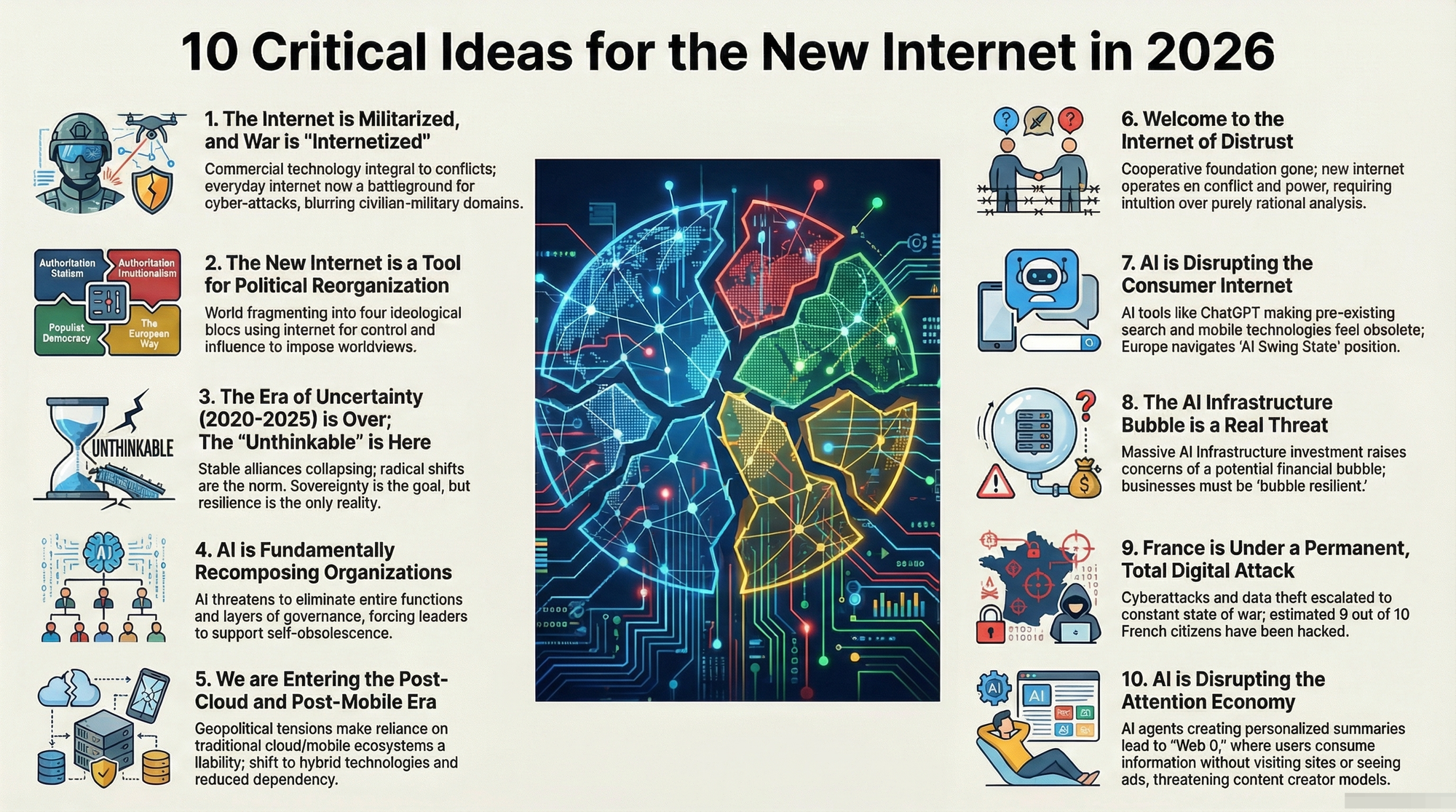
2026 marks the start of a redefinition of interdependencies, agreements and alliances. The surprises are far from over.
Last week, for example, we were talking about Canada joining SAFE, the new European defense procurement body that excludes the United States. A revolution in the military world.
Unprecedented, even unthinkable disagreements could make Europe even more vulnerable. For instance, when the American administration explains that it is considering partnerships on artificial intelligence with Russia, even collaboration on cyber, while withdrawing from the cyber institutions on which Europe depends.
Every major figure in the cyber and intelligence world I have met at my latest conferences is unanimous. They are very worried.
International diplomacy looks more and more like what Giuliano da Empoli describes in his latest book, L'Heure des prédateurs (The Hour of Predators).
Technological shift (2)
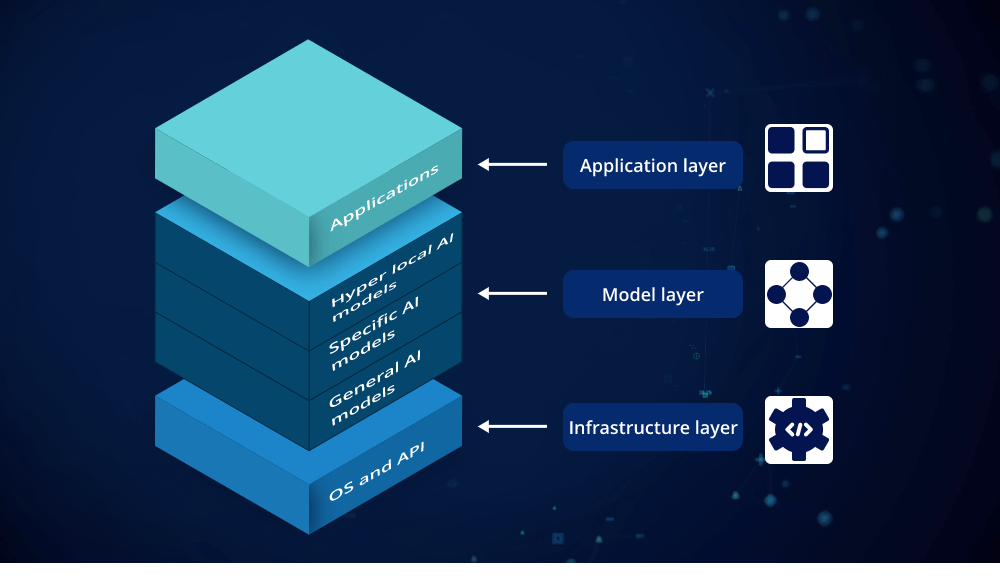
A new computing stack is being born before our eyes. AI is rethinking the infrastructure of companies and individuals alike.
Between the models, the platforms to deploy them, fine-tuning, data access, synthetic data creation, and the qualified databases needed to feed AIs reliably, a new race against the clock is on. Some startups want to be full-stack; others will specialize in a single area.
The model that cloud and mobile have lived on since 2007 is being redefined. For better and sometimes for worse. We will come back to it, because you now have to understand this transition to understand where tech is going.
Platform shift (3)

GPT, Claude, and Gemini with its 600 million users have drawn users away from classic services like search. This raises a real question: are Web 2.0 platforms still viable?
The head of Instagram himself admits, in a long confession, that at a time when reality is faked or artificial, the idea of a social network for sharing images and videos may no longer have a future. He also admits that 80% of users have taken refuge in DMs and stories, which are also the least profitable parts of the app.
At the same time, Sora 2, billed as the Instagram of AI video, is not exactly a success. This may be the year we find out whether the new services replace the old ones, or whether the modernized old services keep their lead.
Cultural shift (4)
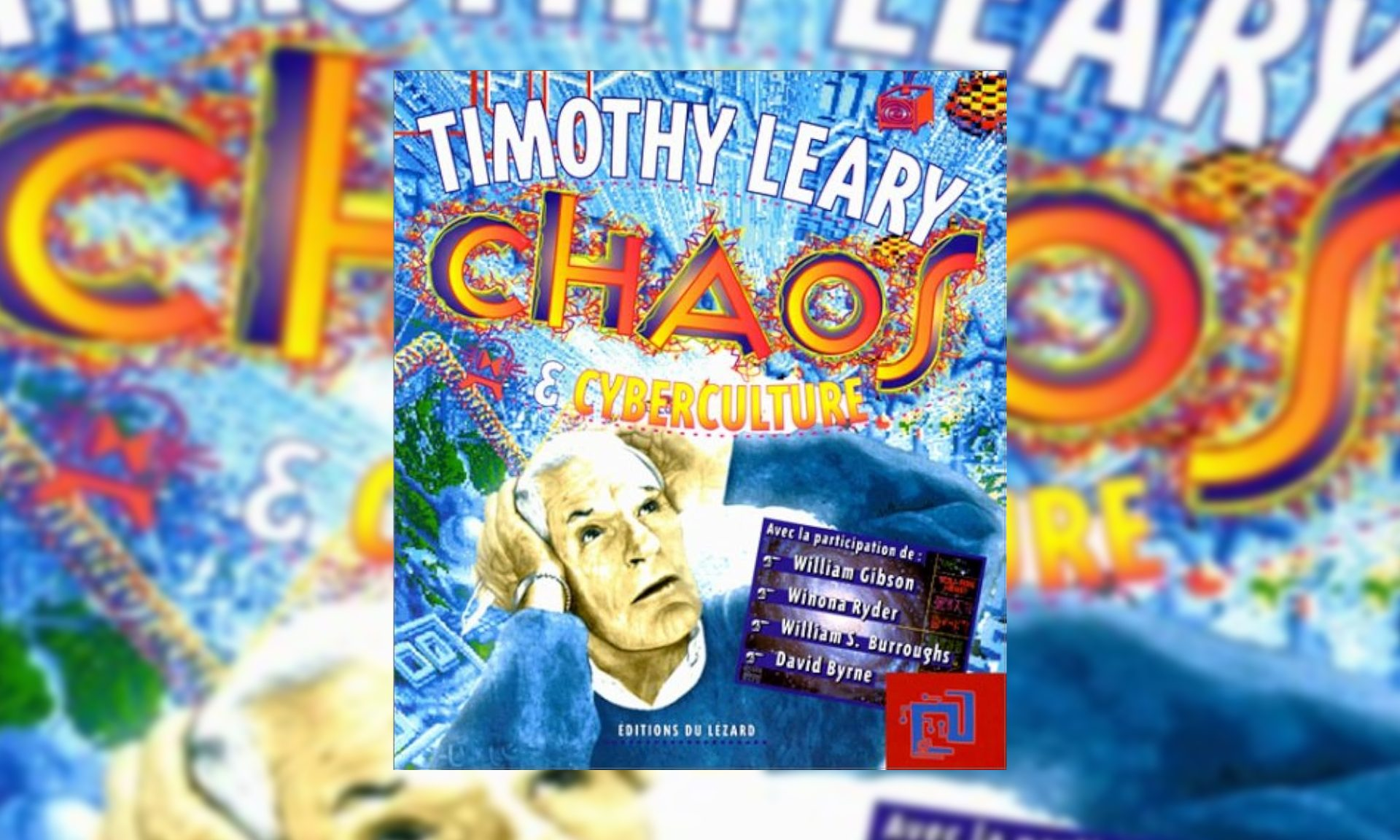
From the AI slop transforming popular culture, to premium AI-generated content, to the urge to go back to analog: we are at a cultural crossroads.
For someone like me, who lived through the cyberculture of the 1990s, I wonder whether the sudden arrival of AI and the visual standardization it brings will allow a real counterculture to emerge.
I would have hoped France would push for a technological counterculture, but so far it has done nothing but follow and worship Big Tech.
What will be interesting is to see whether the younger generation, in a world saturated with AI, will rebel.
One thing is certain: the less dependent they are on algorithms, the more power they will have.
Vibe shift (5)

This is what keeps Big Tech bosses up at night. Far more than AI. What if consumers lost interest in all of it? What if they decided Big Tech had become passé, or worse, that its integration into the new surveillance complex poses more danger than benefit.
The success of social networks and the big platforms rested on simplicity: a global experience, independent of the hardware. The convenience of owning nothing, of moving from one machine to another without friction.
The intrusion of geopolitics, the explosion of Terms of Service, the divergence of innovation trajectories have shattered this paper utopia.
The question every user is asking today
- Where is my data hosted?
- Do I need to be with Big Tech?
- Do I still need an X link?
- And above all, how do I move my data to new services?
For subscribers, here are two extra bonuses: one on Greenland, and the other asks the question: can the United States cut off the Internet?
Read the full article
Sign up now to read the full article and get access to all articles for paying subscribers only.


