

🏛️ From Web Summit to Berlin: a change of mood
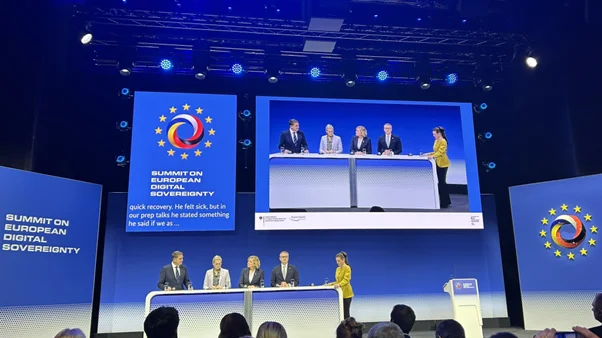
Culture shock after a few days at Web Summit: here we are in pure institutional territory, where everything is calibrated to the millimeter.
The day before, the organizers had invited me to a series of panels with entrepreneurs at the French embassy in Germany.
Our ambassador (and this is rare enough to be worth pointing out) sat through every panel, right up to the end of the cocktail reception that followed. Plenty of very interesting conversations, but Chatham House rules apply, so I won't go into them here.
🇩🇪 German-style organization
The next day, we were all invited to the EURIS Center. German-style organization: impeccable and smooth, vegan food, glass bottles of Apfelschorle and self-serve sparkling water.
The French and German leaders both presented this summit to us as a new chapter for Europe.
But beyond the words and the announcements, this meeting also subtly revealed a clash of visions.
Two visions, two methods
Germany is accelerating on these issues and hopes to become the undisputed leader in digital and defense before the end of the decade.
France, for its part, is standing its ground with an institutional vision steered by the Direction Générale des Entreprises (the Finance Ministry's enterprise directorate), which has been trying in vain since 2021 to codify digital sovereignty through a set of procedures, standards and certifications... with, alas, far less money on the table.
When it comes to industry, our two countries are truly different.
In Germany, SMEs and large corporations feed each other naturally, which lets smaller players like NextCloud or Hetzner hold their own alongside Telekom, the European telecom giant.
In France, it is the state that picks the champions, like Mistral, either by introducing standards that cap the number of players (SecNumCloud, the cloud security certification issued by ANSSI, France's national cybersecurity agency, being the model) or by playing matchmaker, building or blessing partnerships like the one already announced between Thales and Google.
As we explained in a previous newsletter, the operator state has no qualms about marrying a Big Tech company to a French player, since the bodies in charge of digital matters have no authority over geopolitical risk (FISA), which falls under the Presidency of the Republic.
✉️ Why subscribe?
Over the past few weeks, many of you have taken out a paid subscription: thank you! Two years and nearly 100 newsletters later, this newsletter remains true to its mission: offering a safe space to think, where one can add nuance, question, and even criticize the talking points that dominate French tech.
Here, we take the time to think against the tempo, far from the injunctions and the weathervane news cycle.
👉 If you work in tech or follow digital sovereignty issues closely, now is the right time to join the community of subscribers.
You'll get access to all the content, my full monitoring and press reviews like the one at the end of this issue, and long, contextualized analyses, with no unnecessary noise.
So, what to make of the summit?
This week I wanted to share with you an op-ed I also published on LinkedIn in English.
 Tariq Krim
feel free to like, share and, of course, comment!
I'll come back soon, for paying subscribers, with my post-summit analysis, but I need a little time to digest. There's good and there's less good, as usual. But for those who live in the cloud, things are changing, and you need to be ready.
But here, in the meantime, is my op-ed in full.
When will Europe stop being part of the technological third world?
At the Franco-German sovereignty summit in Berlin, digital sovereignty topped the agenda for the first time. Beyond the dozen or so announcements, everyone got what they came for: France secured positive coverage in its national press, and Germany used the event to officially assert itself as Europe's future leader in tech and defense, on the strength of some substantial investment announcements.
The summit was a fairly successful one, and a chance to catch up with old friends and meet new ones from all over Europe.
But one essential element was missing: consumer tech.
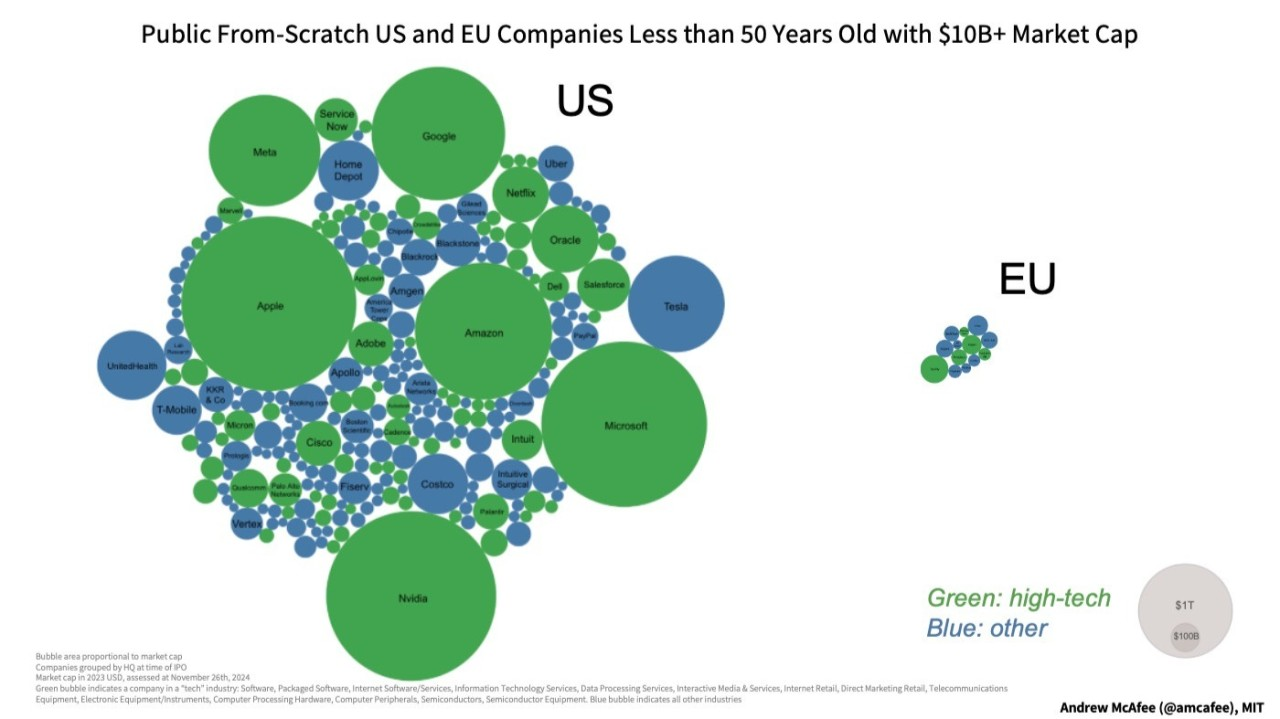
Nobody offered to invest in, or commit to building, a European alternative to the American and Chinese platforms. Probably because they don't believe in it. And that is why Europe, since the birth of the commercial Internet, has given up its past technological dominance to become, sadly, a continent of the technological third world.
Without operating systems (and we would need more than one), without desktops or phones running on those OSes, without an independent web browser, without app stores, without real software distribution channels to consumers, without local chatbots, without open social networking protocols, without the full set of critical applications (messaging, email, photos, storage and the other everyday tools) that comply with European law and respect privacy, without a locally built “knowledge stack,” we have no lever to improve our citizens' digital lives.
Europe no longer has that sovereign consumer tech stack. Which means we are part of the technological third world.
China and the United States have one. They built it and rebuilt it through successive platform shifts, from the PC to the personal cloud, using every tool, API and protocol to create an insurmountable barrier to entry.
It wasn't billions of dollars that made it possible, but simply believing in and funding visionary companies and helping them dominate those markets. Apple, Microsoft, Amazon, Google and Facebook were all born either in garages or in college dorm rooms.
I tried to build that European stack twice in twenty years, with Netvibes and Jolicloud. My second company, a cloud OS and a computer that the American press considered revolutionary, built from Europe, even ran into opposition from my own government. The digital ministry and its advisers told me I had no chance of building an operating system in Europe and therefore refused to support us. While we were winning awards at CES and in the American press, President François Hollande was buying iPads and signing education partnerships with Microsoft and Google. Meanwhile, Obama was actively promoting American Chromebooks.
I wasn't the only one to live through that frustration. Many European consumer-stack entrepreneurs have had a similar experience.
It's not that we lost the battle for the consumer stack, it's that we never even fought it, abandoning along the way everyone who wanted to shape a different future.
My fight for digital sovereignty began in 2004, when I defended MP3, a European technology, against a French government that was already promoting American music platforms. I was stunned to see our own institutions agree to reduce European musical culture to a devalued online back catalogue, without grasping the long-term technological stakes.
Music was only the first step toward a total loss of control over our future.
Twenty years later, we are still approaching digital sovereignty from the wrong end. Sovereign clouds are not the first answer to the challenge of digital sovereignty.
Accessing sovereign clouds from non-sovereign devices, letting foreign players dominate the consumer digital economy and access to content, means giving up our future and our ability to build the digital world we want to live in, not to mention the risks to democracy.
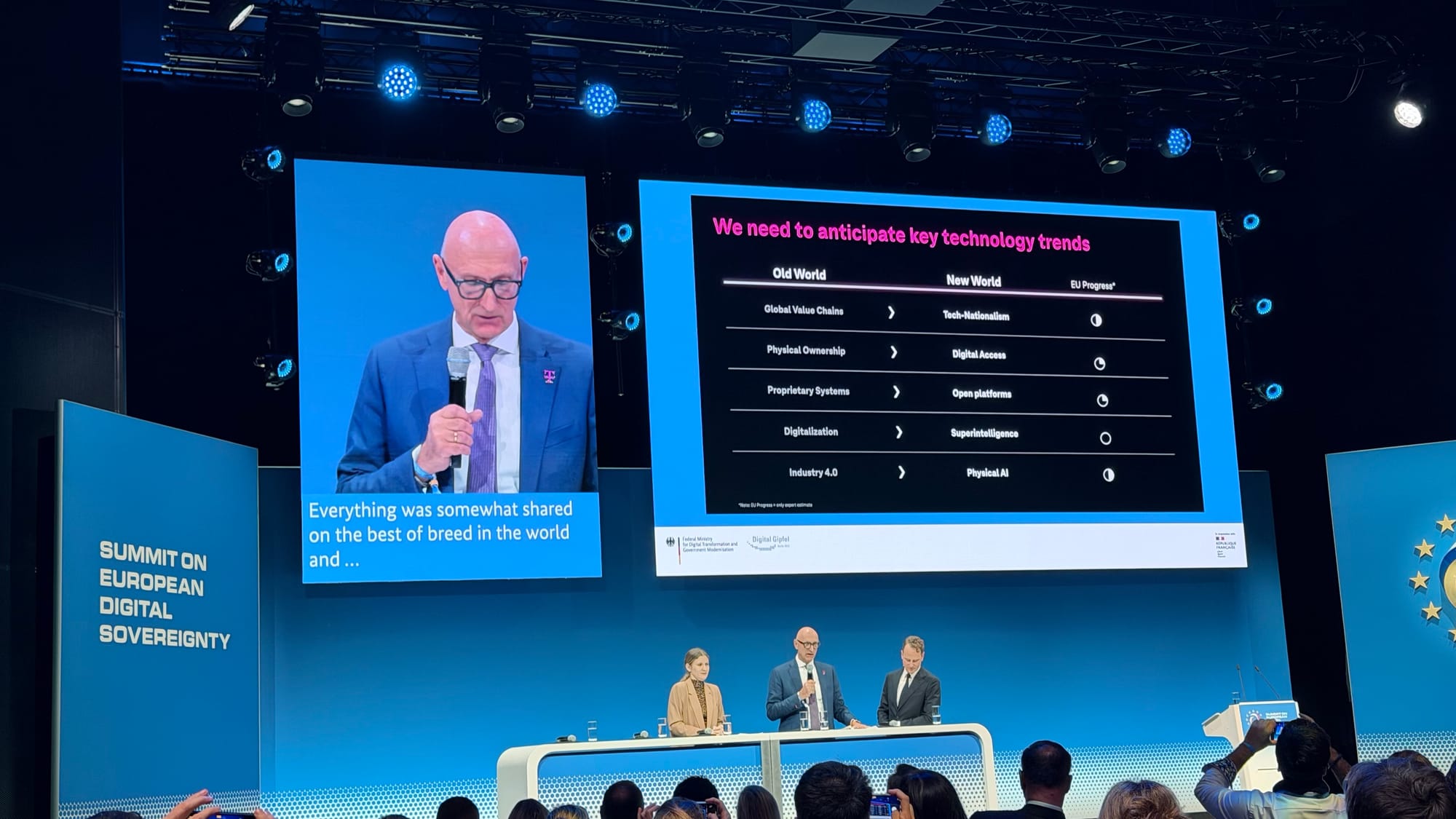
Unfortunately, the subject was not on the summit's agenda. Only Tim, Telekom's CEO, delivered a solid geopolitical analysis of the systemic risks.
The summit focused on forging industrial alliances and announcing deals like the one between SAP and Mistral. That's good news, and it should be celebrated.
But SAP had already announced a partnership with OpenAI a few weeks earlier. That's the reality of business.
These partnerships should be seen for what they are: plain commercial agreements, with no impact whatsoever on sovereignty or on European consumers.
The same reality applies to data centers in Europe that run other people's code and generate value for other players. They contribute nothing to sovereignty; they are just real estate and cheap electricity contracts. Renting code instead of owning it makes you a mere digital tenant.
At Web Summit, during my talk on the geopolitics of intelligent machines, I restated a fundamental truth: Europeans are paying an ever-higher rent to the big platforms, for lack of alternatives. A cost that can only rise in this new digital era marked by uncertainty. Cloud, AI, cybersecurity, personal cloud: none of these services escapes this price inflation.
How did we get here?
It's a historical legacy. In the 1980s and 1990s, Europe dominated consumer electronics. RCA America belonged to Thomson, the French company that bought it in 1987. The former CEO of STMicroelectronics told me that in the glory days, France made one in every three GSM phones in the world.
Do you remember Philips, Grundig, Telefunken, SABA, Bang & Olufsen, Loewe, Salora, Nokia, Schneider, Blaupunkt, Ericsson, Ferguson, Radiola, Dual, Brandt, Continental Edison, Teleavia, Oceanic?
Europe shone for its quality and its style. Yet our leaders and industrialists ignored the computer industry, with the exception of the United Kingdom (which turned Acorn into ARM), Philips (which helped create ASML and TSMC) and STMicroelectronics (born from the merger of Thomson and Olivetti).
Then the paradigm shifted. With Windows, the Mac and the digitization of content, everything (cassette players, phones, consumer electronics) became a peripheral of the computer. The operating system became the new center of gravity. Instead of building a European OS on Linux (created in Finland), our industrialists opted for incompatible proprietary services.
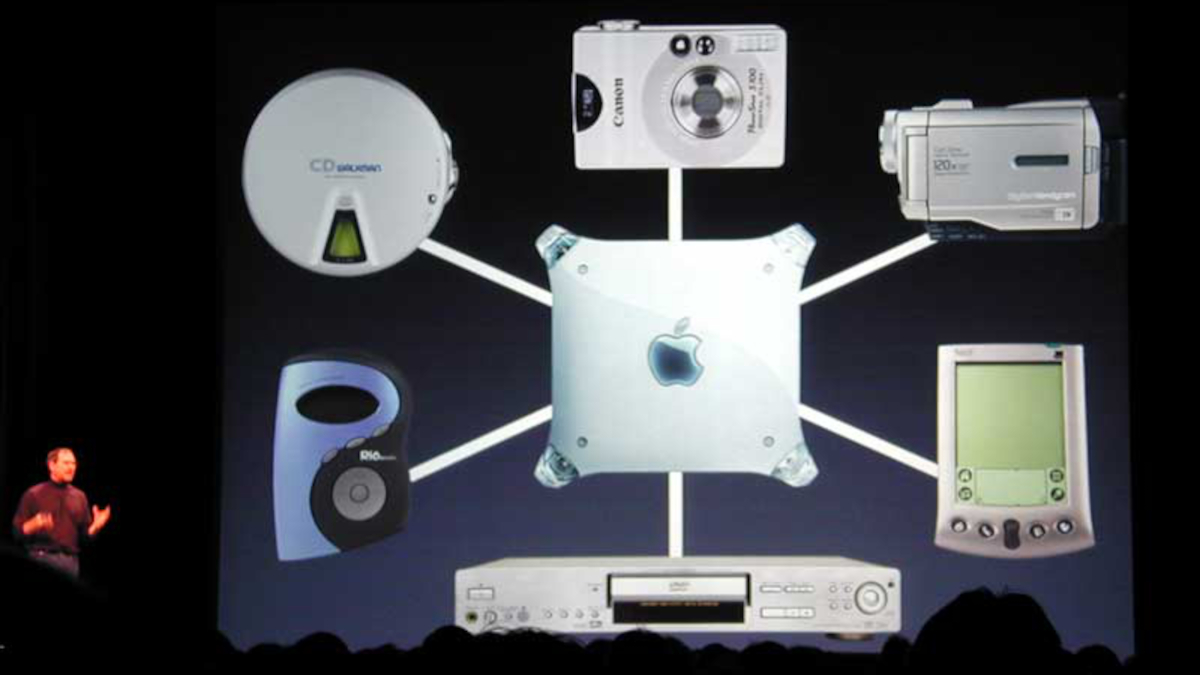
When the PC, and then mobile, became central, our industry first served as the periphery of American tech before disappearing. At the dawn of the digital age, we sold off our phone and electronics divisions to China.
When young Europeans swapped the cassette (co-invented by Grundig) and the Philips walkman for the iPod, our brands became second-class citizens of the digital economy. At the time, nobody at the Commission fought for European players to get access to the Mac or Windows ecosystem. The result: the biggest turnover of consumer goods since 1945 happened without Europe.
The irony of history: the current dominance of the American giants rests on two projects born and funded in Europe, the Web and Linux.
Everything we left to China became the foundation of its digital renaissance. Today it is fully self-sufficient.
Governments, not knowing what to do, took refuge in B2B and industry, abandoning any ambition for the consumer Internet.
The digital economy exploded with mobile, capturing our most intimate data and 30% of the profits generated, by design. Privatized social networks dictate what we see and our ability to be seen.
From advertising to search, the entire chain of digital life extracts ever more value, driven by opaque algorithms.
This summit celebrated European B2B, but not quite digital sovereignty. We will not be sovereign until we have created a new consumer stack for the general public.
It's hard, but it's the major challenge. Otherwise, we will go on living in a digital world that isn't ours, and we will send the signal that Europeans' digital lives are not a priority.
China built its own digital ecosystem in just a few years. Those aren't our values, but it has a complete software stack, with effective products, especially in AI.
Silicon Valley doesn't embody our values either; there, everything is productivity and efficiency. In Europe, quality of life and privacy come first.
For some strange reason, most of the political energy has gone into regulating the American platforms rather than into bringing forth a new generation of consumer tech.
But that generation exists.
Andreas Kling, founder of Ladybird in Sweden, the European Chrome, is showing the way. With just seven people, he is building a new browser, increasingly close to Mozilla, entirely recreated from scratch, when everyone, Google's engineers in particular, told him it would take billions to pull off. Proton has become, over time, an interesting privacy-first alternative for email and everyday productivity. Nextcloud is also showing that an alternative to iCloud can be open source. Murena has proved that you can fork Android without Google. Nothing now makes the phones with the coolest design, and Fairphone builds handsets compatible with European values. Mastodon and the Fediverse have laid the groundwork for a decentralized social networking protocol that other software could use.
None of these companies gets the spotlight. But we need to support them, rebuild hope and make other founders and developers want to follow their example.
On the eve of a new platform shift, it is essential to understand that the future needs both B2B and consumer alternatives.
In their race to AGI, the tech giants are spending hundreds of billions of dollars, and it is largely us who are footing the bill: Europe, the cash cow that feeds their bank accounts every year for lack of alternatives.
But this transition to AI also reveals weaknesses. The New Internet challenges every big tech company on its core business. Apple knows AI has made the smartphone less relevant and is trying to stay in the race. Google is being challenged on search, its main business, as is AWS in traditional cloud, Meta in social networks and Microsoft all the way into Office.
AI cannibalizes and reconfigures everything. It is also arriving locally, on our computers. After the era of mainframe AI, the time of personal AI has come. There is an opportunity here to build something else. There is no barrier to entry to doing it in Europe.
Each of us should call on policymakers and ask them to support a renaissance of European consumer tech. I will be at your side.
The B2B world has the Eurostack. We also need to create a consumer tech emancipation stack.
Now is the time to build a new generation of products, carried by a bold generation of entrepreneurs and investors.
I am also ready to get back in the game with my next project. If you work in this field, let's connect and build together.
The time to act is now.
🔒 For paying subscribers: the important things this week
Read the full article
Sign up now to read the full article and get access to all articles for paying subscribers only.


