

This week we turn to Anthropic, first because it is a company that now has the potential to break into the top 5, but also because since last week we have learned a great deal about how it operates and how it manages uncertainty (geopolitical, cyber, AI disruption).
I am sharing all my findings and my analysis with paying subscribers.
This week I was in Cannes for the AI for Talent Summit, which, as last year, brought together the talent and the innovations at the intersection of AI and film (thank you, Guillaume). This year I skipped the classic Cannes to spend my time exclusively on these questions. It was a chance to take stock of what is new in the sector.

And it must be said that this year is particularly interesting. Generative video AI has moved to 4K and even HDR. It uses formats compatible with professional editing tools and is already widely used for stitching.
The most famous stitching job was on the actor Henry Cavill for Justice League (2017), whose mustache had to be digitally removed to avoid a costly reshoot. But the use cases I saw were far more impressive.
What happens if the car chase you shot has a botched sequence? Well, you digitize the cars and redo it. Or if the color of a shirt in a trailer needs changing? There is a solution for that.
So AI is the ultimate savior. Unlike in 2017, removing a mustache now takes a simple prompt. Not everything is perfect yet, but when you remember what passed for production on TV series in the 1990s or 2000s, or even the digital versions of Leia and Tarkin in Rogue One (December 2016) or of Luke Skywalker in The Mandalorian (December 2020), you tell yourself the audience is ready to accept a few small imperfections if the film is good.

Some of the best AI filmmakers were there, and every AI company except Anthropic was there. And the highlight of the show was Darren Aronofsky presenting his latest AI films with his new company Primordial Soup, largely backed by Google.
 0

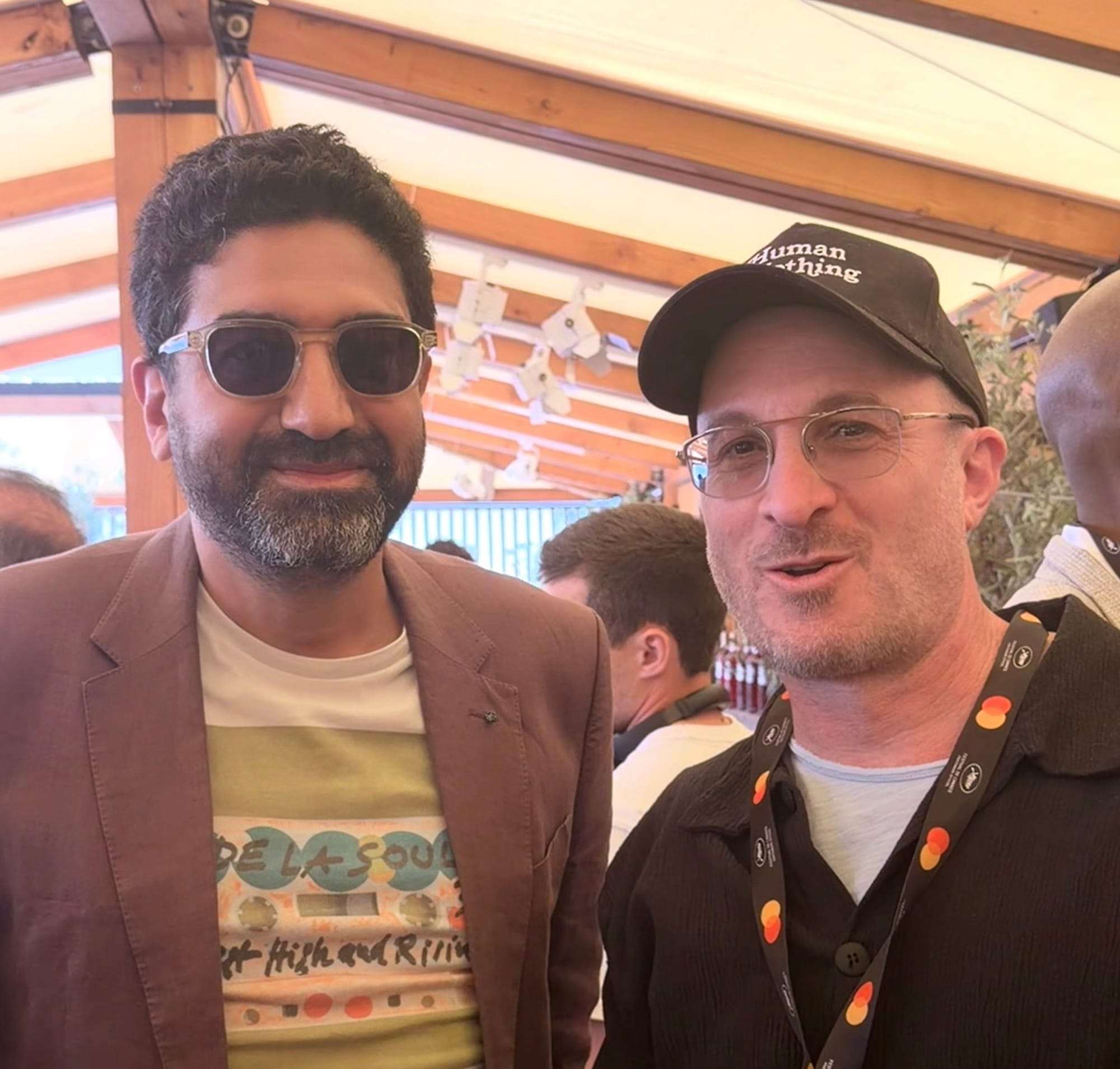
I told Darren Aronofsky that I had gone to see his first film, Pi (1998), on the last day of its theatrical run in an old art-house cinema in San Francisco. I knew nothing about the film, but I had heard it was the first to have an IDM soundtrack (Intelligent Dance Music, not to be confused with EDM, the mush currently in fashion in the US).
If you have never listened to IDM, I can only encourage you to listen to the two volumes of Artificial Intelligence on Warp (1992 and 1994), which remain one of the jewels of the genre.
Both albums in one YouTube video.
But the conversation on everyone's lips was the rise in token prices, which is driving up the cost of producing AI. What one of the big AI players told me off the record is that, for now, Claude's insane, obscene success is forcing the other players to offer big discounts on tokens. But that is temporary.
The explosion of off-plan tokens is going to be the story of the second half of 2026. If you use the video tools on standard (but censored) plans, the price is lower than the pro versions, which are billed on actual usage and can cost up to five times as much.
What is happening in film is also happening in the tools we use every day. We have learned of major changes to Anthropic's billing rules. The way we use Claude is therefore going to change in a month.
Starting June 15, 2026, the Agent SDK and claude -p will no longer be covered by the subscription. Same for Claude Code GitHub Actions and all third-party agents. We are going from an all-inclusive international mobile plan to a set number of included minutes, and then every outgoing call billed at cost.
Each month, a separate monthly credit is calculated at API rates. It expires at the end of the month.
- Pro: $20 in credit
- Max 5x: $100
- Max 20x: $200
Once those credits are used up, you move to pay-as-you-go.
Anthropic is trying to be reassuring about so-called interactive usage. The real issue is that running agentic workloads on your plan (with a subsidy of 25 times the price) made agentic loops economically viable. The famous RalphLoops and the orchestrations that run overnight are therefore going to cost 5 to 25 times more.
The funny thing is that this is also the moment Anthropic has chosen to add its best agentic features: /goal, /loop, Agent Teams.
The flat-rate era for agentic AI seems to be closing. Anthropic opened the dance and GitHub Copilot is following. But it is not certain that Google and OpenAI agree with this idea of pushing prices up too fast.
With a friend on the beach at Cannes, we amused ourselves with the thought that paying €200 twice over (Codex and Claude) to have competing, contradictory services capable of evaluating each other was, in this rising-price environment, going to become a bargain.
Either way, Anthropic is now dictating the rules of the market, a bit like Apple did in its day.
That is why it is impossible today to understand the world of AI without understanding what Anthropic is going to do and what its strategy is. That is what we are going to talk about together.
Become a paying member before the price increase
A subscriber convinced me last week to spend more time writing for my paying subscribers. She had just decided to buy computers and a storage server ahead of time, right before a major price hike, because she had read one of my articles on techflation.
The head of a sizable SME, persuaded by one of our newsletters, is experimenting with local AI solutions on his Mac Mini. He has gotten so far ahead of his sector that he has become the go-to person on the subject.
A consultant who decided to pitch an offering on transatlantic decoupling won her contract.
All of them told me this newsletter has more than paid for itself.
As for the professionals who read me, I have come to understand that they are not paying for information, but for one piece of information, one anecdote, one intuition that allowed them to make the difference. And that is what makes me happy to share my thinking with you.
As a paying subscriber, you also get access to all my monitoring and to all the bonuses I publish whenever I find a piece of information worth digging into.
Become a paying member
SubscribeRead the full article
Sign up now to read the full article and get access to all articles for paying subscribers only.


